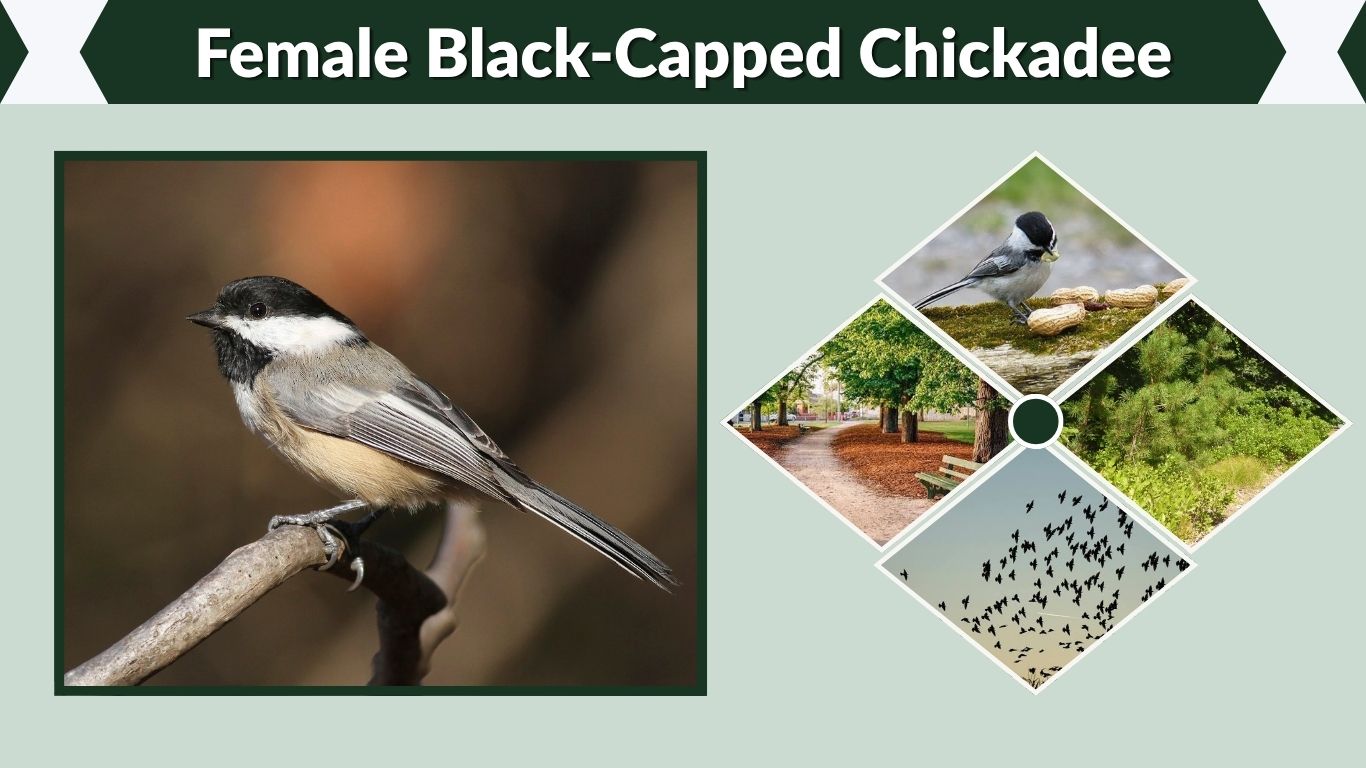
A female Black-capped Chickadee is a tiny, energetic songbird with a black cap, dark throat, white cheeks, gray back, and soft buff-colored sides. However, identifying her sex by appearance alone is extremely difficult because males and females have almost identical plumage. Behavior during courtship and nesting provides much stronger clues. This guide explains what a female looks like, how she differs from a male, and which behaviors can help you identify her.
What Does a Female Black-Capped Chickadee Look Like?
Female Black-capped Chickadees have the same familiar black-and-white face pattern seen in males. They are compact birds with rounded heads, short bills, and relatively long tails.
Female Identification Features
Look for these general characteristics:
- Glossy black cap extending from the forehead to the back of the head
- Black throat patch, commonly called a bib
- Bright white cheeks
- Soft gray back
- Gray wings with pale feather edges
- Whitish chest and belly
- Warm buff or rusty coloring along the sides
- Small, dark bill
- Dark eyes and grayish legs
Adults of both sexes generally measure about 4.7–5.9 inches long. Their rounded body, oversized-looking head, small bill, and long tail create the chickadee’s characteristic compact appearance.
Can You Identify a Female From a Picture?
Usually, no. A photograph can confirm that the bird is a Black-capped Chickadee, but it rarely confirms whether it is male or female. Both sexes display the same black cap, white cheeks, black bib, gray upperparts, and pale underparts.
Some males may average slightly larger or have a somewhat larger black bib, but there is considerable overlap. Lighting, posture, feather condition, distance, and camera angle can also make one bird appear larger or darker than another. Researchers may use a combination of physical measurements to estimate sex, but these differences are not dependable for ordinary backyard identification.
Male vs Female Black-Capped Chickadee
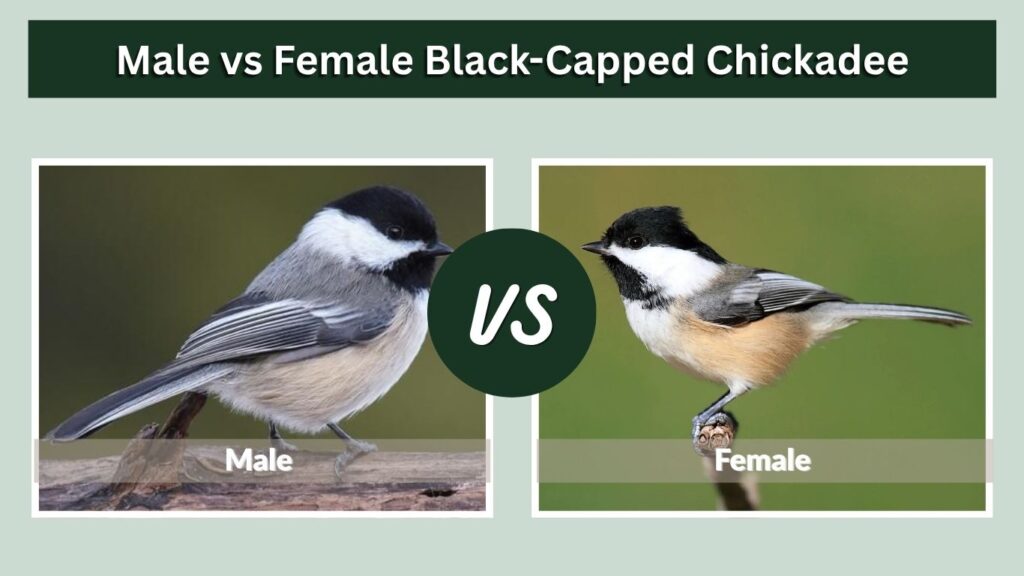
The most useful differences appear in behavior, particularly during the breeding season.
| Feature | Female | Male |
| Plumage | Black cap, black bib, white cheeks and gray body | Nearly identical plumage |
| Average size | May average slightly smaller | May average slightly larger |
| Bib size | Sometimes smaller on average | Sometimes larger on average |
| Nest construction | Builds the inner nest | Does not usually build the finished nest cup |
| Incubation | Incubates the eggs | Does not incubate |
| Courtship feeding | Receives food from the male | Frequently brings food to the female |
| Feeding nestlings | Feeds the young | Feeds the young |
| Singing | Can sing and produces many calls | More frequently heard singing territorial songs |
Appearance Differences
Black-capped Chickadees are not strongly sexually dimorphic. This means males and females do not have clearly different colors or patterns. Unlike Northern Cardinals or many ducks, female chickadees do not wear noticeably duller plumage.
A male may occasionally look slightly bigger, darker, or broader through the throat. However, these clues are too inconsistent to identify a single bird confidently. Comparing two members of a known pair may help, but behavior remains more dependable than appearance.
Nesting Differences
Nesting activity offers some of the clearest identification clues. Both members of a pair may help excavate a cavity in soft or decaying wood, although the female usually selects the nesting location.
The female builds the finished nest inside the cavity. She typically creates a foundation from moss, bark fibers, or similar plant material and lines the nest cup with softer materials such as animal hair.
Therefore, a chickadee repeatedly carrying moss or soft fibers deep into a cavity is likely the female. A bird removing wood chips could be either member of the pair.
Incubation and Parental Care
Only the female incubates the eggs. Black-capped Chickadees commonly lay six to eight eggs, and incubation generally lasts about 12–13 days. While the female remains inside the cavity, the male frequently brings her food.
After hatching, the female initially spends more time brooding the young while the male delivers food. As the nestlings grow, both parents make frequent feeding trips. Watching which bird stays in the nest and which one arrives with insects can therefore help distinguish the pair.
Female Black-Capped Chickadee Behavior
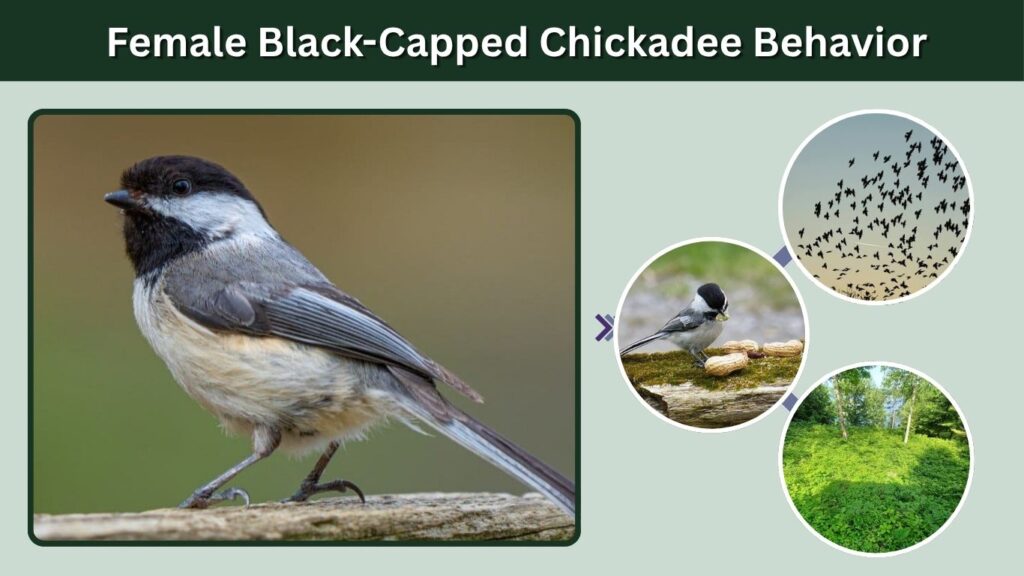
Outside the nesting season, males and females behave so similarly that determining sex becomes much harder. Both search through trees, visit bird feeders, store food, join winter flocks, and produce the familiar chick-a-dee-dee call.
Courtship Feeding
One helpful clue is courtship feeding. Beginning in spring, the male may carry food to his mate. The female can respond by crouching, fluttering her wings, or producing begging sounds.
When one adult repeatedly presents food directly to another adult during the breeding season, the receiving bird is usually the female. However, observers should watch the pair several times before making a final judgment because a single interaction can be misleading. Male feeding of the female may continue while she incubates.
Female Song and Calls
Female Black-capped Chickadees are not silent. Both sexes produce the complex chick-a-dee call, contact notes, alarm calls, and other vocalizations. Females can also produce fee-bee songs.
Research indicates that female song may be used during territorial encounters, mate defense, attraction, and coordination between breeding partners. Nevertheless, males generally deliver the familiar whistled territorial song more frequently, particularly during spring. Hearing a bird sing is therefore a clue, not absolute proof that it is male.
How to Identify a Female in Your Yard
Accurate identification requires patience. Instead of focusing only on plumage, observe the birds repeatedly during spring and early summer.
Watch the Nest From a Safe Distance
A female may be identified by the following activities:
- Carrying moss, hair, or soft fibers into a cavity
- Remaining inside the nest for long periods during incubation
- Receiving food from another adult
- Covering the eggs before leaving
- Spending extended periods brooding newly hatched chicks
Do not open or disturb an active nest simply to identify the parents. Quiet observation from a suitable distance is safer for the birds and often provides enough information.
Observe a Known Pair
Sex differences are easiest to notice when two paired birds can be watched together. Follow which individual enters the nest, which carries nesting material, and which delivers food. A single observation may not be enough, but repeated behavior usually reveals their roles.
Avoid Depending on Bib Size
A large black bib is sometimes associated with a male, but bib size varies among individual birds. Fluffed feathers can enlarge the throat patch, while worn feathers or unusual posture can make it appear smaller.
For a backyard observer, bib size should only be treated as a supporting clue. Incubation, nest building, and courtship feeding are far more useful.
Female Black-Capped Chickadee Habitat and Range
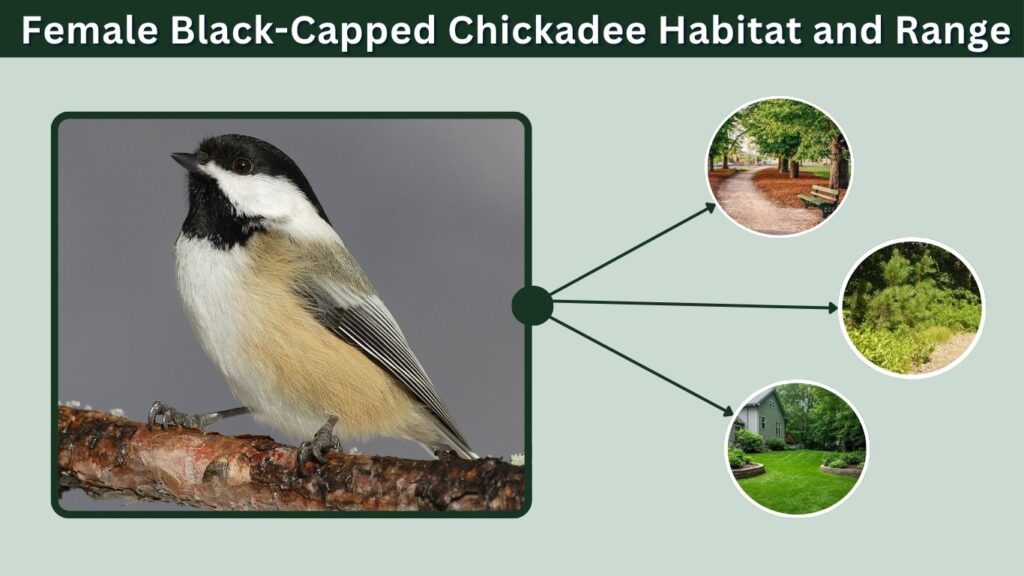
Females live in the same habitats and range as males. Black-capped Chickadees are commonly associated with deciduous and mixed woodland, woodland edges, parks, suburban yards, and areas with scattered trees. They also regularly visit feeders, particularly where sunflower seeds, peanuts, or suet are available.
A female seen in New Hampshire looks the same as one found elsewhere in the species’ range. Location does not produce a reliable male–female color difference. However, geography is useful when separating Black-capped Chickadees from similar species.
Birds That May Be Confused With a Female Black-Capped Chickadee
Carolina Chickadee
Carolina Chickadees closely resemble Black-capped Chickadees. Carolina Chickadees generally have less prominent white edging on their wing feathers, but range and voice are often more useful than minor plumage differences. Where their ranges overlap, the species can be especially difficult to separate.
Mountain Chickadee
The Mountain Chickadee has a noticeable white eyebrow stripe cutting through its black cap. Black-capped Chickadees lack this stripe.
Boreal Chickadee
The Boreal Chickadee has a brown cap rather than the clean black cap of a Black-capped Chickadee. It also tends to show richer brown coloring on its sides.
FAQs
Are female Black-capped Chickadees black and white?
Yes. Females have a black cap and throat, white cheeks, a gray back, pale underparts, and buff-colored sides. Their plumage is essentially the same as that of males.
How can you tell a male from a female Black-capped Chickadee?
Nesting behavior provides the best clues. The female builds the finished nest and incubates the eggs, while the male frequently brings her food. Appearance alone is usually not sufficient.
Do female Black-capped Chickadees sing?
Yes. Females can produce fee-bee songs and many calls. Males typically sing territorial songs more frequently, but singing should not be considered certain proof of sex.
Is the female Black-capped Chickadee smaller than the male?
Females may average slightly smaller, but the size ranges overlap considerably. Without measurements or a known pair for comparison, size is not a dependable identification method.
Which parent incubates Black-capped Chickadee eggs?
The female incubates the eggs. The male commonly feeds her while she remains in the nesting cavity. After the eggs hatch, both parents help feed the nestlings.