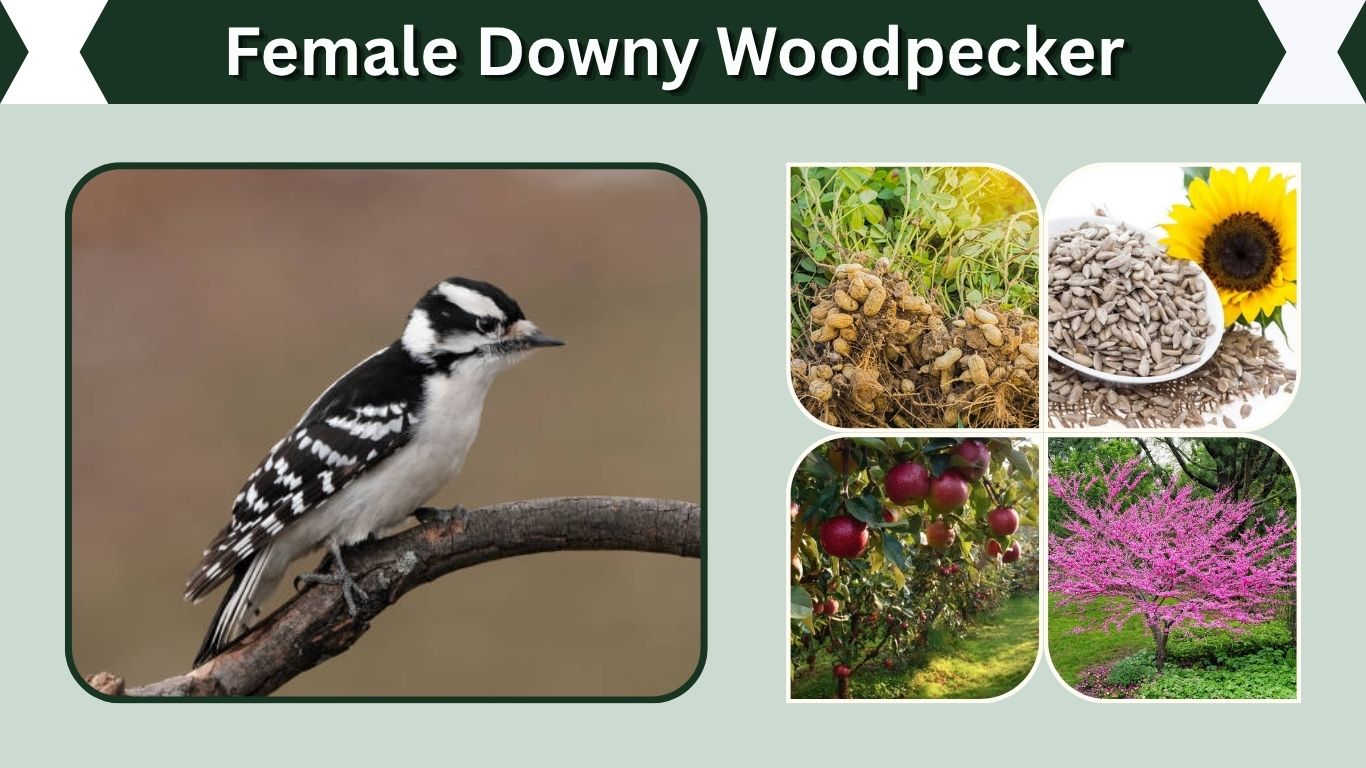
The female Downy Woodpecker is a small black-and-white bird commonly seen in woodlands, parks, orchards, and suburban yards across North America. She closely resembles the male but does not have the small red patch on the back of the head. Her short bill, checkered wings, white back, and spotted outer tail feathers help distinguish her from similar species. This guide explains how to identify a female Downy Woodpecker and separate her from males, juveniles, and female Hairy Woodpeckers.
What Does a Female Downy Woodpecker Look Like?
A female Downy Woodpecker has the classic black-and-white pattern associated with this species. Her upperparts are primarily black, while the center of her back displays a broad white stripe. The wings are black with bold white spots, and the head has contrasting black-and-white stripes.
Unlike an adult male, an adult female has no red patch on the back of her head. This is the easiest way to distinguish the sexes when the bird’s head is clearly visible.
Female Identification Features
- No red patch on the back of the head
- Black upperparts with white wing spots
- Broad white stripe down the center of the back
- White or pale-gray chest and belly
- Black-and-white striped head
- Short, straight, chisel-shaped bill
- White outer tail feathers with small black spots
- Stiff tail feathers used for support on trees
- Compact body approximately the size of a sparrow
Size and Measurements
Female and male Downy Woodpeckers are approximately the same size. Adults measure about 5.5–6.7 inches long, weigh approximately 0.7–1 ounce, and have a wingspan of around 9.8–11.8 inches.
This makes the Downy Woodpecker the smallest North American woodpecker. Its compact size and short bill are important clues when comparing it with the larger Hairy Woodpecker.
Female vs. Male Downy Woodpecker
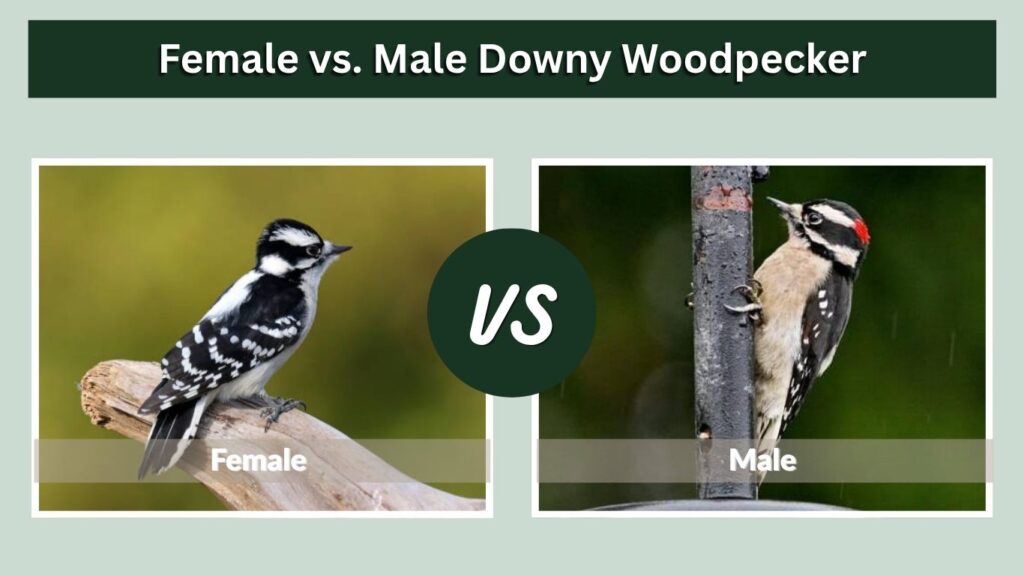
Male and female Downy Woodpeckers share nearly identical body size, wing patterns, facial stripes, and tail markings. The red nape patch is the main visible difference between adult birds.
| Feature | Female Downy Woodpecker | Male Downy Woodpecker |
| Red head marking | Absent | Small red patch on the nape |
| Body size | About 5.5–6.7 inches | About 5.5–6.7 inches |
| Back | Black with central white stripe | Black with central white stripe |
| Wings | Black with white spots | Black with white spots |
| Outer tail | White with black spots | White with black spots |
| Bill | Short and pointed | Short and pointed |
| Drumming | Yes | Yes |
| Nesting duties | Shared | Shared |
Do Female Downy Woodpeckers Have Red?
Adult female Downy Woodpeckers do not normally have red plumage on the head. An adult bird with a clean black-and-white head is therefore likely female.
However, age can complicate identification. Juvenile Downy Woodpeckers may have red feathering on the crown rather than the back of the head. This temporary juvenile marking should not automatically be interpreted as proof that the bird is an adult male.
Behavioral Differences
Males and females may divide feeding areas, particularly outside the breeding season. Females often search for insects on trunks and larger branches, while males frequently forage farther outward on smaller branches and weed stems.
This behavior may reduce competition between the sexes, although either bird can use a variety of feeding locations. Both males and females drum on trees to defend territories, attract partners, and maintain contact.
Juvenile Female Downy Woodpecker
A juvenile female resembles an adult but may appear softer, duller, or less sharply marked. Young birds have recently developed their flight feathers and may behave less confidently while climbing or searching for food.
Juvenile or Adult Female?
Juvenile Downy Woodpeckers can show red on the crown. Some sources describe juvenile males as more likely to have red forehead feathers, while juvenile females usually lack red. Because juvenile plumage varies, identification should consider the position of the red marking, the season, and the bird’s overall appearance.
An adult male has red at the back of the head. An adult female has no red. A young bird with red closer to the forehead or crown is probably showing juvenile plumage rather than the adult male pattern.
Female Downy vs. Female Hairy Woodpecker
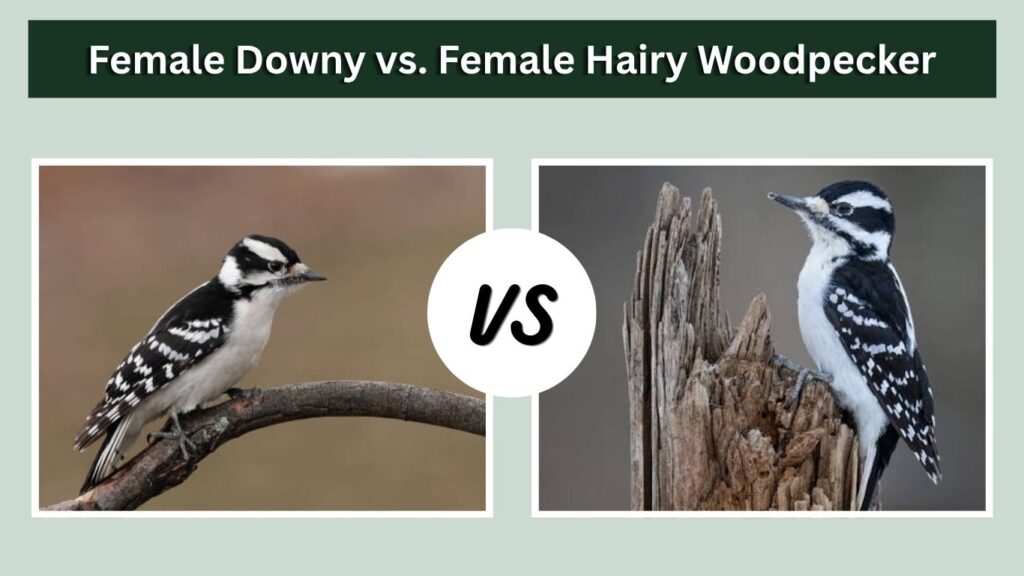
Female Downy and Hairy Woodpeckers are both black and white and lack the red nape patch found on males. They can therefore look nearly identical in photographs without a clear sense of scale.
The best clues are body size, bill length, tail markings, and habitat use.
| Feature | Female Downy | Female Hairy |
| Length | About 5.5–6.7 inches | Approximately 9 inches |
| Relative size | Sparrow-sized | Robin-sized |
| Bill | Short and delicate | Long and heavy |
| Bill compared with head | Much shorter than head | Nearly as long as head |
| Outer tail feathers | Usually black-spotted | Usually plain white |
| Typical habitat | Yards, parks, edges, small trees | Mature woods and larger trees |
Check the Bill First
The Downy Woodpecker has a short, delicate bill that appears much shorter than the length of its head. The Hairy Woodpecker has a stronger, spike-like bill that is nearly as long as its head.
When the bird is facing sideways, bill length is often the most reliable identification feature.
Look at Body Size and Tail Spots
A female Downy Woodpecker is approximately the size of a House Sparrow, while a female Hairy Woodpecker is closer to the size of an American Robin.
The white outer tail feathers of a Downy usually contain small black spots. A Hairy Woodpecker generally has clean white outer tail feathers without these markings. Tail spots can be helpful when bill size is difficult to judge.
Female Downy Woodpecker Habitat and Range
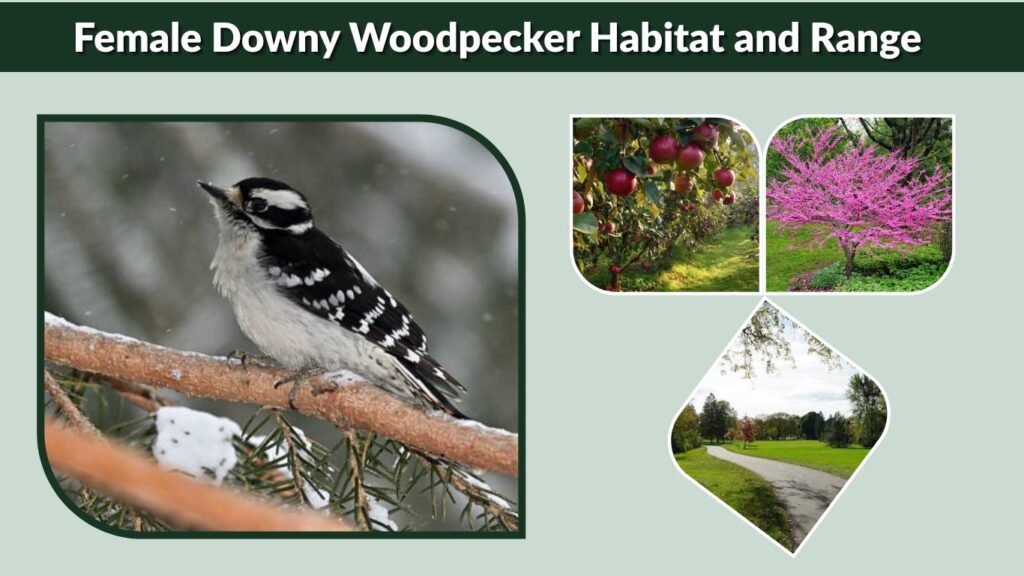
Female Downy Woodpeckers live in open deciduous forests, woodland edges, orchards, parks, gardens, vacant lots, and suburban neighborhoods. They readily use small trees, shrubs, tall weeds, and backyard bird feeders.
The species remains in much of its range throughout the year instead of making a long seasonal migration. Regional plumage varies: birds from western areas may appear darker, while Pacific-coast birds can have a dingy brownish-gray wash underneath.
Diet and Feeding Behavior
Female Downy Woodpeckers search tree bark, branches, stems, and plant galls for insects. They use their bills to tap, probe, and remove bark while looking for hidden prey.
Their diet can include beetle larvae, ants, caterpillars, and other small invertebrates. They also eat seeds and plant material and frequently visit backyard feeders for suet, peanuts, and sunflower seeds.
Downy Woodpeckers can move along thin branches and weed stems that are too delicate for larger woodpeckers. Their stiff tails and gripping feet help support them while climbing vertically.
Female Downy Woodpecker Call
Female and male Downy Woodpeckers produce similar calls. A common call is a short, sharp “pik.” They also make a descending, whinny-like series of notes and produce rattles, chirps, squeaks, and alarm sounds.
Both sexes drum rapidly on resonant trees, branches, poles, or other surfaces. Drumming is not simply feeding behavior; it is also used to announce territory, attract a partner, and communicate with a mate.
Nesting and Parental Care
Male and female Downy Woodpeckers work together to excavate a nest cavity, commonly in a dead limb or decaying section of a tree. Excavation may take one to nearly three weeks.
A female usually lays several white eggs. Both parents incubate them, although the male commonly takes the nighttime shift. After the eggs hatch, both adults feed and protect the nestlings.
The young normally leave the cavity about 18–21 days after hatching. Their parents may continue feeding and guiding them for at least three more weeks.
How to Attract Female Downy Woodpeckers
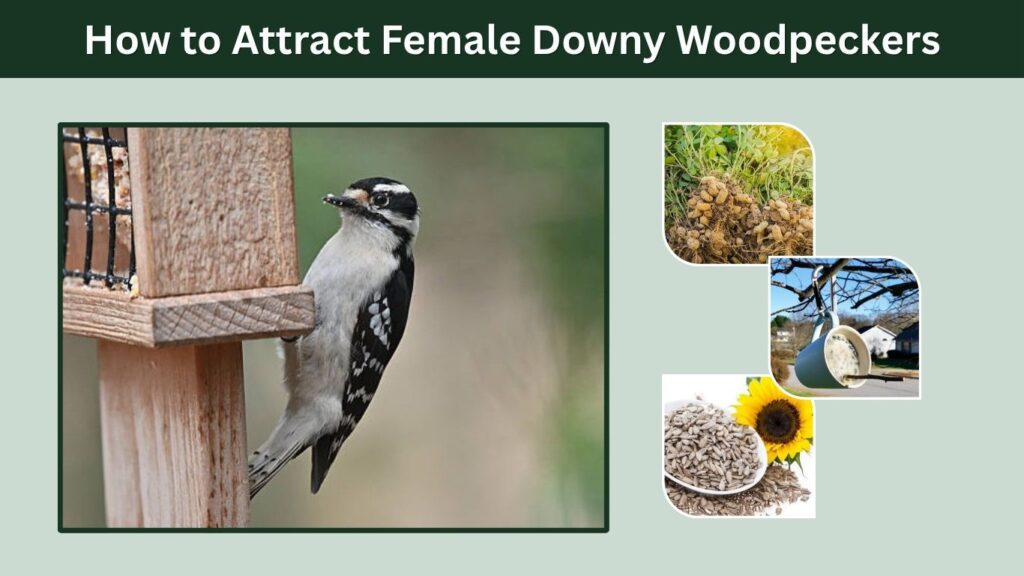
Downy Woodpeckers commonly visit feeders in wooded or suburban areas. You can make a yard more attractive by providing:
- Suet feeders
- Shelled or unshelled peanuts
- Sunflower seeds
- Native trees and shrubs
- Dead branches where safe to retain
- Clean drinking and bathing water
- Pesticide-free areas containing natural insects
Placing suet near trees gives the birds a convenient perch from which to inspect the feeder. Preserving suitable dead wood can also provide natural foraging and nesting opportunities.
FAQs
What is the main difference between a male and female Downy Woodpecker?
The adult male has a small red patch on the back of his head. The adult female has an entirely black-and-white head without red. Their body size and other markings are otherwise very similar.
Is a female Downy Woodpecker larger than a male?
Females and males are generally similar in size. Visual differences between individual birds may result from posture, feather condition, viewing angle, or natural variation rather than sex.
Can a juvenile female Downy Woodpecker have red feathers?
Juveniles can show crown markings that differ from the adult pattern. Adult females lack red, while juvenile plumage can make sex identification less certain. The red position and other characteristics should be examined together.
Does the female help build the nest?
Yes. Both the male and female excavate the cavity. They also share incubation, feeding, nest sanitation, and protection of the chicks after hatching.
How can I distinguish a female Downy from a female Hairy Woodpecker?
Look at the bill, size, and tail. A Downy is smaller, has a short bill, and normally has black spots on its white outer tail feathers. A Hairy is larger with a much longer bill and usually plain outer tail feathers.