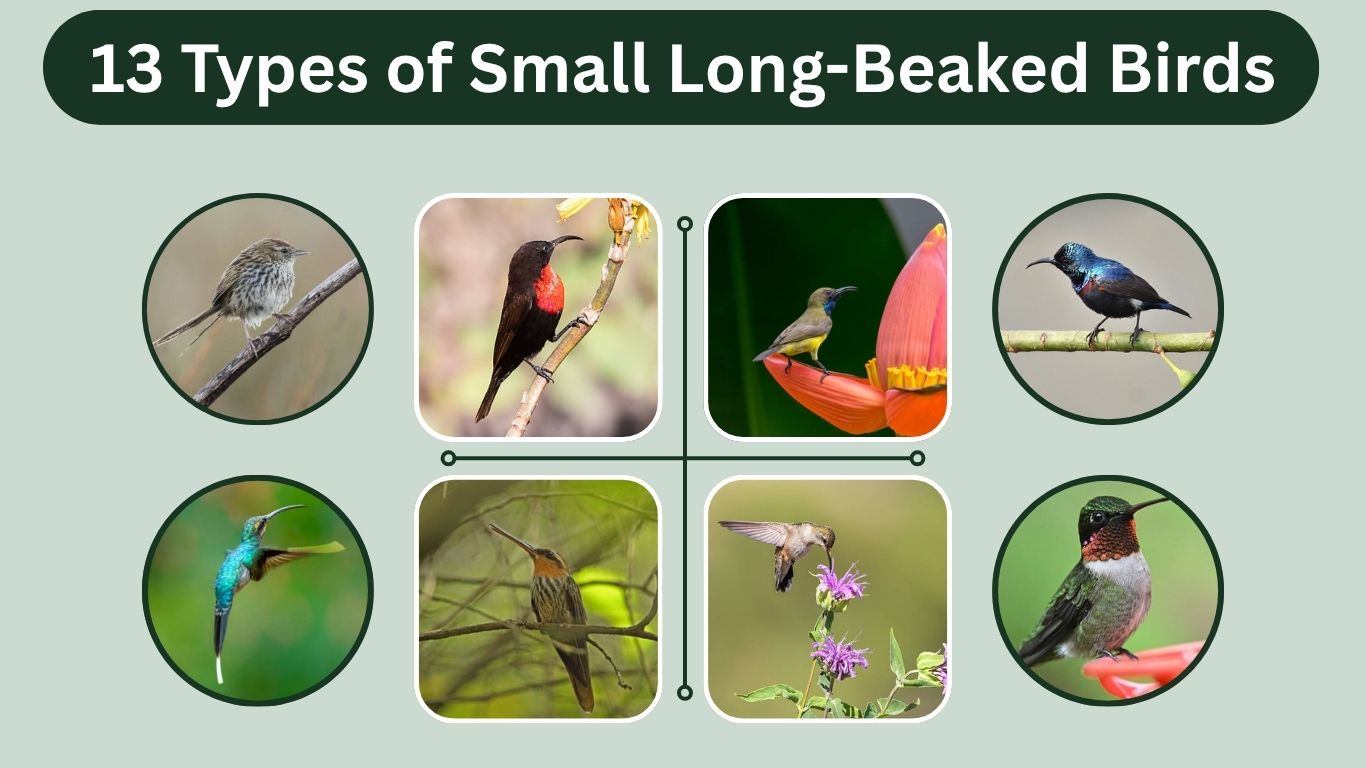
Small long-beaked birds are fascinating species found in gardens, forests, mountains, wetlands, and tropical regions around the world. Their slender or curved bills help them collect nectar, catch insects, probe tree bark, and reach food hidden inside flowers or narrow crevices. Hummingbirds and sunbirds are famous nectar feeders, while treecreepers and gnatwrens use their bills to search for tiny invertebrates. This guide covers 13 types of small long-beaked birds, including their appearance, habitat, diet, range, and nesting behavior. These descriptions can help birdwatchers identify each species and understand how its specialized bill supports its daily survival.
1. Ruby-Throated Hummingbird
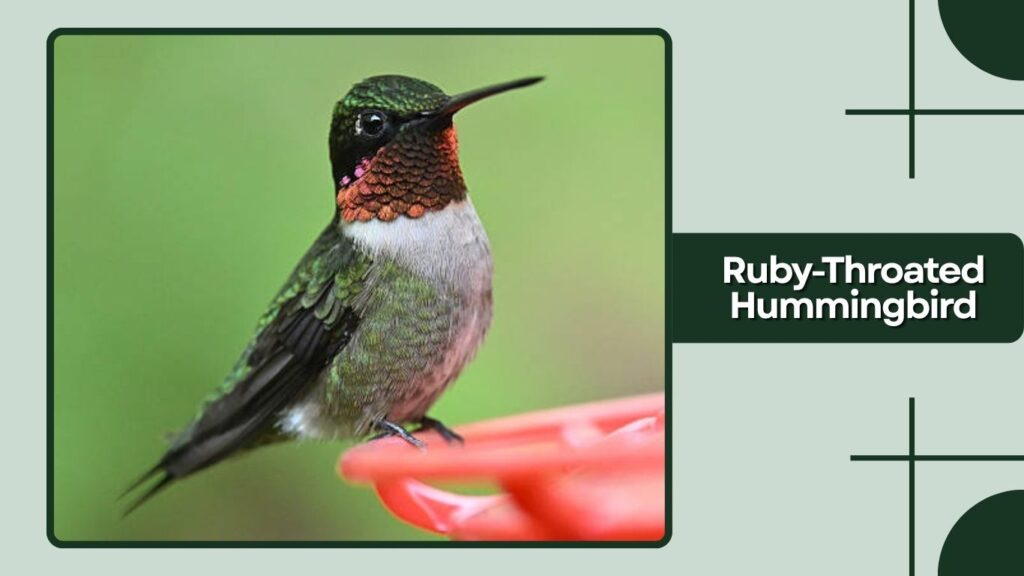
The Ruby-throated Hummingbird is a tiny, long-beaked bird commonly found in eastern North America. It is famous for its rapid wingbeats, hovering ability, and the male’s bright red throat. These energetic birds frequently visit flower gardens, woodland edges, parks, and backyard hummingbird feeders.
Identification
- Adult males have a brilliant ruby-red throat.
- The back and crown are metallic green.
- Females have a white throat and pale underparts.
- The bill is long, thin, straight, and black.
- Adults measure about 2.8–3.5 inches long.
Habitat and Range
Ruby-throated Hummingbirds breed across eastern and central North America, including southern Canada and much of the eastern United States. They prefer gardens, open woodlands, meadows, forest edges, and areas with abundant flowering plants. During winter, they migrate to Mexico and Central America.
Diet and Feeding
These hummingbirds mainly drink nectar from tubular flowers using their long bills and specialized tongues. They also eat mosquitoes, gnats, spiders, fruit flies, and other tiny insects. Their insect diet provides protein, while nectar supplies the energy needed for constant flight.
Nesting Behavior
The female builds a tiny cup-shaped nest on a slender tree branch. She uses plant fibers, spider silk, and soft materials, covering the outside with lichens for camouflage. She usually lays two small white eggs and raises the chicks without help from the male.
2. Anna’s Hummingbird
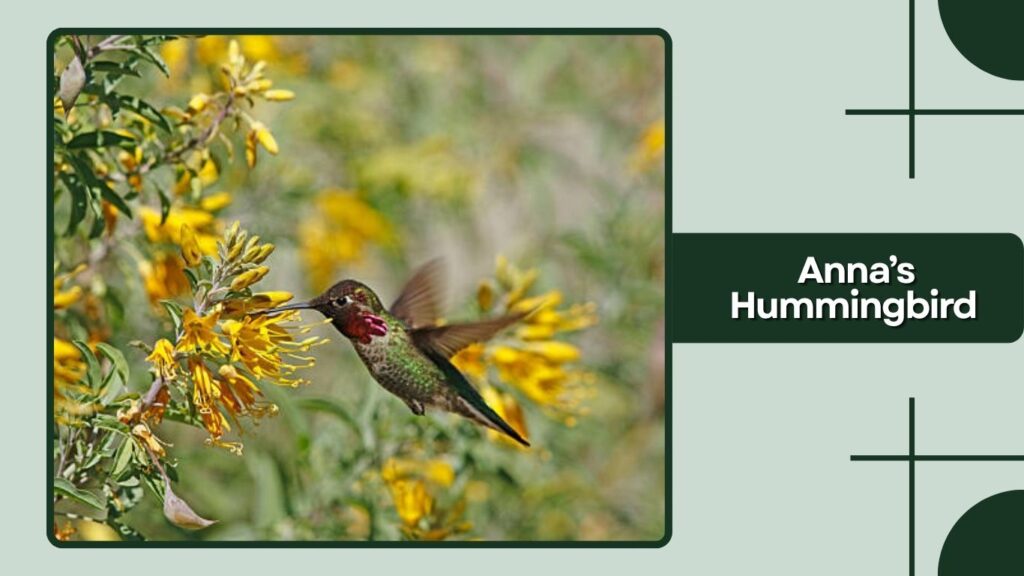
Anna’s Hummingbird is a tiny, long-beaked bird found mainly along the Pacific Coast of North America. It is well known for the male’s brilliant reddish-pink head and throat. Unlike many hummingbirds, it often remains within its range throughout the year and regularly visits gardens, parks, and backyard feeders.
Identification
- Adult males have an iridescent reddish-pink crown and throat.
- Females are mostly green and gray with occasional red throat feathers.
- The back is metallic green, while the underside is grayish.
- The bill is long, straight, slender, and dark.
- Adults measure approximately 3.9 inches long.
Habitat and Range
Anna’s Hummingbirds inhabit coastal scrub, open woodland, gardens, city parks, and suburban neighborhoods. They are widespread along the western coast of North America, from southern Canada through the western United States and into Mexico.
Diet and Feeding
These hummingbirds drink nectar from flowers such as manzanita, currant, gooseberry, and eucalyptus. They also catch midges, leafhoppers, whiteflies, spiders, and other tiny invertebrates in the air or among vegetation.
Nesting Behavior
The female constructs a tiny cup-shaped nest on a tree or shrub branch. She uses plant fibers, feathers, and spider silk, decorating the outside with lichens for camouflage. She usually lays two small white eggs and raises the chicks alone.
3. Black-Chinned Hummingbird
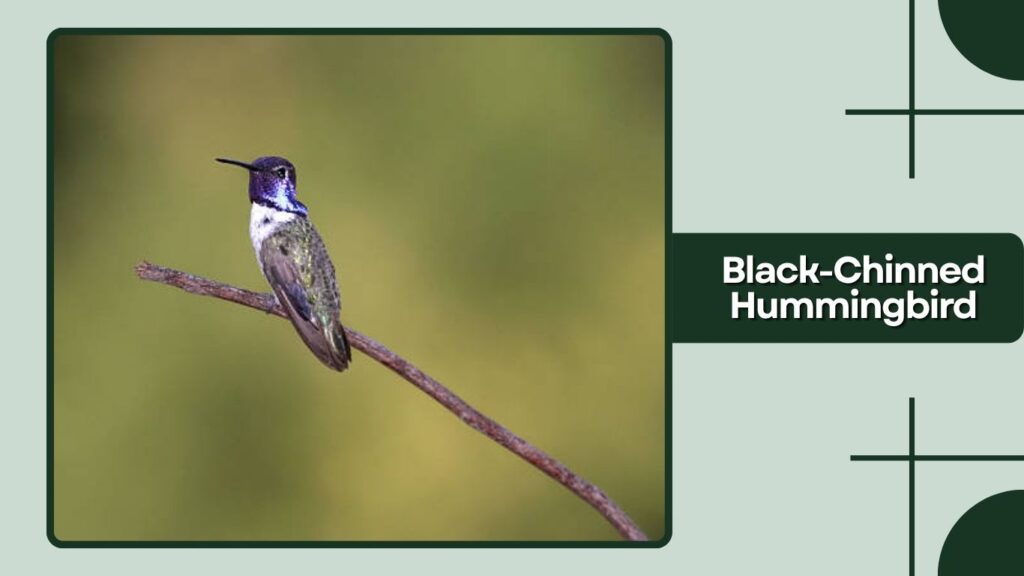
The Black-chinned Hummingbird is a tiny, long-beaked bird commonly found in western North America. It is named for the male’s dark throat, which displays a narrow band of iridescent purple in bright light. These agile birds frequently visit gardens, woodland edges, desert areas, and hummingbird feeders.
Identification
- Adult males have a black chin and throat.
- A shiny purple band borders the bottom of the throat.
- The back and crown are metallic green.
- Females have pale throats and white-tipped outer tail feathers.
- The bill is long, slender, straight, and dark.
Habitat and Range
Black-chinned Hummingbirds inhabit deserts, mountain forests, riverside woodlands, gardens, and suburban neighborhoods. They breed across much of the western United States and parts of southern Canada. Most migrate to Mexico for winter, although a few may remain near the Gulf Coast.
Diet and Feeding
These hummingbirds drink flower nectar and sugar water from feeders. They also catch mosquitoes, gnats, fruit flies, spiders, and other tiny invertebrates, which provide essential protein.
Nesting Behavior
The female builds a deep cup-shaped nest on a small horizontal branch. She uses plant down, spider silk, and cocoon fibers. The nest can stretch as the chicks grow, and the female usually raises the young without assistance from the male.
4. Broad-Tailed Hummingbird
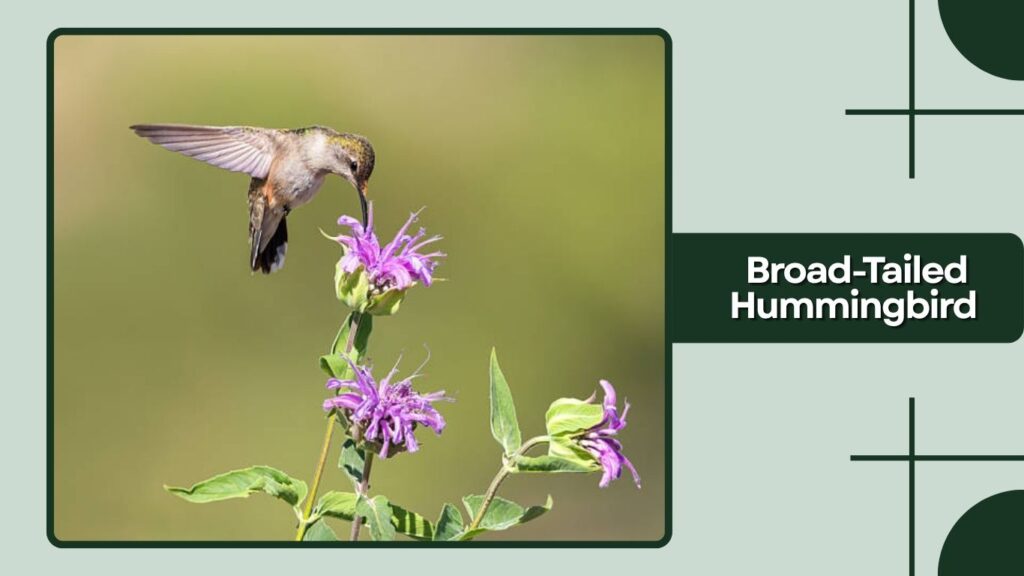
The Broad-tailed Hummingbird is a tiny, long-beaked bird commonly found in mountain regions of western North America. Adult males are known for their bright rose-red throats and distinctive metallic wing sounds. These energetic hummingbirds often visit wildflower meadows, open forests, gardens, and backyard nectar feeders.
Identification
- Adult males have an iridescent rose-red throat.
- The back, crown, and wings are metallic green.
- Females have pale underparts with green spots along the sides.
- The tail is broad and rounded, especially in females.
- The bill is long, thin, straight, and black.
- Adults measure about 3.1–3.5 inches long.
Habitat and Range
Broad-tailed Hummingbirds breed in high-elevation areas across the Rocky Mountains and nearby western regions. They prefer mountain meadows, pine forests, aspen groves, woodland clearings, and areas near streams. During winter, most migrate south to Mexico and parts of Central America.
Diet and Feeding
These hummingbirds drink nectar from tubular flowers such as columbine, paintbrush, and penstemon. They also visit hummingbird feeders filled with sugar water. Small insects, spiders, gnats, and flies provide important protein for adults and growing chicks.
Nesting Behavior
The female builds a tiny cup-shaped nest on a horizontal tree branch. She uses plant fibers, spider silk, feathers, and soft materials, covering the outside with lichens. She usually lays two white eggs and raises the chicks alone.
5. Long-Billed Hermit
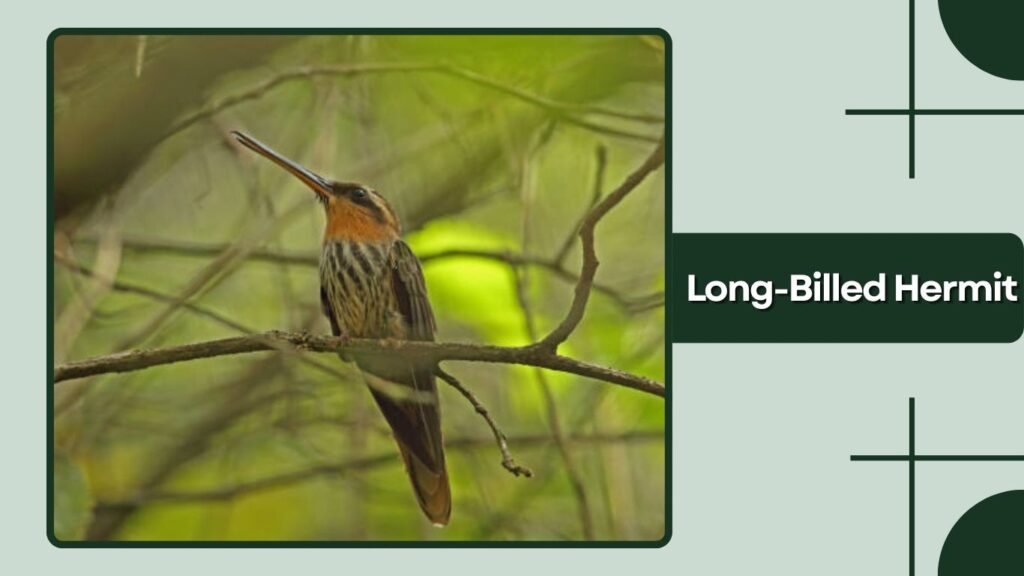
The Long-billed Hermit is a relatively large hummingbird found from central Mexico through Central America and into northwestern South America. Its exceptionally long, curved bill helps it reach nectar inside deep tropical flowers. Unlike brightly colored hummingbirds, it has muted plumage that blends easily into shaded forests.
Identification
- It has a very long, downward-curving bill.
- The upperparts are greenish-brown or bronze-green.
- Its underparts are grayish or brownish.
- Dark and pale facial stripes surround the eyes.
- The central tail feathers are long with prominent white tips.
- Adults measure approximately 5.1–6.3 inches long.
Habitat and Range
Long-billed Hermits inhabit tropical rainforests, cloud forests, secondary woodlands, forest edges, and shaded areas near streams. They generally remain in the understory, where dense vegetation provides shelter and abundant flowering plants.
Diet and Feeding
This hummingbird follows a regular feeding route between flowers, a behavior known as trap-line feeding. It drinks nectar from plants such as heliconias and passionflowers and also consumes spiders and other small arthropods for protein.
Nesting Behavior
The female builds a hanging, cone-shaped nest beneath a broad leaf. She uses plant fibers, spider silk, and soft materials and usually lays two tiny white eggs. The female handles incubation and raises the chicks without assistance from the male.
6. Green Hermit
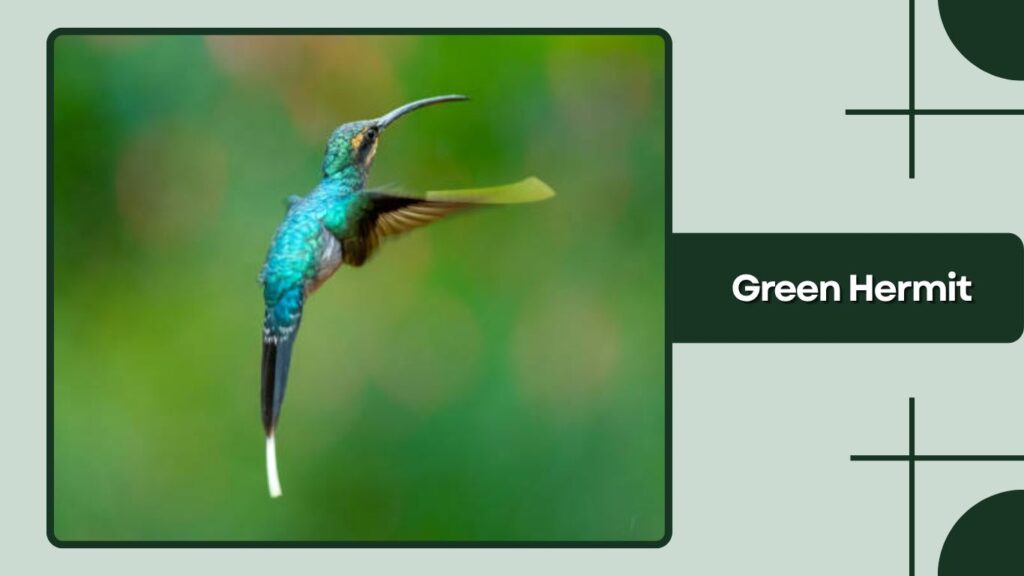
The Green Hermit is a long-billed hummingbird found in tropical forests of Central and northern South America. Its scientific name is Phaethornis guy. The bird’s curved bill is specially adapted for reaching nectar inside deep, tubular flowers. It usually remains within shaded forest undergrowth near streams.
Identification
- Males have dark, iridescent green plumage.
- Females are grayer underneath and have longer bills.
- The bill is extremely long and curves downward.
- Pale facial stripes surround the dark eye area.
- The central tail feathers are elongated and white-tipped.
- Adults measure approximately 5.1–5.7 inches long.
Habitat and Range
Green Hermits inhabit moist lowland rainforests, mountain forests, forest edges, and dense vegetation near water. Their range extends from Costa Rica and Panama into Colombia, Ecuador, Peru, Venezuela, and Trinidad. They generally remain in warm tropical habitats throughout the year.
Diet and Feeding
These hummingbirds mainly drink nectar from heliconias and other tubular flowers. They follow regular feeding routes between flowering plants and also capture tiny insects and spiders for protein.
Nesting Behavior
The female builds a cone-shaped hanging nest beneath a large leaf, often above water. She uses plant fibers, soft materials, and spider silk. Green Hermits typically lay one white egg, which the female incubates and cares for alone.
7. Purple Sunbird
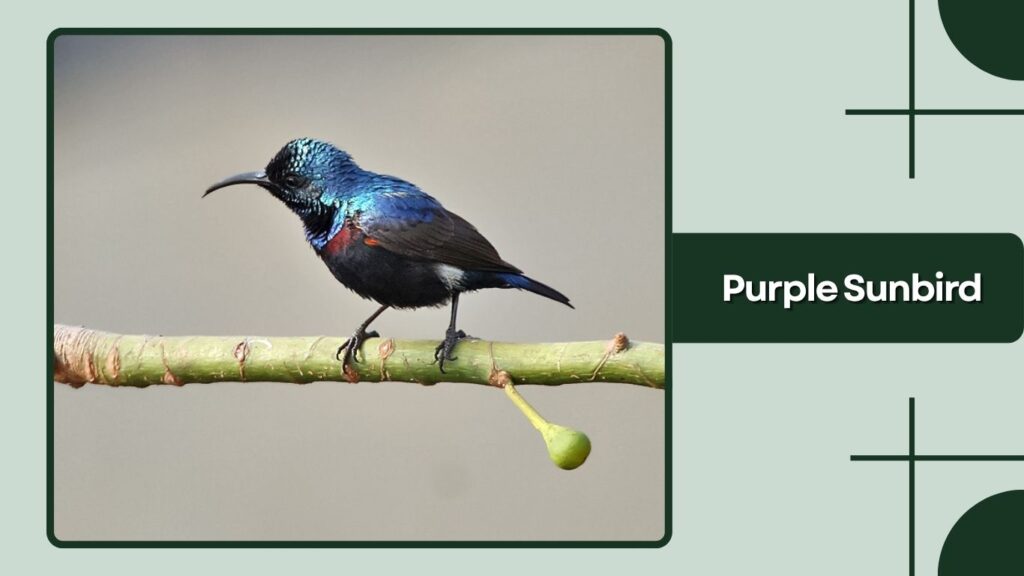
The Purple Sunbird is a small, long-beaked bird found across South Asia and parts of the Middle East. Adult males become glossy purple-black during the breeding season, while females remain olive-brown and yellow. These energetic birds commonly visit gardens, farmland, scrublands, and flowering trees in search of nectar and insects.
Identification
- Breeding males have shiny purple, blue, and black plumage.
- Nonbreeding males show yellow underparts with a dark central stripe.
- Females are olive-brown above and pale yellow below.
- The bill is long, slender, and slightly curved downward.
- Adults measure about 3.9–4.3 inches long.
- Both sexes have short wings and relatively narrow tails.
Habitat and Range
Purple Sunbirds occur in Bangladesh, India, Pakistan, Sri Lanka, Nepal, Myanmar, and parts of the Arabian Peninsula. They live in gardens, open forests, scrublands, farms, city parks, and dry countryside. They are often seen near flowering shrubs and trees.
Diet and Feeding
These birds mainly drink nectar from flowers using their long tongues. They may pierce the base of a flower to reach nectar directly. Purple Sunbirds also eat spiders, caterpillars, ants, beetles, and other small insects, especially when feeding their chicks.
Nesting Behavior
The female builds a hanging, pouch-shaped nest from grass, leaves, bark, fibers, spiderwebs, and plant material. It is usually attached to a thin branch or wire. She generally lays two or three pale eggs and performs most of the incubation.
8. Olive-Backed Sunbird
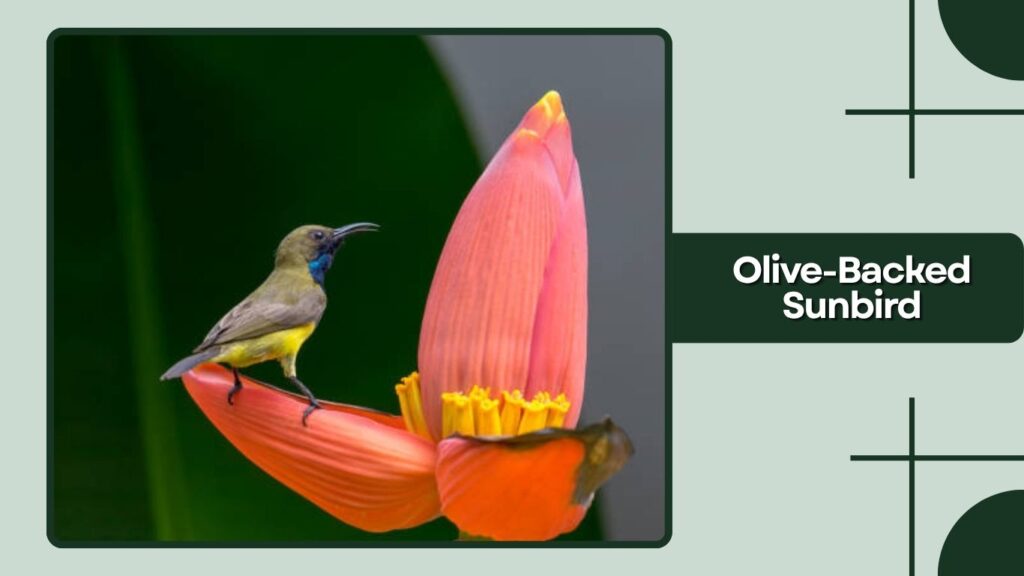
The Olive-backed Sunbird is a tiny, long-beaked bird commonly found across South and Southeast Asia. It is also known as the Yellow-bellied Sunbird. This adaptable species often lives close to people and can be seen in gardens, parks, coastal vegetation, plantations, and urban neighborhoods.
Identification
- Males have an olive-green back and bright yellow underparts.
- The throat and upper chest are glossy blue-black or purple.
- Females have olive-brown upperparts and yellow bellies.
- The bill is long, slender, and curved downward.
- Adults measure about 4.3–4.7 inches long.
- Both sexes have short wings and quick, active movements.
Habitat and Range
Olive-backed Sunbirds occur from southern China and the Philippines through Southeast Asia, Indonesia, New Guinea, and northern Australia. They prefer gardens, mangroves, forest edges, scrublands, plantations, and flowering urban areas. Their ability to live near houses makes them one of the most familiar sunbirds in many regions.
Diet and Feeding
These birds mainly drink nectar from tubular flowers using their long tongues. They also eat spiders, caterpillars, ants, and other tiny insects. Insects provide important protein, particularly when adults are raising young chicks.
Nesting Behavior
The female builds a hanging, pouch-shaped nest from grass, leaves, bark, spiderwebs, and plant fibers. It is often attached to a low branch, wire, or sheltered structure. She usually lays one or two pale eggs and handles most of the incubation.
9. Beautiful Sunbird
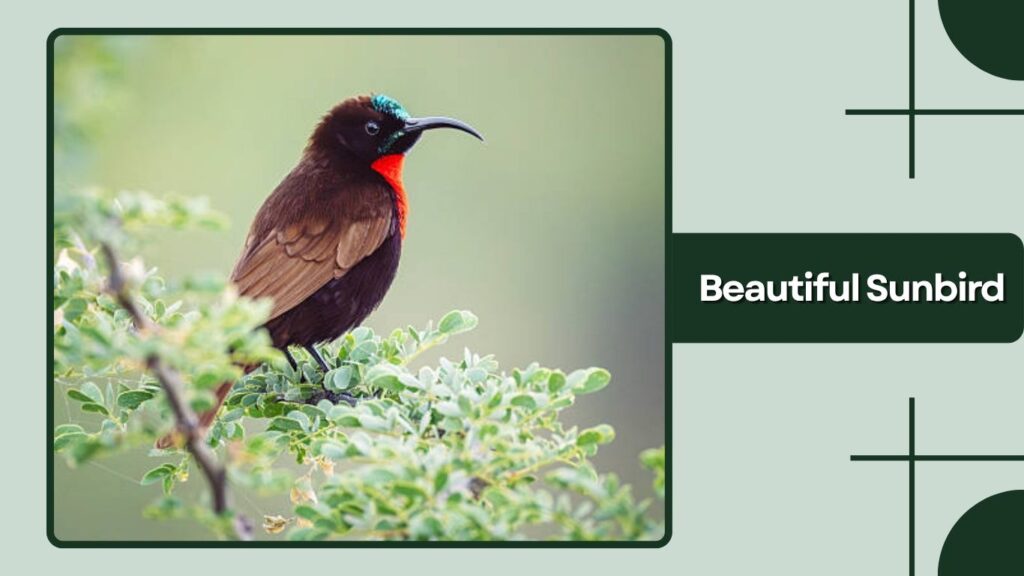
The Beautiful Sunbird is a tiny, long-beaked bird found mainly in dry regions of Africa. Adult males display brilliant metallic colors, while females have softer brown and yellow plumage. These active birds frequently visit flowering shrubs, gardens, savannas, and woodland edges where nectar and insects are abundant.
Identification
- Adult males have glossy green heads and upper bodies.
- The chest may show bright red, purple, or yellow coloring.
- Females are mostly gray-brown above with pale yellow underparts.
- The bill is long, narrow, and curved downward.
- Adults measure approximately 3.9–4.7 inches long.
- Males may develop elongated central tail feathers.
Habitat and Range
Beautiful Sunbirds occur across parts of northeastern, western, and central Africa. They prefer dry savannas, scrublands, open woodlands, gardens, farmland, and areas with flowering trees. Some populations move locally to follow seasonal rainfall and blooming plants.
Diet and Feeding
These birds primarily drink nectar from tubular flowers using their long tongues. They may hover briefly while feeding or perch beside a flower. Beautiful Sunbirds also eat spiders, beetles, caterpillars, flies, and other small insects, especially during the nesting season.
Nesting Behavior
The female constructs a hanging, pouch-shaped nest from dry grass, leaves, plant fibers, bark, and spiderwebs. She attaches it to a thin branch and may decorate the outside with leaves for camouflage. The female usually lays one or two eggs and performs most nesting duties.
10. Scarlet-Chested Sunbird
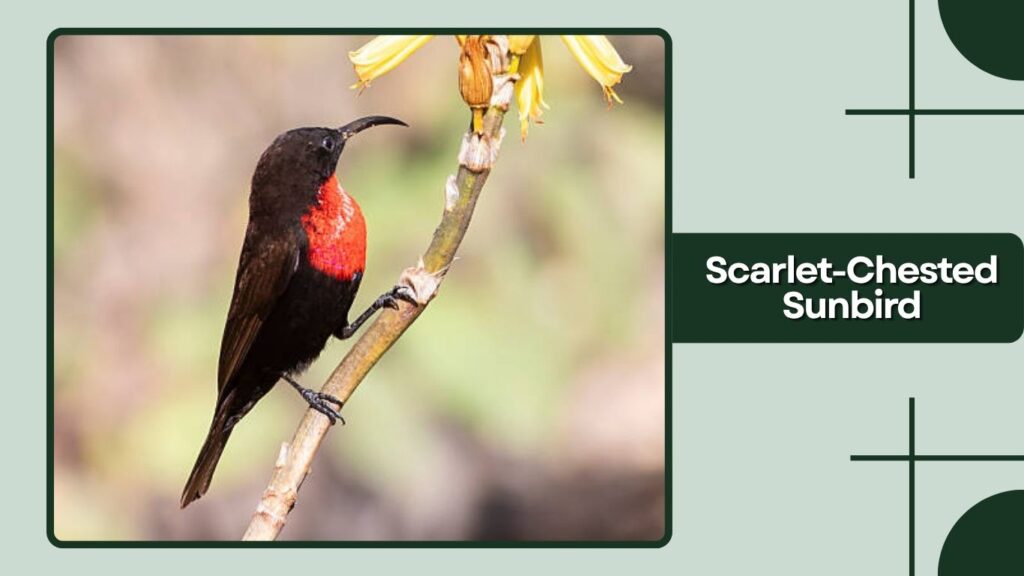
The Scarlet-chested Sunbird is a small, long-beaked bird found throughout much of sub-Saharan Africa. Adult males are especially striking, with glossy black plumage and a bright scarlet chest patch. These energetic birds commonly visit flowering trees, gardens, savannas, woodland edges, and scrublands in search of nectar and insects.
Identification
- Adult males have glossy black or dark blue-black plumage.
- A large, brilliant scarlet patch covers the chest.
- Females are mostly grayish-brown with lighter underparts.
- The bill is long, slender, and curved downward.
- Adults measure approximately 5.5–6 inches long.
- Males usually have longer tails than females.
Habitat and Range
Scarlet-chested Sunbirds occur across eastern, central, western, and southern Africa. They inhabit open woodlands, savannas, scrublands, farmland, gardens, and areas with flowering shrubs. They are especially noticeable when feeding in tall trees covered with nectar-rich blossoms.
Diet and Feeding
These birds mainly consume nectar from tubular flowers, including aloes and flowering trees. They use their curved bills and specialized tongues to reach deep inside blossoms. Scarlet-chested Sunbirds also eat spiders, flies, caterpillars, beetles, and other small insects.
Nesting Behavior
The female builds a hanging, pouch-shaped nest from grass, bark, leaves, plant fibers, and spiderwebs. It is attached to a thin branch and often decorated for camouflage. She usually lays one or two eggs and performs most incubation duties.
11. Brown Creeper
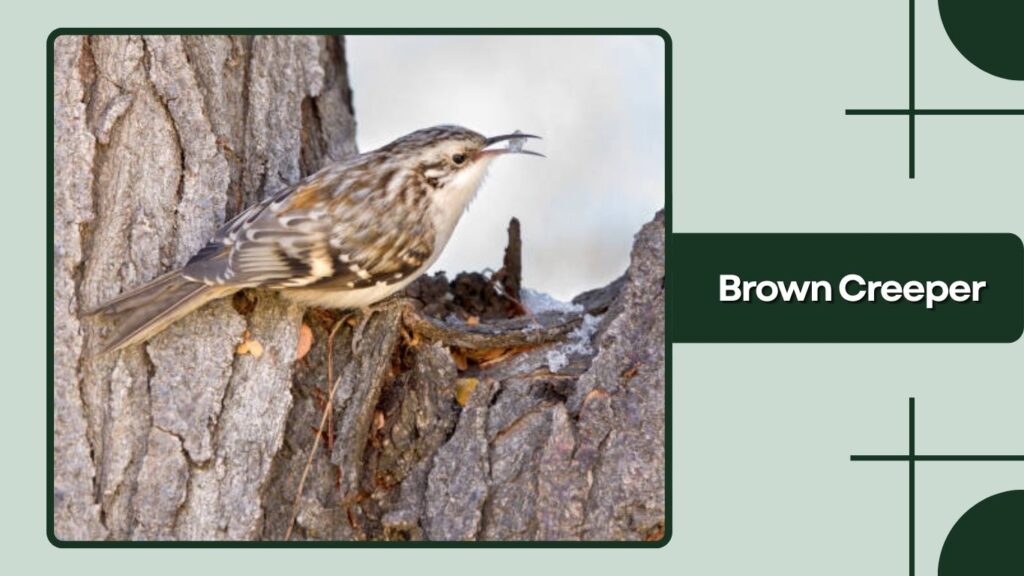
The Brown Creeper is a small, long-beaked woodland bird known for climbing upward along tree trunks. Its brown, streaked feathers provide excellent camouflage against bark. This quiet bird is often difficult to notice until it moves in a spiral around a tree while searching for insects hidden inside cracks.
Identification
- The upperparts are mottled brown, black, and white.
- The underparts are pale white or cream-colored.
- The bill is long, thin, and slightly curved downward.
- The tail is stiff and helps support the bird against tree trunks.
- Adults measure about 4.7–5.5 inches long.
- A pale eyebrow stripe is visible above each eye.
Habitat and Range
Brown Creepers live in mature coniferous, deciduous, and mixed forests across North America. They prefer areas with large trees and rough bark. Northern populations may move south during winter, while birds in milder regions often remain in the same area throughout the year.
Diet and Feeding
These birds mainly eat beetles, ants, spiders, insect eggs, larvae, and other tiny invertebrates. A Brown Creeper usually begins near the base of a tree and climbs upward while probing bark crevices with its curved bill. It then flies to the bottom of another tree and repeats the process.
Nesting Behavior
The female builds a hammock-shaped nest behind a loose piece of tree bark. She uses twigs, moss, bark strips, feathers, and plant fibers. A typical clutch contains five to six small white eggs marked with reddish-brown spots.
12. Eurasian Treecreeper
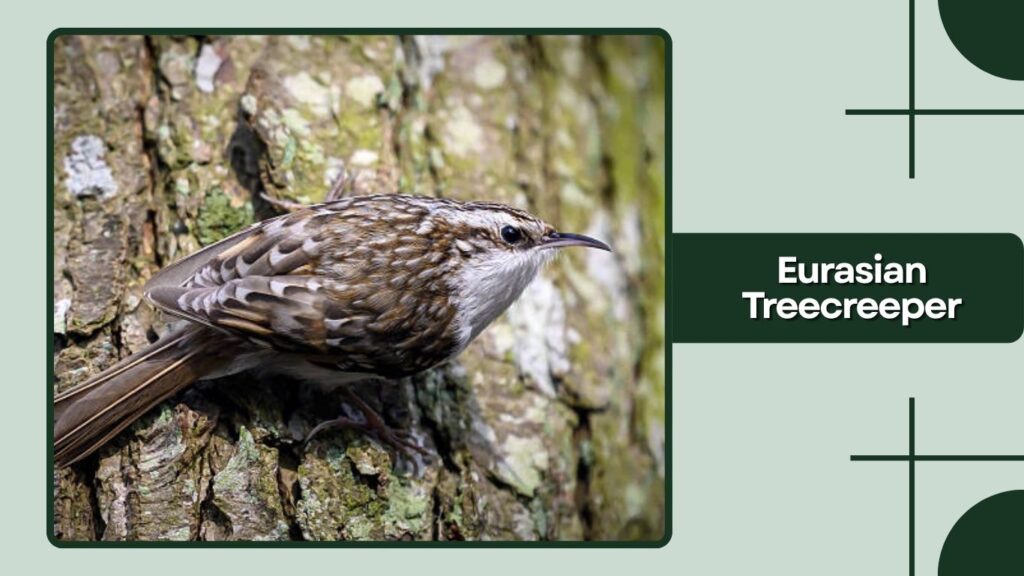
The Eurasian Treecreeper is a small, long-beaked woodland bird found across Europe and Asia. Its mottled brown plumage blends closely with tree bark, making it difficult to notice while resting. This active bird moves upward along trunks in a spiral pattern as it searches for insects hidden inside cracks and crevices.
Identification
- The upperparts are mottled brown, black, and cream.
- The underparts are mostly white or pale buff.
- The bill is long, narrow, and curved downward.
- A pale eyebrow stripe appears above each eye.
- The tail feathers are stiff and pointed.
- Adults usually measure about 4.7–5.9 inches long.
Habitat and Range
Eurasian Treecreepers inhabit mature deciduous, coniferous, and mixed forests. They are widespread across Europe, Russia, Central Asia, and parts of East Asia. They also occur in wooded parks, orchards, and large gardens with old trees. Most populations remain in the same general area throughout the year.
Diet and Feeding
These birds mainly eat beetles, ants, spiders, larvae, insect eggs, and other tiny invertebrates. They begin near the base of a tree and climb upward while probing bark with their curved bills. After reaching a higher point, they fly down to another tree and repeat the search.
Nesting Behavior
The female builds a nest behind loose tree bark or inside a narrow tree crevice. She uses twigs, grass, moss, feathers, and plant fibers. A typical clutch contains five or six white eggs marked with small reddish-brown spots.
13. Long-Billed Gnatwren
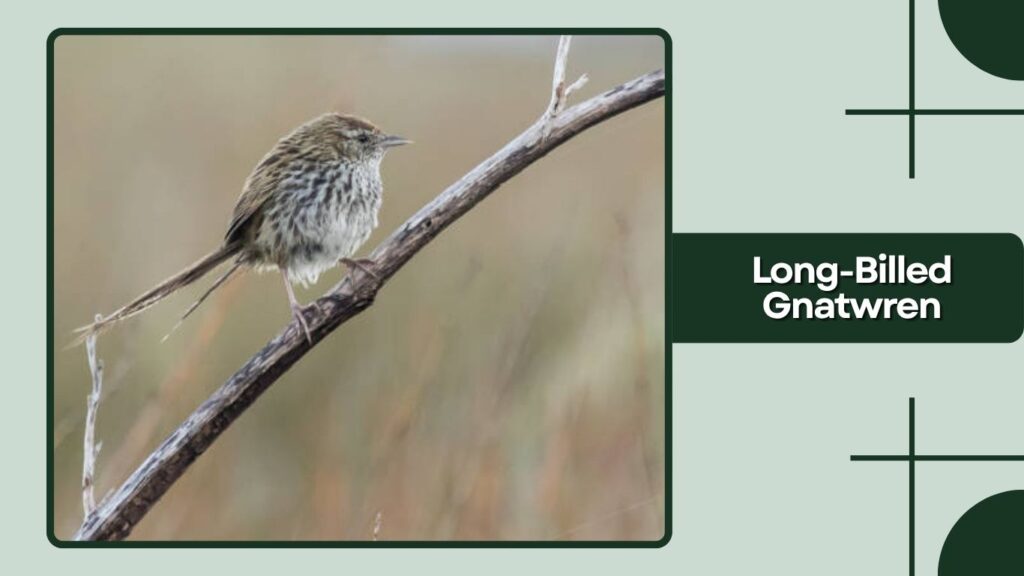
The Long-billed Gnatwren is a tiny tropical bird recognized by its remarkably long bill and energetic movements. It lives in forests across Central and South America, where it searches through vines, leaves, and tangled vegetation for insects. Its small body, long tail, and constantly flicking behavior make it distinctive.
Identification
- The bill is exceptionally long, thin, and slightly curved.
- The upperparts are olive-brown or grayish-brown.
- The underparts are pale gray or whitish.
- A noticeable white eyebrow stripe appears above the eye.
- The tail is long, narrow, and often held upright.
- Adults usually measure about 4–5 inches long.
Habitat and Range
Long-billed Gnatwrens inhabit tropical rainforests, forest edges, secondary woodlands, plantations, and dense riverside vegetation. Their range extends from southern Mexico through Central America and across much of northern South America. They usually remain in the forest understory.
Diet and Feeding
These birds mainly eat ants, beetles, spiders, insect larvae, and other tiny invertebrates. Their long bills allow them to reach prey hidden inside curled leaves, narrow bark cracks, and tangled vines. They often forage alone or in pairs.
Nesting Behavior
The Long-billed Gnatwren builds a small, delicate nest among vines, shrubs, or low branches. Plant fibers, leaves, moss, and spiderwebs are commonly used. The female usually lays two small eggs, and both parents may help feed and protect the young.
FAQs
What are some common small birds with long beaks?
Common examples include hummingbirds, sunbirds, treecreepers, hermits, and gnatwrens. These birds use their long beaks to drink nectar, catch insects, probe tree bark, or reach food hidden inside flowers, leaves, and narrow crevices.
Why do small birds have long beaks?
A long beak helps a bird reach food that other species cannot easily access. Hummingbirds and sunbirds use theirs for nectar, while treecreepers search beneath bark. The beak’s shape usually reflects the bird’s habitat and feeding behavior.
Which small long-beaked birds drink nectar?
Ruby-throated, Anna’s, Black-chinned, and Broad-tailed Hummingbirds mainly drink nectar. Long-billed and Green Hermits also feed from deep flowers. Purple, Olive-backed, Beautiful, and Scarlet-chested Sunbirds use curved bills and specialized tongues to collect nectar.
Do small long-beaked birds also eat insects?
Yes, most small long-beaked birds eat insects in addition to nectar or fruit. Insects provide protein and other nutrients, especially during breeding season. These birds may catch flying insects, search leaves, or probe bark and flowers for hidden prey.
How can I attract small long-beaked birds?
Grow native nectar-rich flowers, provide clean water, and avoid pesticides. Hummingbird feeders can attract nectar-feeding species when filled with a proper sugar-water mixture. Trees, shrubs, and flowering plants also provide insects, nesting locations, shelter, and natural feeding opportunities.