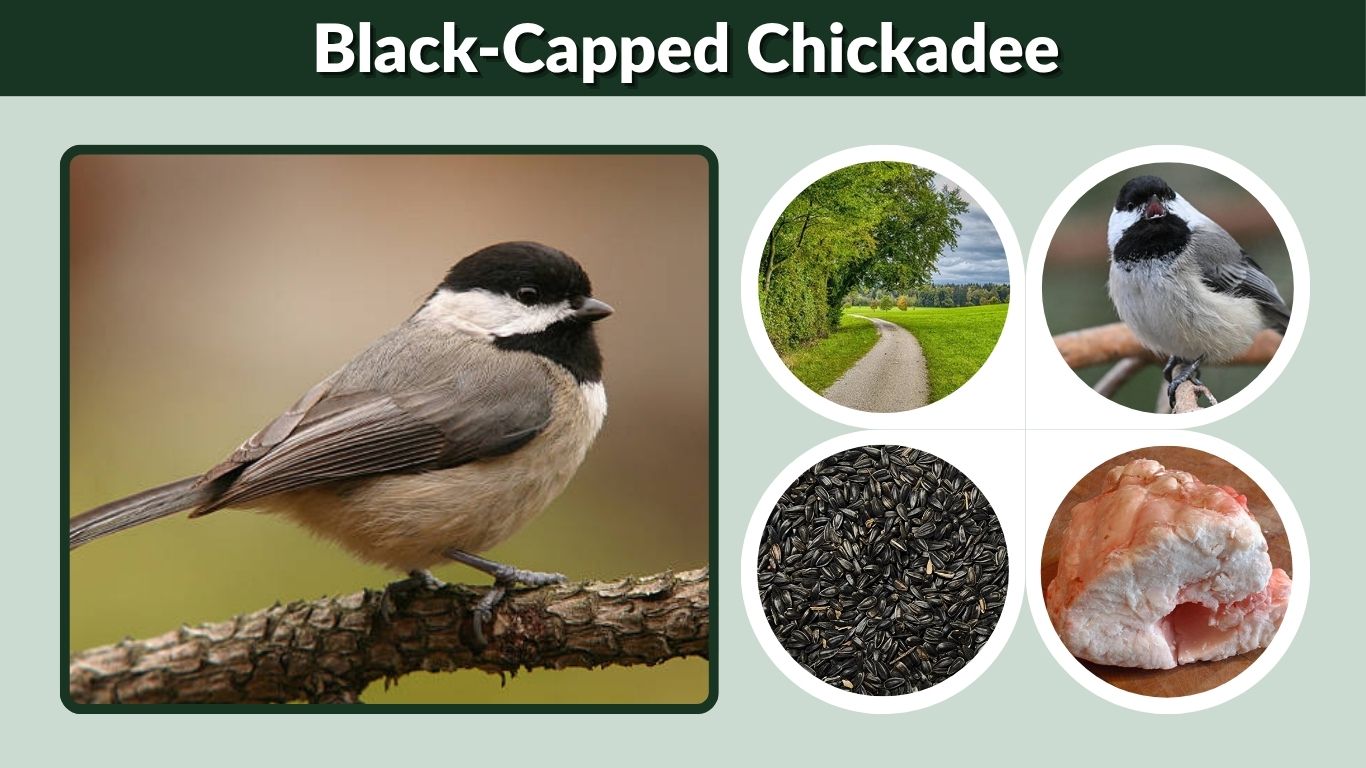
The Black-capped Chickadee is a tiny, energetic songbird known for its bold black cap, bright white cheeks, and familiar “chick-a-dee-dee-dee” call. Common across much of northern North America, it visits forests, parks, gardens, and backyard feeders throughout the year. Despite its delicate appearance, this hardy bird survives freezing winters, stores food for later, and communicates through an impressive variety of calls.
Black-Capped Chickadee Quick Facts
The scientific name of the Black-capped Chickadee is Poecile atricapillus. It belongs to the chickadee and titmouse family, Paridae. Adults are smaller than most sparrows and have compact bodies, short bills, rounded heads, and relatively long tails.
| Feature | Description |
| Scientific name | Poecile atricapillus |
| Length | 4.7–5.9 inches |
| Wingspan | 6.3–8.3 inches |
| Weight | 0.3–0.5 ounces |
| Main foods | Insects, spiders, seeds, berries and suet |
| Nest type | Tree cavity or birdhouse |
| Eggs | Usually white with reddish-brown markings |
| Migration | Mainly a year-round resident |
What Does a Black-Capped Chickadee Look Like?
Black-capped Chickadees are easy to recognize once their main markings become familiar. Their contrasting head pattern is usually visible even when the bird is moving quickly through branches.
Identification
- Solid black cap extending across the top of the head
- Black bib beneath the bill and throat
- Large, bright white cheek patches
- Soft gray back, wings and tail
- Pale belly with warm buff-colored sides
- Small, pointed black bill
- Rounded head and short neck
- Narrow tail that appears fairly long for the body
Adults measure approximately 4.7–5.9 inches long, with a wingspan of around 6.3–8.3 inches. Their weight may be only 0.3–0.5 ounces.
Male vs Female Black-Capped Chickadee
Male and female Black-capped Chickadees look almost identical. Both have the same black cap, black bib, white cheeks and gray body. Males may average slightly larger and sometimes have a somewhat larger bib, but these differences are unreliable in the field.
Behavior can provide better clues during breeding season. Males frequently sing, defend territories and feed females during courtship and incubation. However, observing a bird’s behavior over time is usually necessary to determine its sex confidently.
Black-Capped Chickadee Call and Song
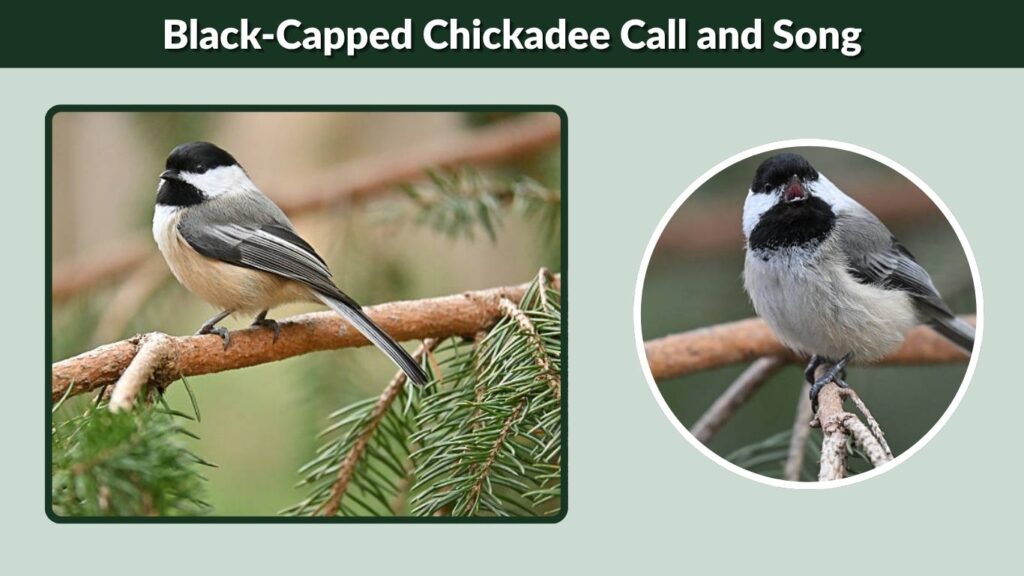
This species has a surprisingly complex vocal system. Chickadees use separate songs, contact notes, alarm calls and aggressive sounds to communicate with mates and flock members.
The “Chick-a-dee-dee-dee” Call
The best-known Black-capped Chickadee sound gives the bird its name. The call begins with sharper “chick-a” notes and finishes with one or more “dee” notes.
The number of “dee” notes can communicate the seriousness of a threat. More repeated notes may indicate a greater level of alarm, allowing nearby birds to respond appropriately.
Black-Capped Chickadee Song
The typical song is a clear, whistled phrase often described as “fee-bee” or “hey, sweetie.” The first note is higher, followed by a noticeable drop in pitch. Males sing most frequently during late winter and spring while establishing territories and attracting mates.
Other Chickadee Sounds
A thin, high-pitched “see” may warn of a fast-moving predator. Chickadees also produce gargling noises during aggressive encounters, especially when a dominant bird confronts another bird that comes too close. Quiet contact notes help flock members remain connected while feeding among dense branches.
Black-Capped Chickadee Habitat and Range
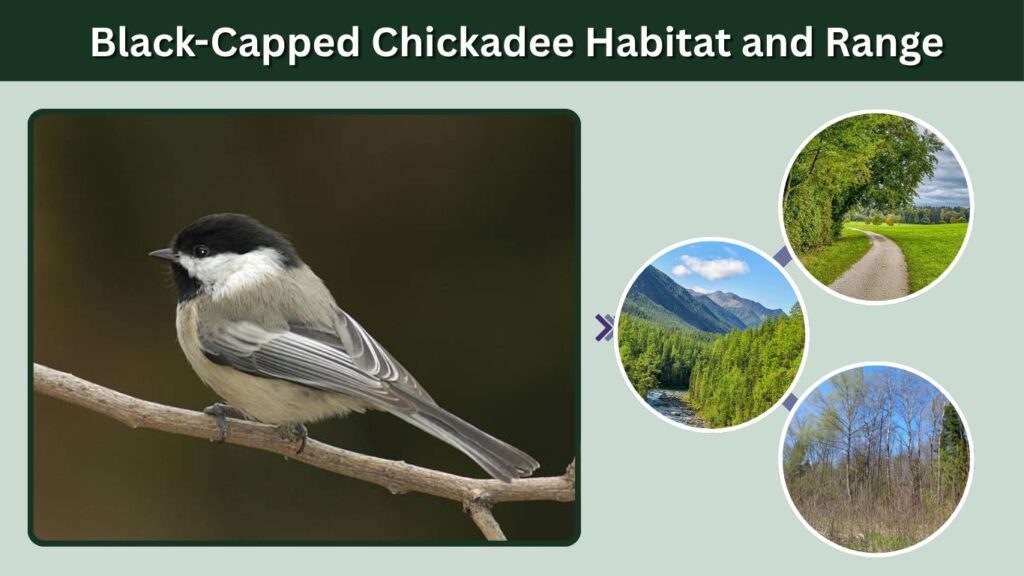
Black-capped Chickadees inhabit much of Canada, Alaska and the northern United States. Their range extends across northern forests and southward into parts of the central and northeastern United States. Adults are generally nonmigratory, although young birds occasionally travel considerable distances during irregular movements called irruptions.
Suitable habitats include:
- Deciduous and mixed forests
- Woodland edges and open woods
- Birch, alder and willow thickets
- Parks and residential neighborhoods
- Gardens with mature trees
- Cottonwood groves
- Brushy fields and wetland edges
They are especially common where trees provide natural cavities, decaying branches and abundant insects.
What Do Black-Capped Chickadees Eat?
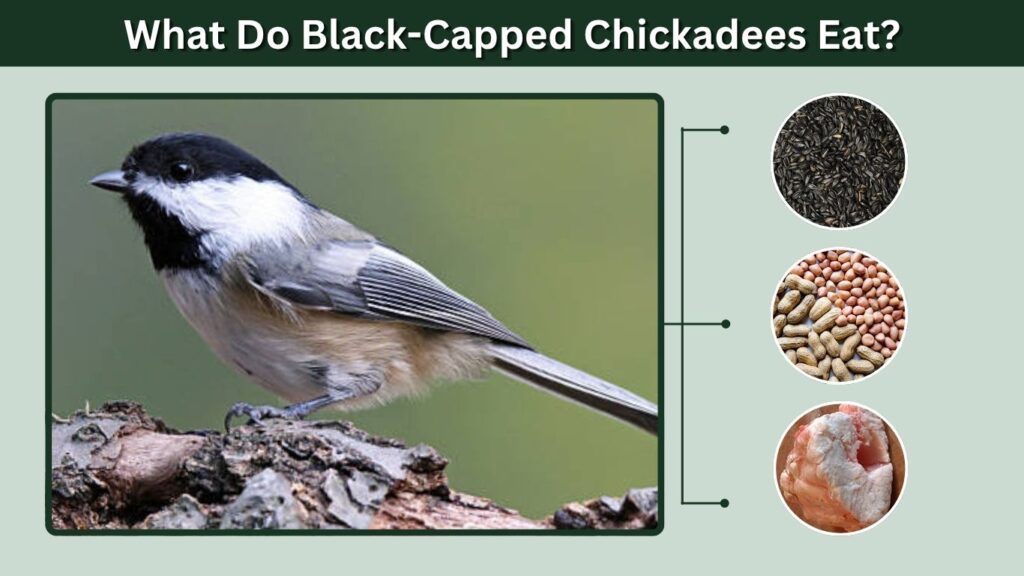
The Black-capped Chickadee changes its diet with the seasons. During warmer months, animal foods dominate because insects are abundant and provide protein for adults and growing chicks.
Natural Foods
Spring, summer and fall foods include caterpillars, beetles, insect eggs, spiders and other small invertebrates. Chickadees search leaves, bark and small branches, sometimes hanging upside down to reach hidden prey.
During winter, seeds, berries and other plant material become more important. Chickadees also store individual pieces of food in bark crevices, under leaves and in other protected locations for later use.
Food at Backyard Feeders
Black-capped Chickadees readily visit feeders containing:
- Black-oil sunflower seeds
- Shelled or crushed peanuts
- Suet
- Mealworms
- Mixed birdseed
- Safflower seeds
A chickadee often grabs one seed and carries it to a nearby branch. It holds the seed between its feet and pecks through the shell before eating the contents.
Black-Capped Chickadee Nest and Eggs
Black-capped Chickadees are cavity nesters. They may use a natural hole, an abandoned woodpecker cavity, a decaying tree branch or a properly designed birdhouse.
Nesting Habits
Both members of a pair may help excavate a cavity in soft, rotten wood. The female constructs the inner nest using moss, bark strips and coarse plant material. She then adds a soft lining made from animal hair, fur or fine plant fibers.
Birch and alder trees are frequently selected, although the species uses many other trees when suitable cavities are available.
Black-Capped Chickadee Eggs
The eggs are white with fine reddish-brown dots or small spots. A clutch can contain between one and 13 eggs, although extremely small or large clutches are less typical.
The female incubates the eggs for approximately 12–13 days. The chicks hatch nearly naked, with closed eyes and only small patches of down.
Baby Chickadees and Fledglings
Both parents bring insects and other food to the nestlings. Caterpillars are particularly valuable because they provide moisture and protein.
Young chickadees generally remain in the nest for about 12–16 days. After fledging, they stay close to their parents while learning how to forage, recognize danger and communicate with other chickadees.
Black-Capped vs Carolina Chickadee
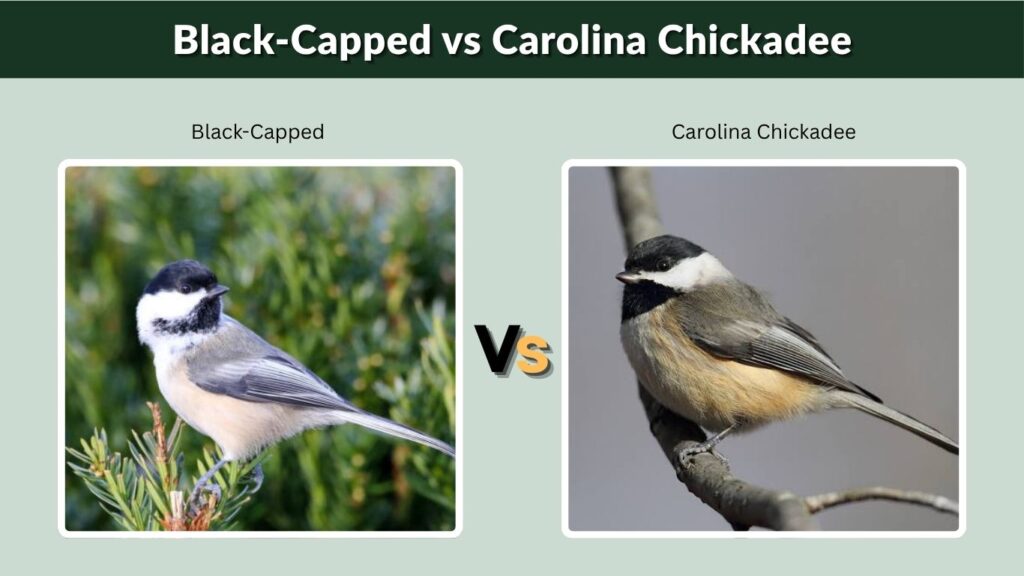
The Carolina Chickadee is the species most commonly confused with the Black-capped Chickadee. Their ranges meet in parts of the eastern United States, where identification can be especially difficult because the two species sometimes hybridize and imitate each other’s songs.
| Feature | Black-Capped Chickadee | Carolina Chickadee |
| General range | Northern United States and Canada | Southeastern United States |
| Size | Usually slightly larger | Usually slightly smaller |
| Tail | Relatively longer | Relatively shorter |
| Wing pattern | Often more white edging | Usually less white edging |
| Typical song | Two or three clear notes | Often four notes at alternating pitches |
| Identification difficulty | Hard where ranges overlap | Hard where ranges overlap |
Voice and location are often more useful than appearance. Black-capped Chickadees usually sing a clear two- or three-note whistle, while Carolina Chickadees commonly produce a faster song containing more notes.
How to Attract Black-Capped Chickadees
Place a tube, platform or hopper feeder near shrubs or trees where birds can retreat after collecting food. Black-oil sunflower seeds, peanuts, mealworms and suet are among the most effective choices.
A birdhouse can also attract a breeding pair. Install it before nesting season and place untreated wood shavings inside so the birds can excavate the material. Native trees, shrubs and pesticide-free plants support the insects chickadees need for feeding their young. Leaving safe dead branches or snags may also provide valuable nesting cavities.
FAQs
Are Black-capped Chickadees friendly?
Black-capped Chickadees are naturally curious and may approach people more closely than many wild birds. They quickly learn to use backyard feeders. However, they remain wild animals and should be observed without attempting to capture, pet or keep them.
Do Black-capped Chickadees migrate?
Most adults remain within the same general region throughout the year. Young birds may occasionally move south or travel long distances when populations are high or food becomes scarce, but these irregular movements are not considered normal seasonal migration.
What does a Black-capped Chickadee sound like?
Its most recognizable call sounds like “chick-a-dee-dee-dee.” It also produces a clear whistled “fee-bee” song, quiet contact notes, high-pitched alarm signals and rough gargling calls during aggressive interactions.
Where do Black-capped Chickadees sleep?
They commonly sleep alone in sheltered tree cavities, old woodpecker holes or other protected spaces. These enclosed roosts reduce exposure to wind and cold. Dense vegetation may also provide temporary shelter when a suitable cavity is unavailable.
Are Black-capped Chickadees endangered?
Black-capped Chickadees are widespread and are currently considered a species of relatively low conservation concern. However, removing too many dead trees can reduce available nesting cavities, while pesticide use may decrease the insects needed to raise chicks.