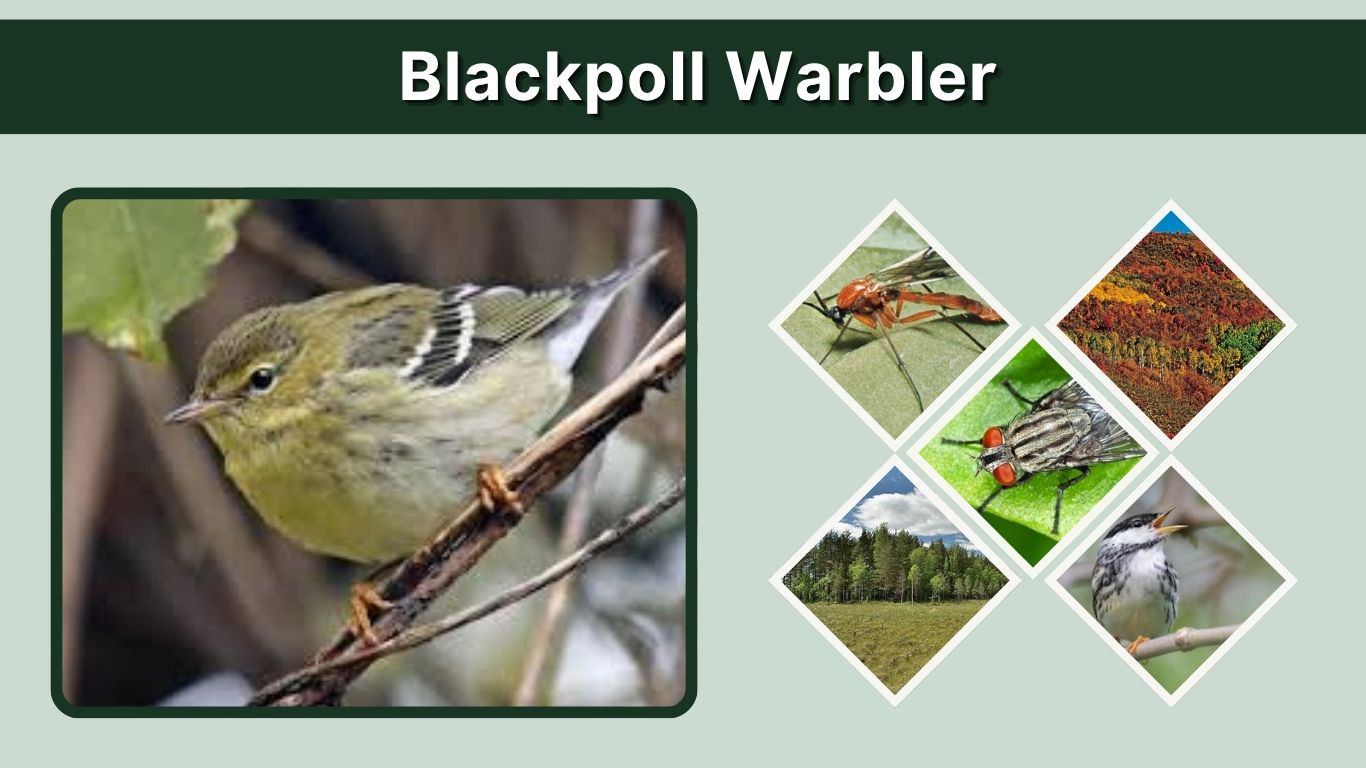
The Blackpoll Warbler is a small North American songbird famous for completing one of the most demanding migrations recorded among birds of its size. Breeding males have a striking black-and-white appearance, but females, juveniles, and fall migrants are much less colorful and can be difficult to identify. These lightweight birds breed across the northern boreal forest before traveling to South America. During autumn, many complete a nonstop flight lasting several days over the Atlantic Ocean.
Blackpoll Warbler Quick Facts
The scientific name of the Blackpoll Warbler is Setophaga striata. It belongs to Parulidae, the family of New World warblers. Despite weighing little more than a pen, it has long wings suited to extended migratory flight.
| Feature | Information |
| Scientific name | Setophaga striata |
| Family | Parulidae |
| Length | About 5.5 inches |
| Weight | Approximately 0.4–0.5 ounces |
| Wingspan | Around 8.3–9.1 inches |
| Main diet | Insects, spiders, and seasonal fruit |
| Breeding habitat | Northern boreal forest |
| Winter range | Northern South America |
| Nest location | Usually in spruce or fir trees |
| Population trend | Decreasing |
Blackpoll Warblers measure approximately 14 centimeters long, weigh around 12–13 grams, and have a wingspan of 21–23 centimeters.
What Does a Blackpoll Warbler Look Like?
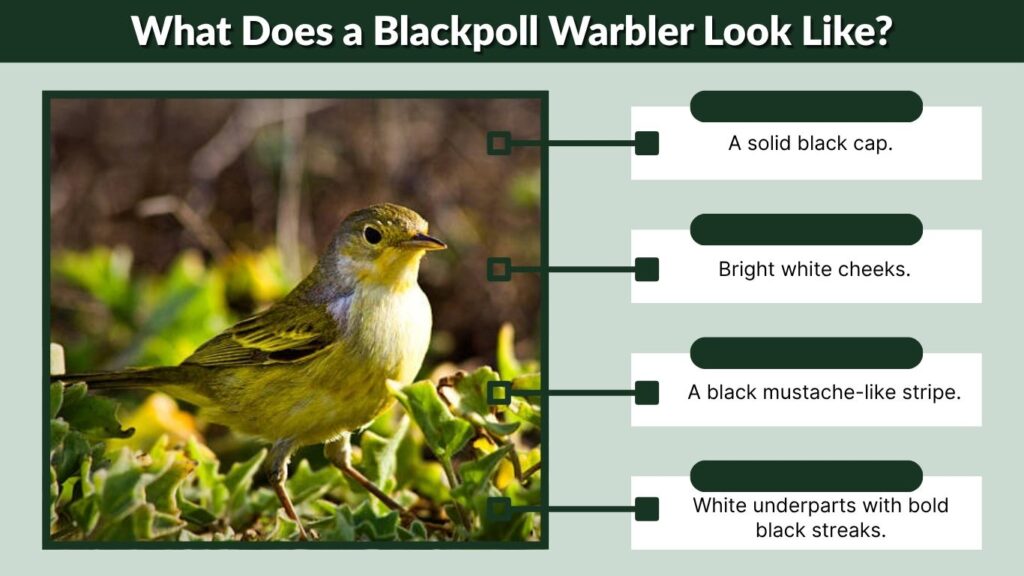
The bird’s appearance changes considerably with sex, age, and season. Breeding males are relatively easy to recognize, while females and fall birds resemble several other yellow-green warblers.
Breeding Male Identification
A breeding male has:
- A solid black cap
- Bright white cheeks
- A black mustache-like stripe
- White underparts with bold black streaks
- Dark wings with two white wing bars
- Olive markings on the back
- Pale orange or yellowish legs
- A short tail and thin, pointed bill
The contrast between the male’s black cap and white cheeks gives it an appearance sometimes compared with a chickadee. Unlike a chickadee, however, it has a slimmer bill, streaked underparts, and the body shape of a warbler.
Female Blackpoll Warbler
Breeding females are less strongly patterned. They usually have gray-brown or olive upperparts, pale underparts with dark streaking, two white wing bars, and a broken yellowish eye ring. Some show a yellow wash across the face, throat, or breast.
Females lack the male’s solid black cap and bold white cheeks. Their orange-yellow legs can provide a useful clue, although leg color may be difficult to see in poor light.
Juvenile and Immature Birds
Juvenile Blackpoll Warblers are generally yellow-green above and pale below. They show blurry streaks along the breast and flanks, prominent white wing bars, and a noticeable dark line through the eye. Young birds may resemble females by the time they begin migrating south.
Blackpoll Warbler Fall Plumage
Blackpoll Warblers look dramatically different after molting into nonbreeding plumage. The male loses his black cap and becomes yellow-green, making fall identification considerably more challenging.
Fall birds commonly show:
- An olive-green or yellowish head
- A pale eyebrow
- A dark line through the eye
- Two distinct white wing bars
- Fine streaking on the sides and flanks
- White undertail feathers
- Pale or yellowish legs
These birds are often described as “confusing fall warblers” because they can resemble Bay-breasted, Pine, and immature Blackburnian warblers.
Blackpoll vs. Bay-Breasted Warbler
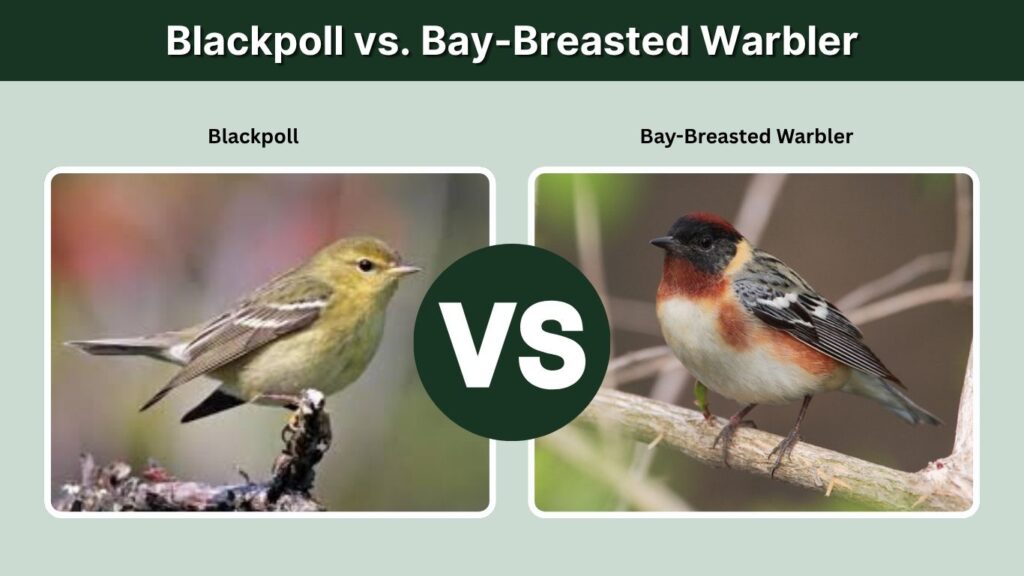
The Blackpoll and Bay-breasted Warblers can look extremely similar during fall migration. Examining several features together is more reliable than relying on a single mark.
| Feature | Fall Blackpoll Warbler | Fall Bay-breasted Warbler |
| Flanks | Usually faintly streaked | Usually plain or lightly chestnut-washed |
| Undertail coverts | White | Buff or creamy |
| Legs | Often pale or yellowish | Usually dark |
| Wing bars | Clear but relatively narrow | Often broader and bolder |
| Face | More obvious eyeline | Plainer face |
| Body color | Yellow-green with streaking | Greenish with warmer buff areas |
The most dependable clues are the Blackpoll’s streaked flanks and white undertail coverts. Bay-breasted Warblers usually have plain flanks and buff-colored undertail feathers.
Where Do Blackpoll Warblers Live?
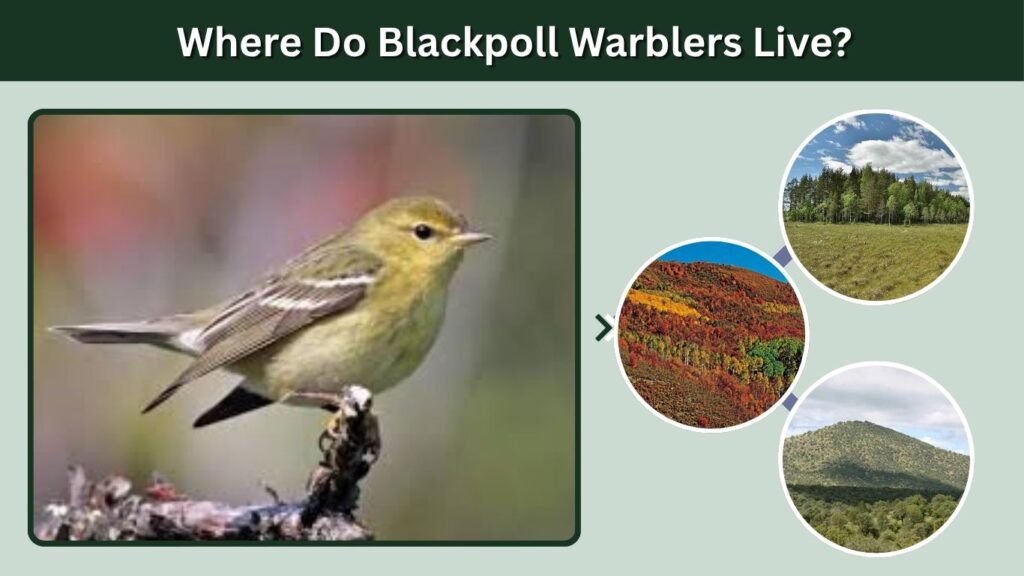
Blackpoll Warblers breed across Alaska, most of Canada, and parts of the northeastern United States. Their breeding distribution reaches northern New England and the Adirondack Mountains of New York.
Breeding Habitat
During summer, they primarily occupy boreal forests containing black spruce and tamarack. In western Canada, they also use dense growths of spruce, alder, and willow. Populations in northern New England commonly live in cool, wet areas with evergreen trees.
Migration Habitat
During migration, Blackpoll Warblers use a broader range of environments, including:
- Deciduous forests
- Evergreen woodlands
- Scrubby thickets
- Forest edges
- Coastal vegetation
- Gardens and parks with mature trees
Most birdwatchers in the continental United States encounter them during spring or fall migration rather than during the breeding season.
Winter Habitat
After reaching South America, Blackpoll Warblers mainly occupy forest edges and second-growth forest east of the Andes. They may be found from lowlands to elevations approaching 10,000 feet.
Blackpoll Warbler Migration
The Blackpoll Warbler’s fall migration is its most remarkable characteristic. Birds breeding as far west as Alaska first travel eastward across North America. They gather and refuel along the Atlantic coast before beginning their ocean crossing toward the Caribbean or northern South America.
Nonstop Atlantic Flight
Tracking research confirmed that Blackpoll Warblers complete nonstop overwater flights ranging from approximately 2,270 to 2,770 kilometers. The average crossing was about 2,540 kilometers and lasted roughly 62 hours, with some birds remaining airborne for up to three days.
Before departure, the birds consume large amounts of food and substantially increase their body mass. These stored fat reserves power the flight because there are few opportunities to land or feed over the open Atlantic.
Some individuals complete annual round trips exceeding 20,000 kilometers when movements between western breeding areas, Atlantic departure points, and South American wintering grounds are combined.
Spring Migration
The return journey generally follows a more overland route through the Caribbean and eastern North America. Males travel north in fresh breeding plumage and may sing during stopovers, making spring one of the best seasons for observing them.
Blackpoll Warbler Call and Song
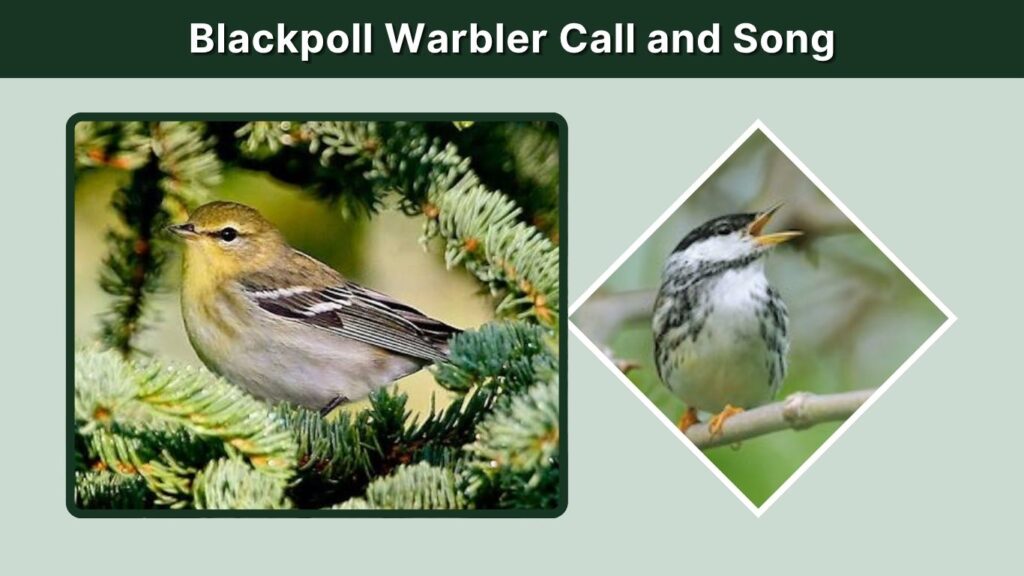
The male’s song is a rapid series of very high, thin notes. The notes grow louder toward the middle and then become softer, producing a pattern resembling:
“tsit-tsit-TSIT-TSIT-tsit-tsit.”
The song can be difficult for some people to hear because of its unusually high pitch. Males also produce a faster trill, while both sexes use a sharper squeaking or chipping call.
Calling and singing are most frequently heard on the breeding grounds and during spring migration. Fall migrants are usually quieter.
What Do Blackpoll Warblers Eat?
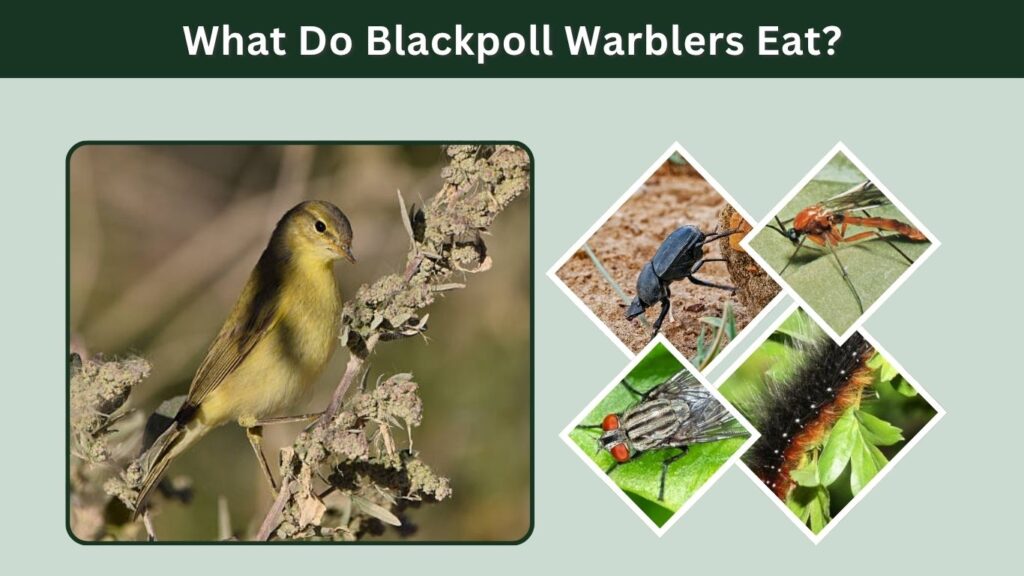
Blackpoll Warblers mainly eat insects and spiders. Their prey includes caterpillars, beetles, mosquitoes, ants, flies, gnats, and other small invertebrates. They search leaves, twigs, and branches, often feeding at eye level or higher in trees.
During autumn, they add energy-rich fruit to their diet while preparing for migration. Documented foods include honeysuckle berries, pokeberries, and yew fruit. This seasonal shift helps them build the fat reserves required for their Atlantic crossing.
Nesting and Breeding
The female selects the nest site, commonly in a spruce or fir tree within dense boreal vegetation. The protected location helps conceal the nest from predators and harsh weather.
The nest is generally a small open cup made from plant material and lined with softer fibers. The female performs most incubation, while both parents help feed the chicks after hatching. Young birds must grow quickly during the brief northern summer before preparing for their first southbound migration.
Conservation and Population Decline
The Blackpoll Warbler remains widespread, but monitoring shows a major long-term population decline. Cornell describes it as a common bird in steep decline, while BirdLife International lists its population trend as decreasing.
Important threats include:
- Loss and alteration of boreal breeding forest
- Logging and resource extraction
- Habitat loss on South American wintering grounds
- Climate-related changes to northern forests
- Collisions with buildings and illuminated towers
- Severe weather during ocean migration
Protecting breeding, stopover, and winter habitats is important because the species depends on locations spread across two continents and the Caribbean.
FAQs
How big is a Blackpoll Warbler?
A Blackpoll Warbler is approximately 5.5 inches long, weighs about 0.4–0.5 ounces, and has a wingspan of around 8.3–9.1 inches. It is a small bird with unusually long wings for a warbler.
Where does the Blackpoll Warbler migrate?
It breeds across northern North America and winters mainly in northern South America. In fall, many birds travel to the Atlantic Coast and fly nonstop over the ocean toward the Caribbean or South America.
What does a female Blackpoll Warbler look like?
The female is olive or gray-brown above with pale, streaked underparts, two white wing bars, a thin dark eyeline, and a partial yellowish eye ring. She lacks the breeding male’s solid black cap.
Why do Blackpoll Warblers look different in fall?
Adults molt after breeding. Males lose their bold black-and-white pattern and develop yellow-green nonbreeding plumage similar to females and juveniles. The softer coloration provides camouflage during migration and winter.
What makes the Blackpoll Warbler’s migration special?
A bird weighing only about 12 grams can remain in flight for around three days while crossing more than 2,000 kilometers of open ocean. It is one of the longest nonstop overwater journeys documented for a songbird.