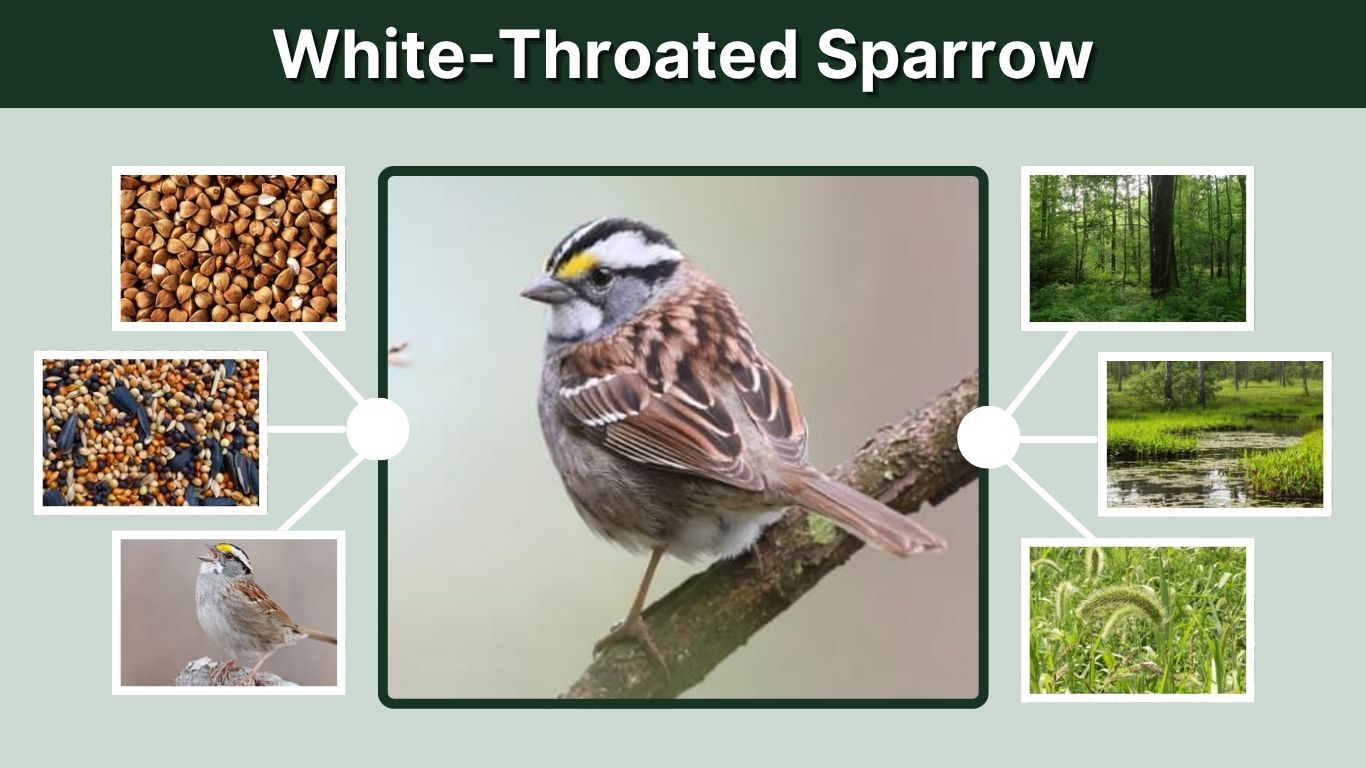
The White-throated Sparrow is a plump North American songbird recognized by its bright white throat, yellow eyebrow patches, striped crown, and musical whistling song. Although it breeds mainly in northern forests, it becomes a familiar winter visitor around woodland edges, parks, gardens, and backyard feeders across much of the eastern United States. Adults occur in two distinct color forms, while juveniles have duller markings that can make identification more challenging.
What Is a White-Throated Sparrow?
The White-throated Sparrow, scientifically known as Zonotrichia albicollis, belongs to the New World sparrow family. It is larger and fuller-bodied than many familiar sparrows, with a rounded head, long legs, narrow tail, and relatively small gray bill.
| Feature | Description |
| Scientific name | Zonotrichia albicollis |
| Length | 6.3–7.1 inches |
| Weight | 0.8–1.1 ounces |
| Wingspan | 7.9–9.1 inches |
| Main diet | Seeds, fruits, insects and other invertebrates |
| Nest location | Usually on or close to the ground |
| Main habitat | Forests, thickets, woodland edges and backyards |
These measurements apply to both sexes, which are generally similar in size and outward appearance.
White-Throated Sparrow Identification
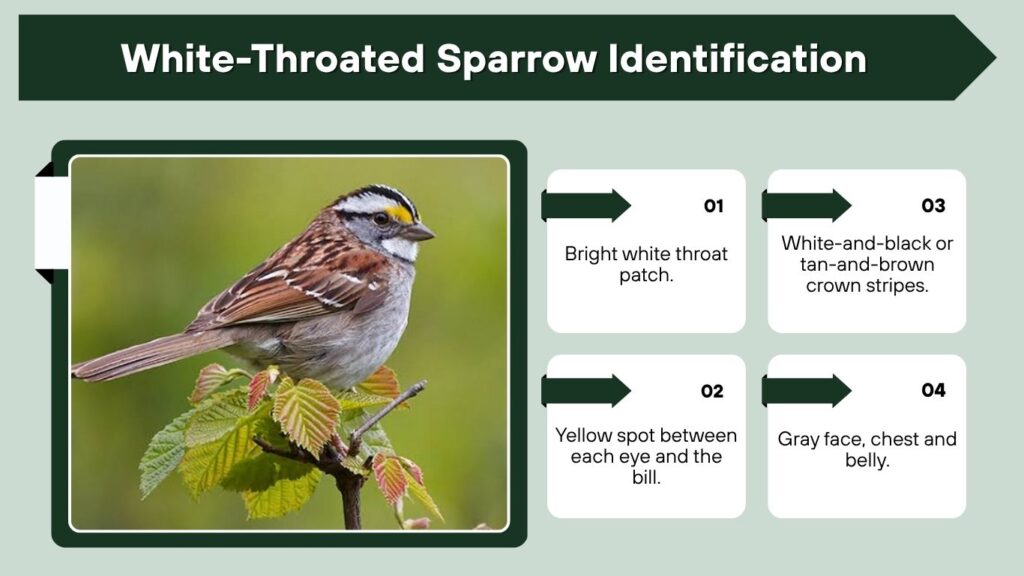
The easiest way to recognize this species is to examine its throat, face, crown and overall body shape. Adults have brown, heavily patterned upperparts, grayish underparts and a sharply defined white throat patch.
Adult Identification Features
Look for the following combination:
- Bright white throat patch
- Yellow spot between each eye and the bill
- White-and-black or tan-and-brown crown stripes
- Gray face, chest and belly
- Reddish-brown wings with pale wing bars
- Small gray bill
- Long, narrow brown tail
- Large, rounded body
The white throat is bordered by darker facial markings, making it look especially noticeable. However, the intensity of the head pattern depends on which color morph the bird has.
White-Striped and Tan-Striped Morphs
Adult White-throated Sparrows occur in two permanent color forms.
The white-striped morph has crisp white crown stripes bordered by black. Its face and throat usually appear brighter and more strongly contrasting.
The tan-striped morph has buff or tan crown stripes bordered by brown. Its facial pattern is softer and less contrasting, but it still has a white throat and yellow patches near the bill. Both morphs include males and females.
White-striped birds generally show greater territorial aggression during the breeding season, whereas tan-striped individuals are often associated with greater parental investment. Pairs are formed overwhelmingly between birds of opposite morphs.
Male vs. Female White-Throated Sparrow
Male and female White-throated Sparrows cannot be reliably separated by plumage. Either sex can be white-striped or tan-striped, and both have the characteristic white throat, yellow lores and streaked brown back.
Behavior provides better clues during breeding. Males regularly sing to advertise and defend territories. White-striped females may also sing, while tan-striped females sing only rarely.
Do White-Throated Sparrows Have Four Sexes?
The phrase “four sexes” is popular shorthand rather than a claim that the species literally has four biological sexes. The bird has males and females, but each sex occurs in white-striped and tan-striped forms. A chromosome-based supergene influences coloration, behavior and mate choice, producing four reproductive combinations.
Juvenile and Immature Identification
Juvenile White-throated Sparrows are browner and more heavily streaked than adults. Their head stripes are brown and black rather than bright white and black, the yellow facial patches are faint, and the breast may show light streaking.
As immature birds mature, their white throat and yellow lores become more noticeable, but the head may remain less sharply marked than that of a fully developed adult.
White-Throated Sparrow Song and Calls
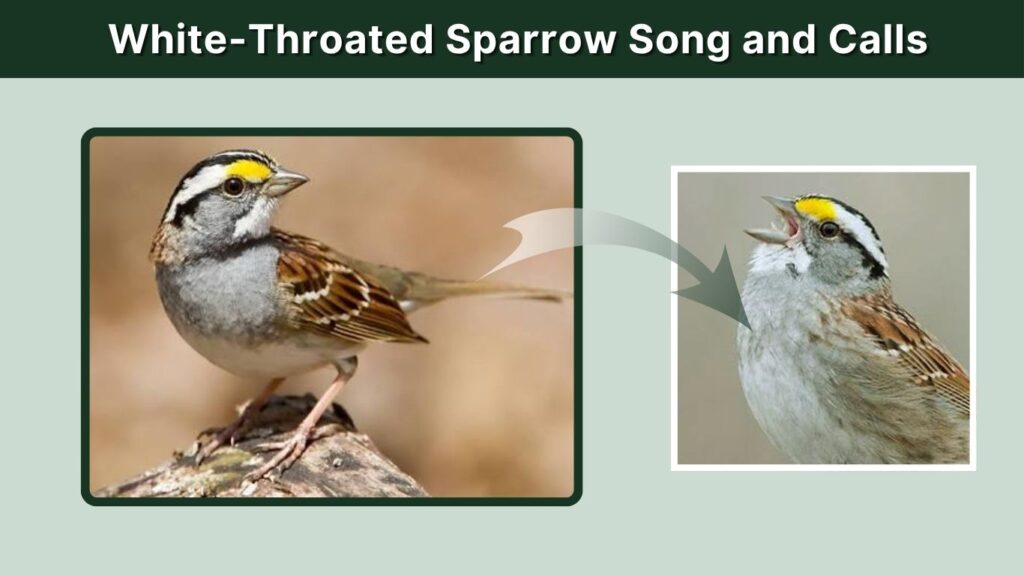
The clear song is one of the bird’s most recognizable characteristics. It is frequently heard in northern forests during summer, although individuals may also sing while migrating or on their wintering grounds.
What Does the Song Sound Like?
The song begins with several clear, thin whistles and continues with repeated notes. Birders commonly represent it with mnemonics such as “Old Sam Peabody, Peabody” or “Oh sweet Canada, Canada.”
The complete song lasts approximately four seconds. Its pitch may rise or fall slightly around the second or third note, creating a clear but somewhat melancholy sound.
Common Calls
The main White-throated Sparrow call is a sharp, explosive “chink.” Birds often use it when alarmed by a predator or disturbance near their nest. They also produce trills, aggressive two-part calls and a soft “seep” while communicating within feeding flocks.
White-Throated Sparrow Range, Habitat and Migration
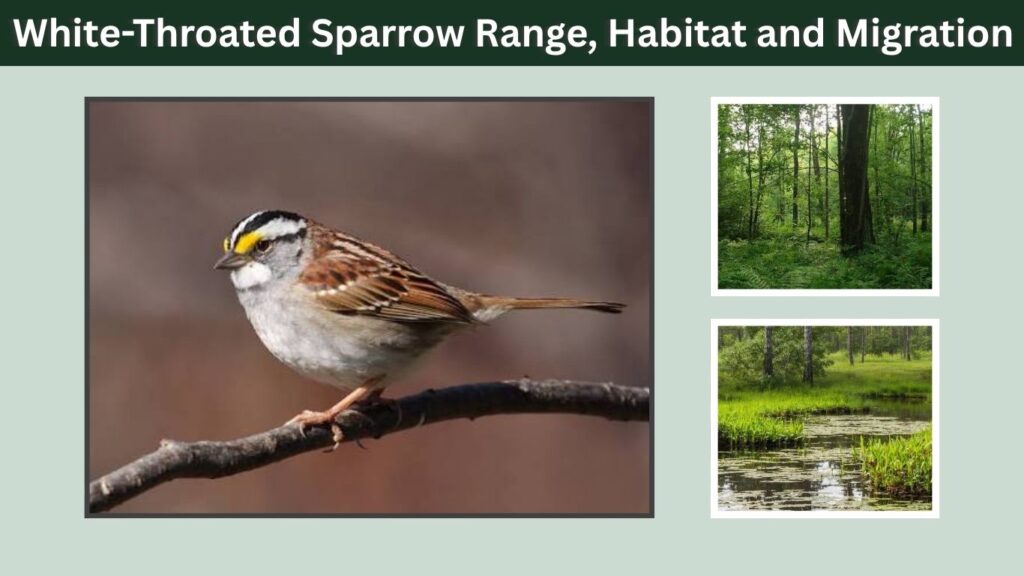
White-throated Sparrows breed primarily in forests across Canada, the northeastern United States and the northern Midwest. They favor coniferous, deciduous or mixed forests containing openings, thick shrubs and low vegetation.
Where Do White-Throated Sparrows Live?
Breeding habitats include:
- Northern forest clearings
- Pond and bog edges
- Regenerating logged or burned forests
- Dense woodland undergrowth
- Brushy areas near the treeline
During winter, they occupy forest edges, hedgerows, overgrown fields, thickets, parks, gardens and wooded suburban neighborhoods. They are especially common winter birds in eastern North America, although smaller numbers occur farther west.
Do White-Throated Sparrows Migrate?
Most populations migrate seasonally. They leave northern breeding areas during fall and spend winter farther south, especially across the eastern and southern United States. Their migration generally occurs at night, which can expose them to collisions with illuminated buildings and other tall structures.
White-Throated Sparrow Diet and Feeding Behavior
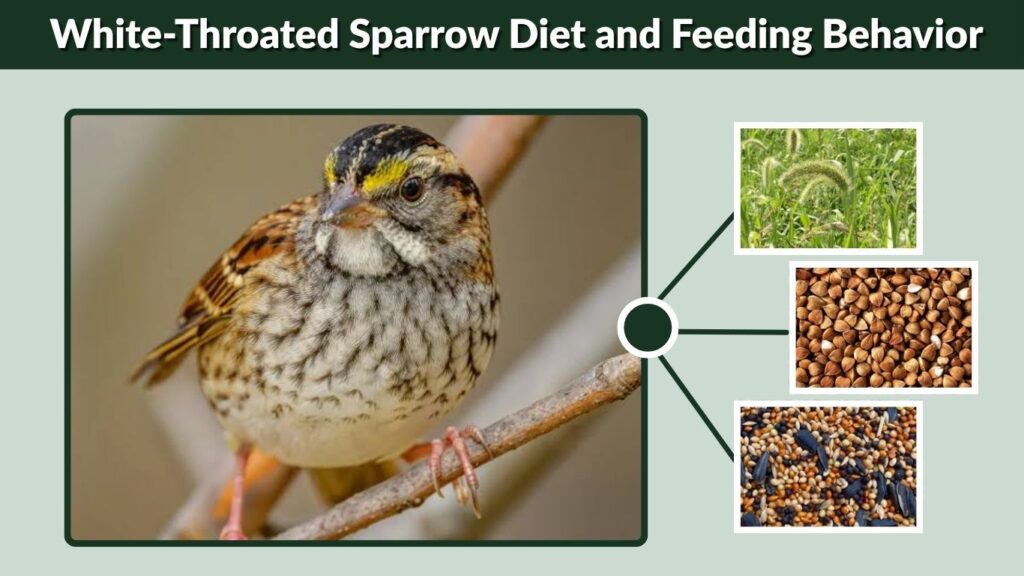
White-throated Sparrows feed mostly on the ground, hopping through leaf litter and scratching backward with both feet. They then jump forward to capture insects or collect seeds uncovered beneath the leaves.
What Do White-Throated Sparrows Eat?
Their diet includes:
- Grass and weed seeds
- Ragweed and buckwheat seeds
- Millet and sunflower seeds
- Grapes, blueberries and blackberries
- Sumac, dogwood and rose fruits
- Beetles, flies, wasps and caterpillars
- Spiders, snails, millipedes and centipedes
- Tree buds, blossoms and young seeds
Insects and other animal foods become particularly important during summer. Parents feed their nestlings almost entirely animal matter, providing the protein needed for rapid growth.
White-Throated Sparrow Nest, Eggs and Fledglings
The female chooses the nesting site and completes most of the nest construction. Nests are ordinarily hidden on or immediately above the ground beneath shrubs, grasses, ferns or old vegetation.
Nest Construction
The nest is an open cup made from moss, grasses, twigs, wood chips and pine needles. Fine grasses, rootlets and animal hair form the softer inner lining.
Although ground nesting is typical, replacement nests may be placed in brush piles, shrubs or low trees following the loss of an earlier attempt. Rare nests have been recorded as high as approximately 10 feet.
Eggs and Young
A clutch may contain one to six pale blue or greenish-blue eggs marked with purple, chestnut or lilac spots. Incubation lasts approximately 11–14 days, followed by a nestling period of about 7–12 days.
The chicks hatch nearly naked, with closed eyes and only sparse patches of down. Adults may produce one or two broods in a breeding season.
White-Throated Sparrow vs. Similar Birds
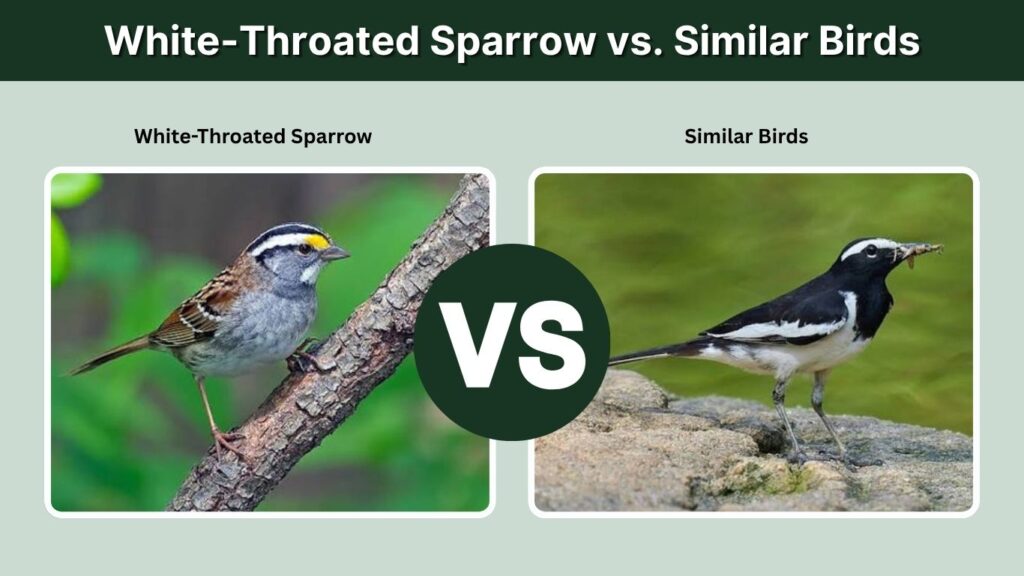
Several sparrows share brown plumage or striped crowns. The white throat and yellow lores are the most useful features for separating this species from its closest look-alikes.
White-Throated vs. White-Crowned Sparrow
A White-throated Sparrow has a sharply defined white throat and yellow spots between the eyes and bill. A White-crowned Sparrow lacks both features. Its black-and-white crown pattern is usually broader and more extensive, and its underparts appear cleaner and more uniformly gray.
White-Throated vs. Song Sparrow
Song Sparrows have strongly streaked breasts, often with the streaks forming a dark central spot. They lack the White-throated Sparrow’s yellow lores, contrasting white throat and bold crown stripes.
How to Attract White-Throated Sparrows
Place millet or black-oil sunflower seeds in a ground feeder, low platform or beneath a hanging feeder. Position the feeding area near shrubs so the birds can quickly retreat into cover.
Maintaining native grasses, leaf litter, brush piles and dense hedges will create additional feeding and sheltering opportunities. These sparrows often prefer searching below feeders rather than remaining on elevated feeding ports.
FAQs
Are White-throated Sparrows rare?
White-throated Sparrows are widespread and often common, particularly in eastern North America during winter. Their abundance varies by region and season, so they may seem rare outside their normal migration or winter range. They are currently classified as a species of low conservation concern.
What does a female White-throated Sparrow look like?
Females resemble males and can belong to either the white-striped or tan-striped morph. They have a white throat, yellow lores, brown wings and grayish underparts. Plumage cannot reliably determine sex, although singing and territorial behavior may provide useful clues during the breeding season.
Where do White-throated Sparrows nest?
They usually nest on or slightly above the ground beneath grasses, shrubs, ferns or fallen vegetation. The female conceals the cup-shaped nest carefully from above. Some pairs build replacement nests in shrubs, brush piles or low conifer branches after losing an earlier ground nest.
What is special about the White-throated Sparrow’s song?
Its thin, clear whistles form one of North America’s most recognizable bird songs. The tune is commonly remembered as “Old Sam Peabody” or “Oh sweet Canada.” Males of both morphs sing, white-striped females sometimes sing, and tan-striped females sing only very rarely.
What is the difference between white-striped and tan-striped birds?
White-striped birds have high-contrast black-and-white crowns, while tan-striped birds have softer brown-and-tan crowns. Both forms include males and females. Their behavioral tendencies also differ, and breeding pairs almost always contain one white-striped bird and one tan-striped bird.