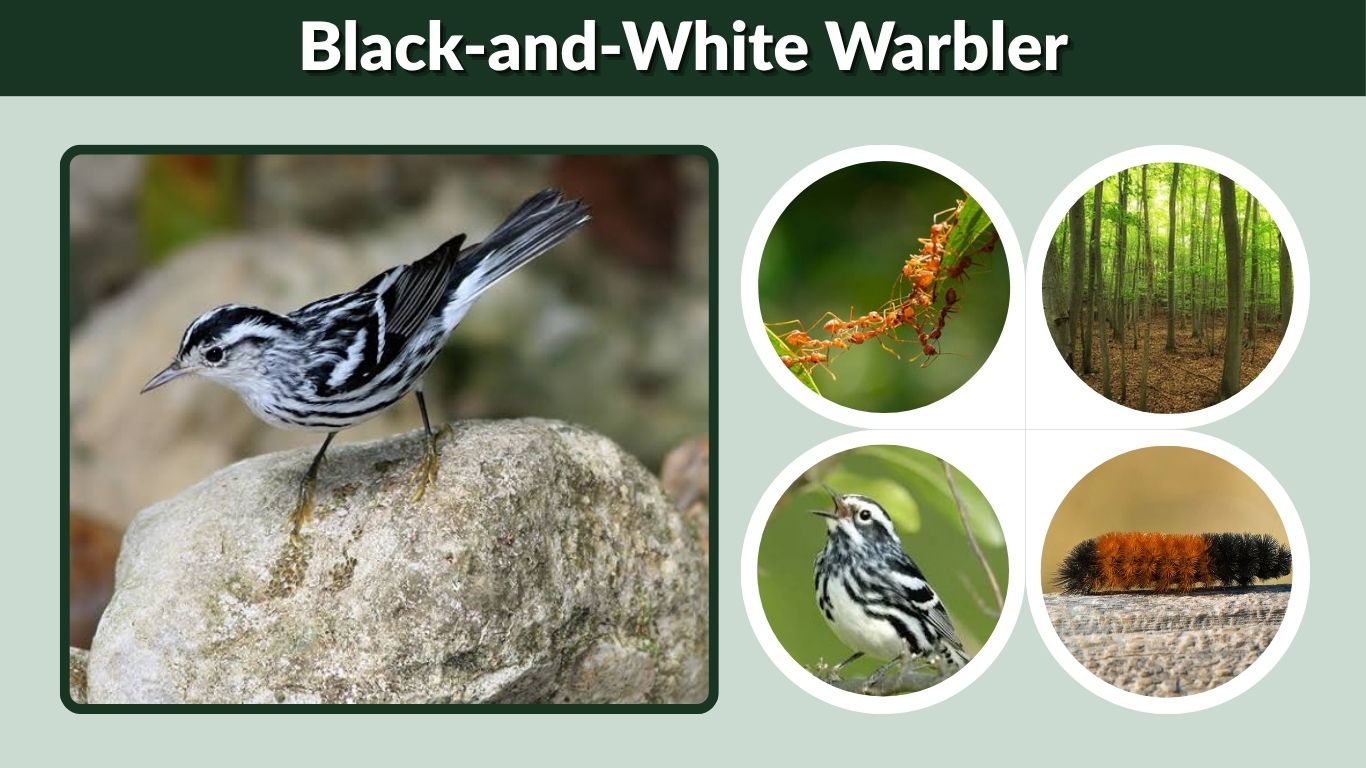
The Black-and-white Warbler is a small migratory songbird known for its bold striped plumage and unusual tree-climbing behavior. Rather than hopping through leaves like most warblers, it creeps along trunks and large branches while searching bark crevices for insects. Males and females have similar patterns, although males are more strongly marked. The species breeds across central and eastern North America and winters from Florida and the Caribbean to northern South America.
Black-and-White Warbler Quick Facts
The scientific name of the Black-and-white Warbler is Mniotilta varia. It is the only species placed in the genus Mniotilta, a name associated with its habit of picking insects from bark and moss.
| Feature | Information |
| Scientific name | Mniotilta varia |
| Family | Parulidae |
| Length | 4.3–5.1 inches |
| Weight | 0.3–0.5 ounces |
| Wingspan | 7.1–8.7 inches |
| Diet | Insects, spiders and larvae |
| Habitat | Deciduous and mixed forests |
| Nest location | Usually on the ground |
| Migration | Short- to long-distance migrant |
| Conservation status | Least Concern globally |
Black-and-white Warblers measure about 11–13 centimeters long and weigh approximately 8–15 grams. They are similar in size to Black-capped Chickadees but have longer wings, shorter tails and thinner, slightly curved bills.
What Does a Black-and-White Warbler Look Like?
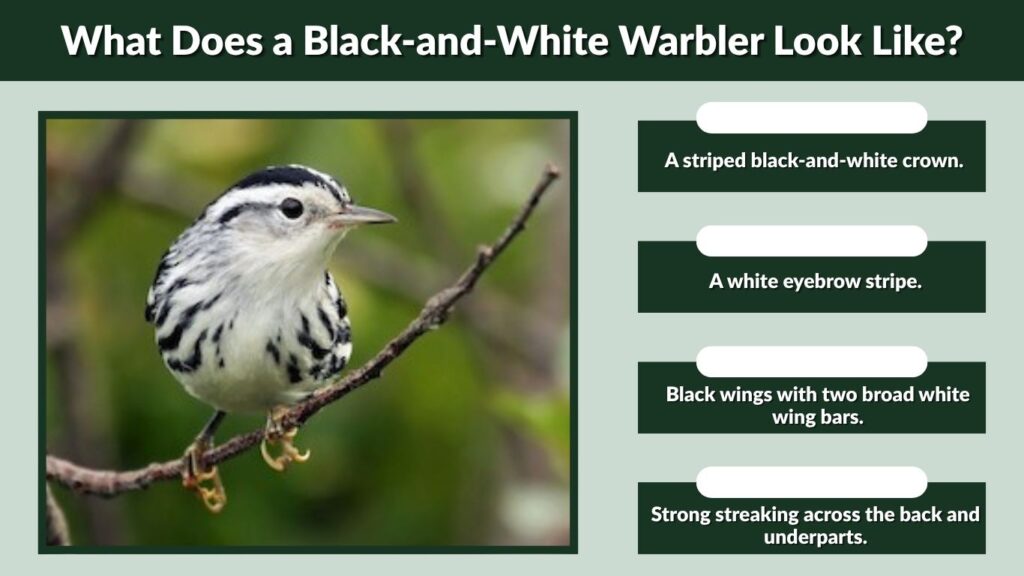
This warbler is covered with contrasting black-and-white stripes. Its pattern resembles the bark, shadows and patches of light found on tree trunks, helping it remain less noticeable while feeding.
Identification Features
Important characteristics include:
- A striped black-and-white crown
- A white eyebrow stripe
- Black wings with two broad white wing bars
- Strong streaking across the back and underparts
- A thin, slightly downcurved bill
- A short tail with white outer spots
- Large black spots beneath the tail
- Relatively strong legs and an elongated rear claw
The black-spotted undertail coverts are especially useful when identifying a bird seen from below. Its long hind claw and stronger-than-average warbler legs help it cling to bark while moving around trunks and branches.
Male Black-and-White Warbler
Adult males have the strongest contrast. They possess a dark cheek patch, black throat and heavier black streaking across the breast and sides. During spring, the male’s crisp pattern can make him appear almost completely black and white.
Female Black-and-White Warbler
Females have the same basic striped pattern but are usually paler. They generally show a white throat, a grayish cheek or ear patch and less black streaking underneath. Some females also have a light buff wash along the flanks.
Juvenile and Immature Birds
Juveniles resemble adult females, with softer markings, whiter throats and grayish facial patches. Their overall appearance becomes more strongly patterned as their feathers mature, but immature birds can remain difficult to distinguish from females.
Black-and-White Warbler Behavior
The bird’s feeding behavior is one of its best identification clues. It acts more like a nuthatch or creeper than a typical warbler.
It moves rapidly upward, downward and sideways across trunks and thick branches. It may also hang underneath a branch while inspecting loose bark. Brown Creepers usually move upward, while many nuthatches commonly travel headfirst downward; the Black-and-white Warbler moves freely in every direction.
Despite its small size, the species can be territorial and aggressive. Males chase intruders from breeding territories, and individuals may confront chickadees, nuthatches, American Redstarts and other warblers near important feeding areas.
Black-and-White Warbler Call and Song
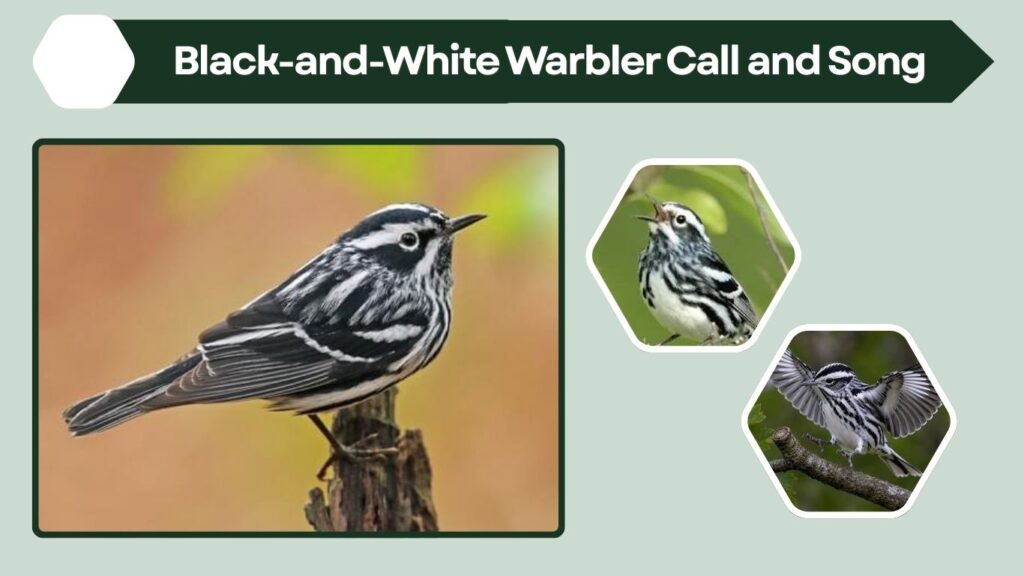
The male sings a high, thin and repetitive series of notes often written as “weesy, weesy, weesy.” The song lasts approximately three seconds and is frequently compared to the squeaking of a small wheel. On breeding territories, males may produce longer and more varied versions.
Both males and females also make sharp “chit” or “pit” calls. These calls help mates stay in contact, especially when one bird is away from the nest. The high pitch can make the song difficult for some people to hear, but its repeated rhythm is distinctive.
Black-and-White Warbler Habitat
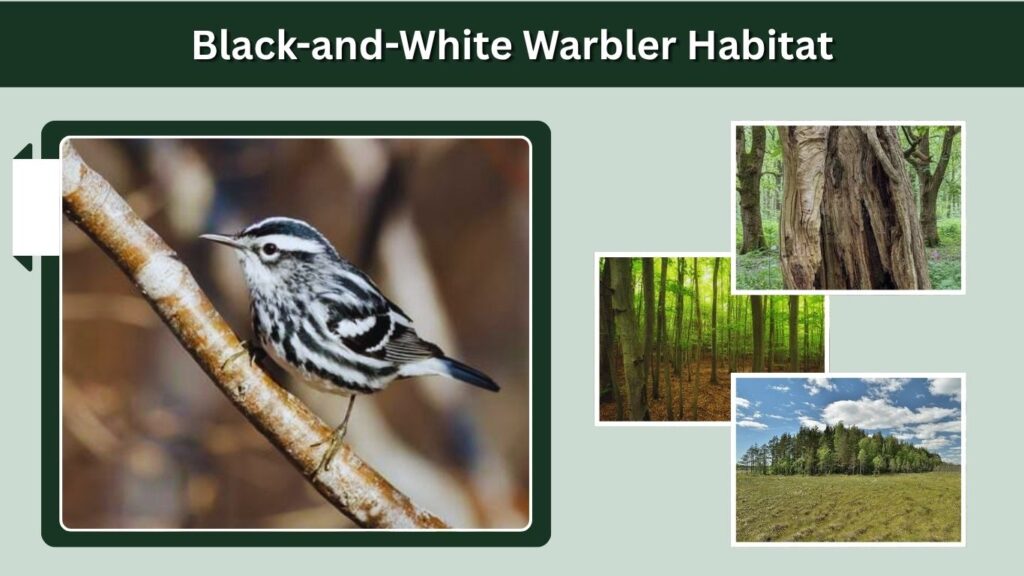
During summer, Black-and-white Warblers favor deciduous and mixed forests containing trees of different ages and sizes. A varied forest provides trunks, limbs, dead branches and bark surfaces where the birds can find insects.
Breeding Habitat
Breeding territories occur in mature or older woodland, often with a developed understory and fallen logs. The birds may use both dry upland forests and wetter wooded areas, depending on the region.
Although they spend most of their feeding time in trees, they place their nests on or close to the forest floor. This makes leaf litter, low plants, logs and protected ground cover important habitat features.
Migration and Winter Habitat
During migration, the species can appear in almost any wooded setting, including parks, gardens, forest edges, woodlots and streamside forests. On its tropical wintering grounds, it uses forests, mangroves, wetlands, orchards, shade-coffee plantations and some urban areas.
Black-and-White Warbler Range and Migration
The species breeds mainly across central and eastern North America, including broad portions of Canada and the eastern United States. In Canada, its breeding distribution extends from Alberta eastward to the Atlantic coast.
Black-and-white Warblers are short- to long-distance migrants. Some winter in Florida or Baja California, while others travel through Mexico, Central America and the Caribbean to northern South America. They are among the earliest Neotropical migrants to return north in spring.
Birdwatchers in states such as Florida may observe them during winter as well as migration. Farther north, including Illinois, Michigan and Pennsylvania, they are mainly spring and summer birds or temporary migrants.
What Do Black-and-White Warblers Eat?
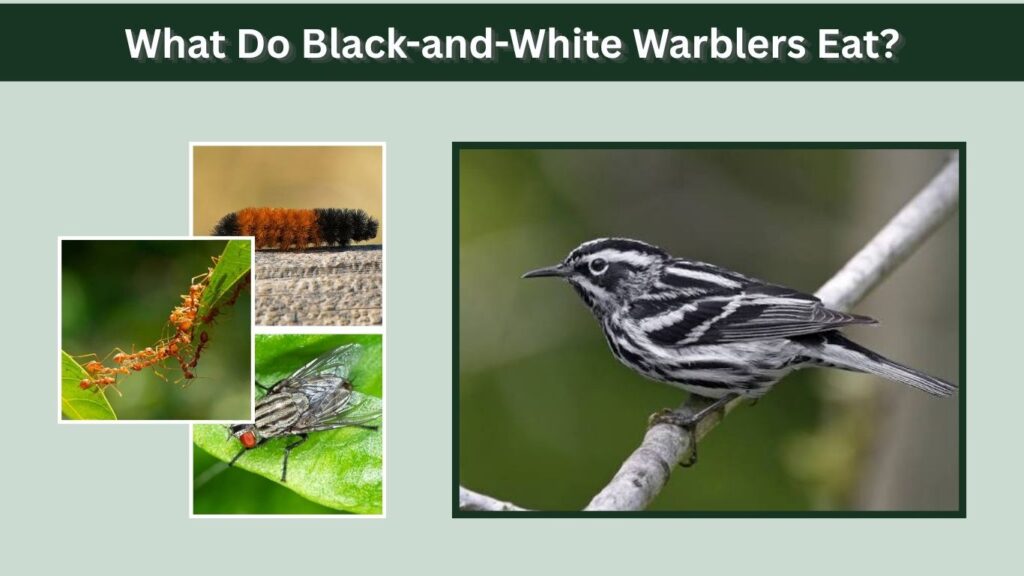
Black-and-white Warblers are primarily insect eaters. They probe cracks, loose bark, moss and dead branches with their slender bills.
Common Foods
Their diet includes:
- Moth and butterfly caterpillars
- Ants
- Flies
- Spiders
- Leaf beetles
- Click beetles
- Wood-boring insects
- Leafhoppers
- Weevils
Moth and butterfly larvae form an especially important part of their diet during spring migration and the breeding season. The birds may also eat insects attracted to sap flowing from Yellow-bellied Sapsucker feeding holes.
Black-and-White Warbler Nest, Eggs and Chicks
Despite spending much of the day on trees, the Black-and-white Warbler normally nests on the ground. The female selects a concealed position near the base of a tree, rock, stump, bush or fallen log. Occasionally, a nest is built in a stump cavity, rock crevice or mossy bank.
Nest Construction
The female builds an open cup using:
- Dry leaves
- Grass
- Bark strips
- Pine needles
- Moss
- Fine plant material
- Animal hair
The surrounding leaves and vegetation help conceal the nest from predators. The male may accompany the female while she examines possible locations, but she takes the leading role in construction.
Eggs and Young
A typical clutch contains four to six creamy-white or pale blue-green eggs marked with brown or lavender speckles. Incubation lasts approximately 10–12 days, and the young remain in the nest for another 8–12 days after hatching.
Black-and-White Warbler vs. Blackpoll Warbler
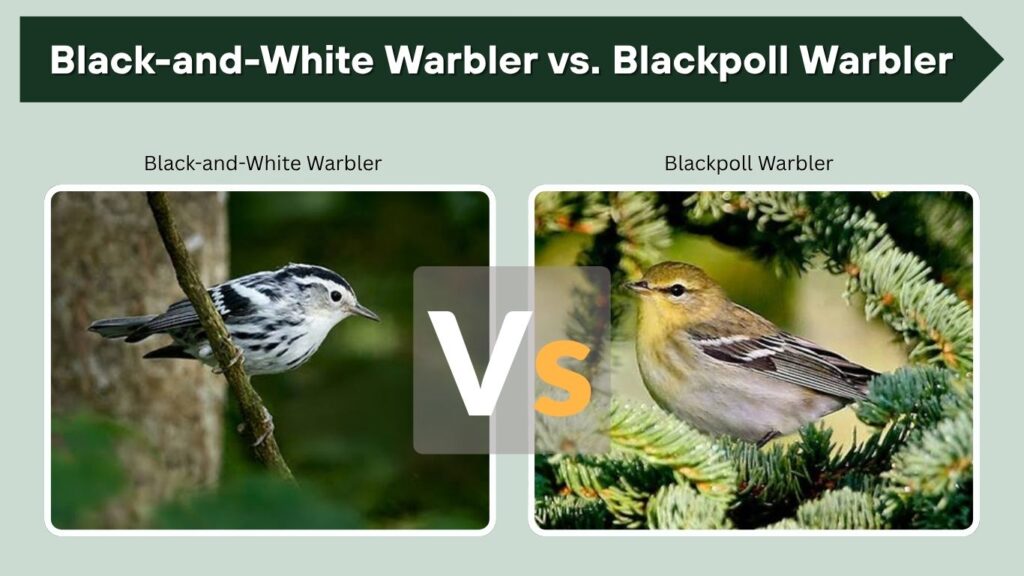
These species share black-and-white plumage, but their patterns and behavior are noticeably different.
| Feature | Black-and-White Warbler | Blackpoll Warbler |
| Crown | Striped | Solid black on breeding male |
| Cheeks | Black or grayish patch | Large white cheek on breeding male |
| Foraging style | Creeps along bark | Searches leaves and small branches |
| Bill | Slightly downcurved | Short, straight and pointed |
| Legs | Darker | Often orange-yellow |
| Overall pattern | Striped across most of body | Black cap with streaked sides |
The Black-and-white Warbler’s striped crown and bark-climbing behavior are the fastest ways to separate it from a breeding male Blackpoll Warbler.
Conservation
The Black-and-white Warbler remains widespread and is globally classified as Least Concern. However, some monitoring has recorded long-term declines, and the species can be affected by forest fragmentation, pesticide exposure and habitat loss on its wintering grounds. Nocturnal migrants are also vulnerable to collisions with illuminated buildings and communication towers.
FAQs
Is the Black-and-white Warbler rare?
It is not globally rare and remains widespread across its range. However, its abundance varies locally, and forest fragmentation has reduced suitable habitat in some regions.
What does a female Black-and-white Warbler look like?
The female has black-and-white stripes but is less heavily marked than the male. She usually has a white throat, grayish cheek patch and sometimes a light buff wash along her sides.
Where does the Black-and-white Warbler build its nest?
It normally builds a concealed cup-shaped nest on the ground near a tree, stump, rock, shrub or fallen log. Its nesting behavior differs from its mainly tree-based feeding habits.
Does the Black-and-white Warbler have yellow feathers?
A true Black-and-white Warbler does not normally have bright yellow plumage. A bird with a yellow throat or face may instead be a Yellow-throated, Blackburnian or Black-throated Green Warbler.
How long do Black-and-white Warblers live?
Many wild individuals have much shorter lives, but the oldest documented Black-and-white Warbler was a banded female that reached at least 11 years and 3 months.