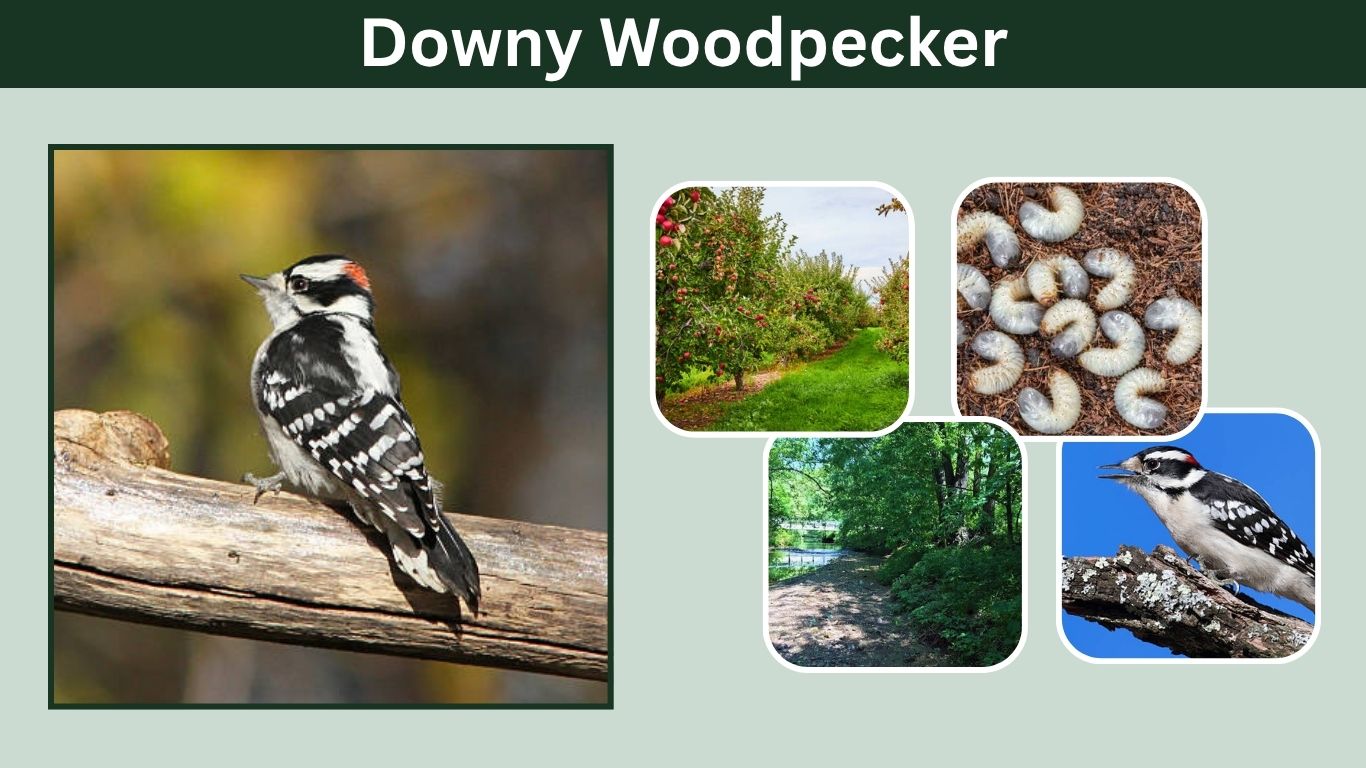
The Downy Woodpecker is a small, energetic bird commonly seen in forests, parks, orchards, and residential backyards across North America. Its bold black-and-white feathers, short bill, and acrobatic feeding behavior make it fairly easy to recognize once you know what to look for. However, its close resemblance to the larger Hairy Woodpecker often causes confusion. This guide covers the Downy Woodpecker’s appearance, size, male and female differences, sounds, habitat, diet, nesting habits, juveniles, and identification features.
Downy Woodpecker Overview
The Downy Woodpecker’s scientific name is Dryobates pubescens. It is considered the smallest woodpecker in North America and is one of the woodpeckers most frequently seen at backyard feeders.
| Feature | Description |
| Scientific name | Dryobates pubescens |
| Length | 5.5–6.7 inches |
| Wingspan | 9.8–11.8 inches |
| Weight | 0.7–1 ounce |
| Main colors | Black, white, and red on males |
| Diet | Insects, larvae, seeds, berries, and nuts |
| Habitat | Woodlands, parks, orchards, and suburbs |
| Migration | Usually a year-round resident |
Downy Woodpeckers are approximately 14–17 centimeters long and weigh only 21–28 grams. Their compact size allows them to search thin branches, weed stalks, and other places that larger woodpeckers cannot easily reach.
What Does a Downy Woodpecker Look Like?
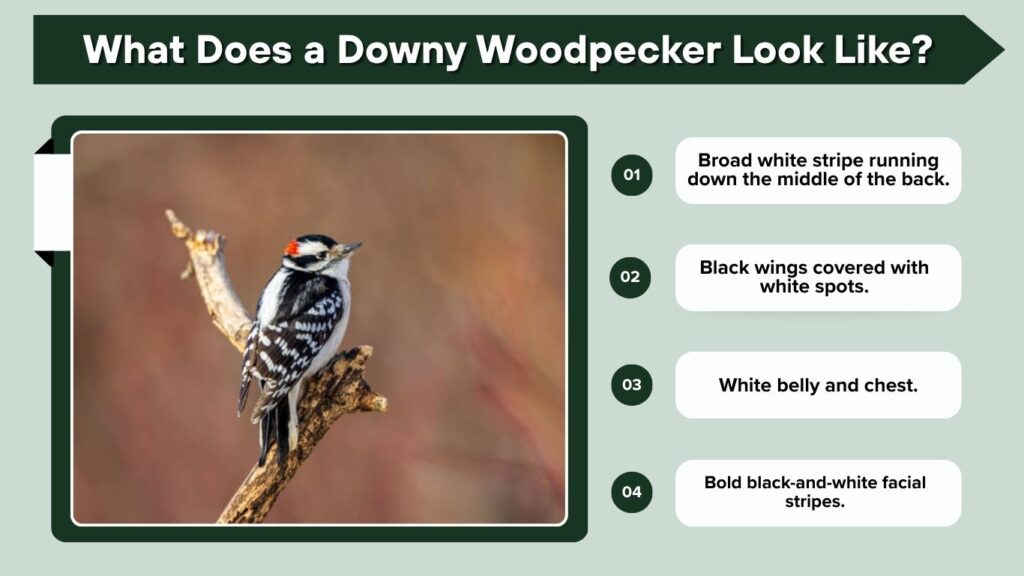
A Downy Woodpecker has the familiar upright posture of a woodpecker but appears noticeably small and delicate. It has a blocky head, broad shoulders, stiff tail feathers, and a short, straight bill.
Identification Features
Look for the following characteristics:
- Broad white stripe running down the middle of the back
- Black wings covered with white spots
- White belly and chest
- Bold black-and-white facial stripes
- Short, pointed, chisel-shaped bill
- White outer tail feathers marked with small black spots
- Small red patch on the back of an adult male’s head
The black markings on the white outer tail feathers are particularly useful when distinguishing a Downy Woodpecker from a Hairy Woodpecker.
Downy Woodpecker Size
Downy Woodpeckers are usually between the size of a sparrow and an American Robin. Their small body and short bill give them a compact appearance.
A Hairy Woodpecker is roughly one-third larger. When both species are seen together, the size difference is usually obvious. Without a direct comparison, however, bill length and tail markings are more dependable identification clues.
Downy Woodpecker in Flight
In flight, the Downy Woodpecker follows a rising-and-falling path. It produces several quick wingbeats and then briefly folds its wings, causing its body to dip before rising again.
The white central back stripe may be visible when the bird flies away. Flights are usually short as the bird moves between nearby trunks, branches, feeders, and shrubs.
Male vs. Female Downy Woodpecker
Male and female Downy Woodpeckers are almost identical in body size and feather pattern. The easiest way to distinguish them is by examining the back of the head.
Male Downy Woodpecker
An adult male has a small but noticeable red patch on the back of his head. The patch is located near the nape rather than across the entire crown.
The rest of the male’s plumage consists of black-and-white facial stripes, spotted wings, white underparts, and a white stripe down the back.
Female Downy Woodpecker
A female has the same black-and-white body pattern but does not have a red head patch. The back of her head is entirely black and white.
Males and females may also use slightly different feeding areas. Males commonly forage on thinner branches and weed stems, while females may spend more time on larger branches and tree trunks.
Juvenile Downy Woodpecker
A juvenile looks similar to an adult but may have softer, less clearly defined plumage. Young Downy Woodpeckers can display red feathers on the top or front of the crown.
This juvenile marking should not be confused with the adult male’s red patch, which is positioned at the back of the head. The crown color gradually disappears as the young bird develops adult plumage.
Downy vs. Hairy Woodpecker
The Downy and Hairy Woodpeckers share nearly identical black-and-white feather patterns. Size, bill length, tail markings, and calls provide the best ways to separate them.
| Feature | Downy Woodpecker | Hairy Woodpecker |
| Body size | Small, about 6 inches | Larger, about 9 inches |
| Bill | Short and delicate | Long and heavy |
| Bill proportion | About one-third of head length | Nearly as long as the head |
| Outer tail feathers | Usually have black spots | Usually appear plain white |
| Call | Softer, descending whinny | Sharper, stronger call |
| Feeding areas | Thin branches and weed stems | Larger trunks and branches |
The Downy Woodpecker’s short bill is often the most reliable clue. It looks much shorter than the width of the head, whereas the Hairy Woodpecker’s bill appears almost equal to its head length.
Downy Woodpecker Habitat and Range
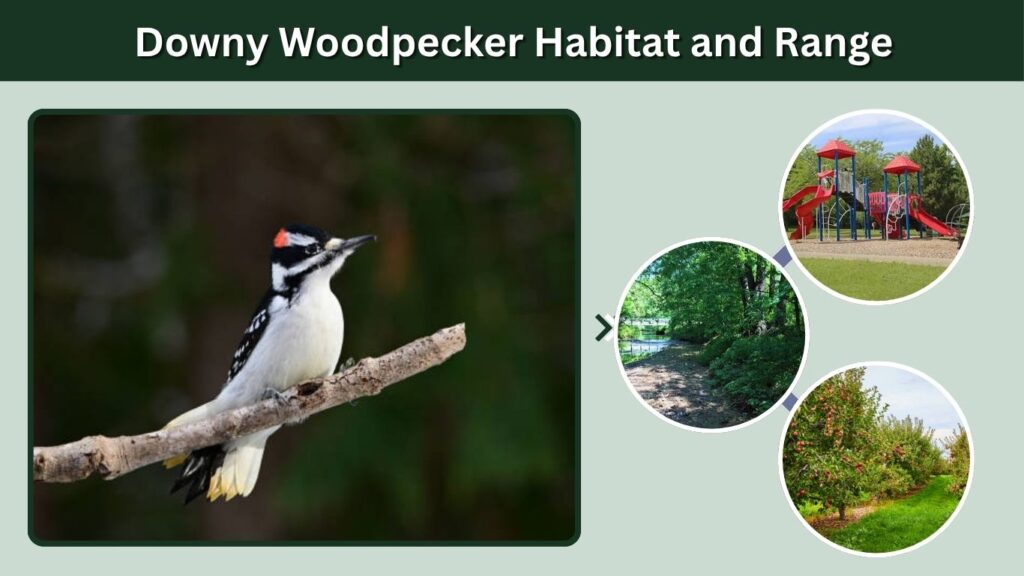
Downy Woodpeckers live throughout much of the United States and Canada. They are commonly found in open deciduous forests, woodland edges, streamside trees, parks, orchards, farms, and suburban neighborhoods.
Unlike species that depend on mature forests, Downy Woodpeckers can adapt to fragmented and human-modified environments. They often visit yards containing mature trees, shrubs, standing deadwood, and bird feeders.
Most populations do not complete long-distance seasonal migrations. Individual birds may move locally during winter in response to severe weather or changing food supplies.
What Do Downy Woodpeckers Eat?
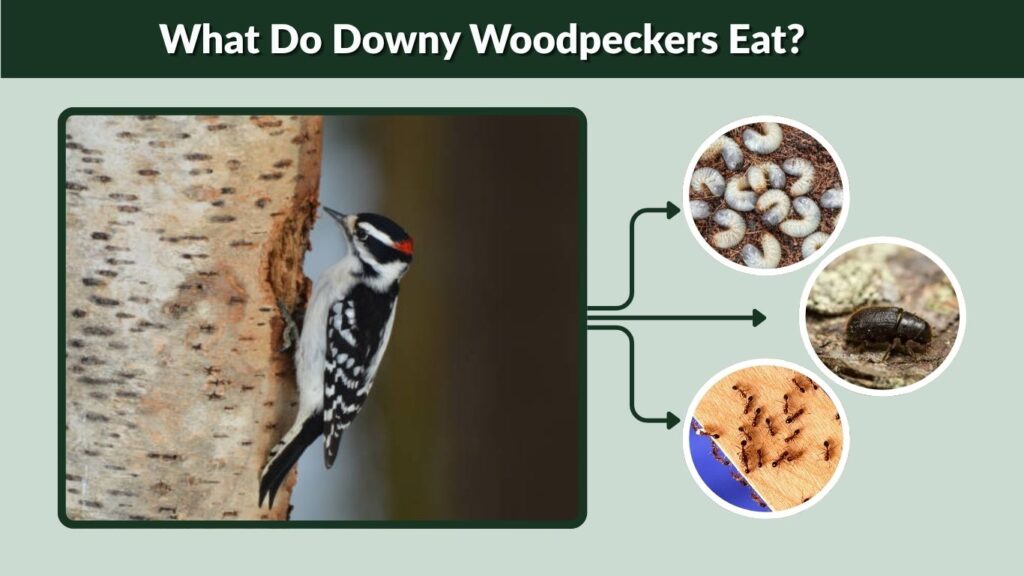
Downy Woodpeckers mainly eat insects, although they also consume plant material.
Natural Diet
Their diet includes:
- Beetle larvae
- Bark beetles
- Ants
- Caterpillars
- Spiders
- Wood-boring insects
- Insect eggs
- Berries
- Acorns
- Seeds and grains
The bird searches for cracks in bark, taps weakened wood, and hangs from narrow branches while looking for prey. It may also open plant galls to reach insects living inside them.
Approximately one-quarter of its diet can consist of plant material, including berries, grains, and acorns.
Attracting Downy Woodpeckers to Feeders
Downy Woodpeckers readily visit backyard feeding stations. Suitable foods include suet, black oil sunflower seeds, peanuts, and peanut pieces.
A cage-style suet feeder gives the bird a secure surface to cling to. Placing feeders near trees or shrubs provides protective cover and makes the area more attractive.
Downy Woodpecker Call and Sound
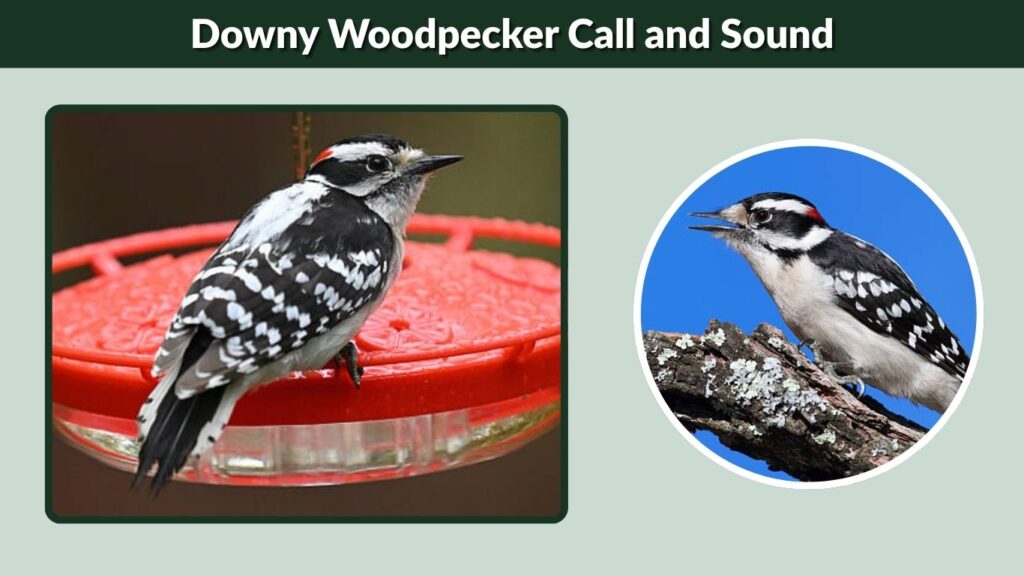
The most common Downy Woodpecker call is a short, high-pitched “pik” note. It may be repeated when the bird is communicating with a mate, reacting to danger, or moving through its territory.
Another recognizable sound is a rapid whinny consisting of several notes that descend in pitch toward the end. The similar Hairy Woodpecker produces a stronger whinny that generally remains on a more even pitch.
Downy Woodpeckers also drum on resonant trees, branches, utility poles, gutters, and other surfaces. Drumming is used for communication and territory advertisement rather than for feeding.
Downy Woodpecker Nesting
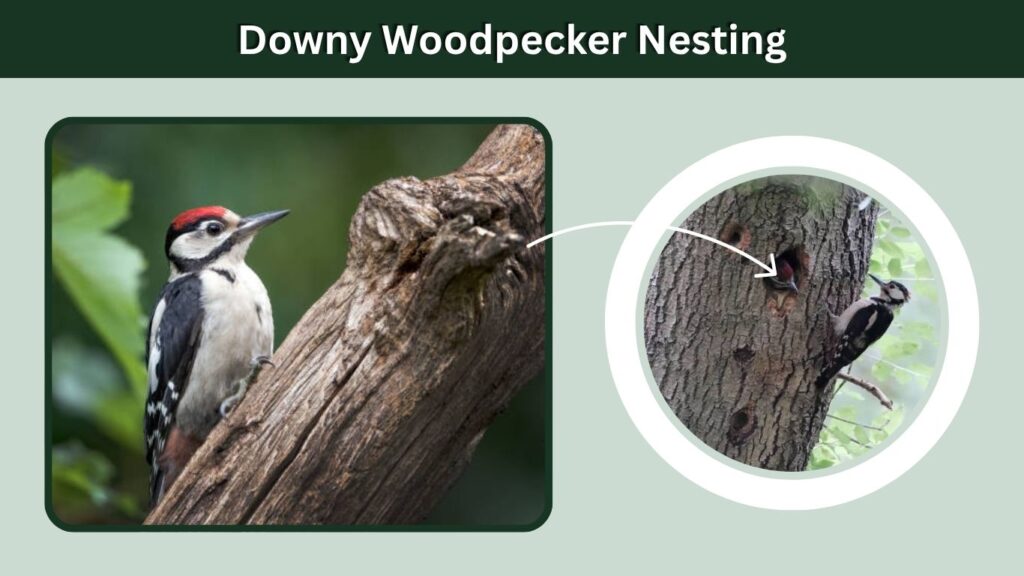
Downy Woodpeckers are cavity nesters. A pair usually excavates a fresh nesting hole in a dead tree, decaying branch, broken stump, or dead section of a living tree.
Nest and Eggs
The entrance is small and round, helping prevent larger birds from entering. Both adults participate in excavating the cavity, although the male may perform much of the work.
The female usually lays three to eight white eggs directly on wood chips inside the cavity. No grass, leaves, or feathers are added as nesting material.
Raising the Young
Both parents incubate the eggs and deliver insects to the nestlings. Young woodpeckers become noisy as they grow, especially when an adult approaches with food.
After leaving the cavity, juveniles may remain with their parents for several weeks while learning where and how to find food.
Downy Woodpecker Nest Box
Downy Woodpeckers may occasionally use a correctly sized nest box, especially where natural cavities are limited. A box should have a small entrance hole, an untreated interior, drainage openings, and enough depth to protect the nest.
Adding a layer of wood shavings may encourage excavation behavior. The box should be mounted securely near trees and away from busy areas.
FAQs
Are Downy Woodpeckers rare?
Downy Woodpeckers are not generally considered rare. They are widespread across much of North America and commonly inhabit forests, parks, farms, orchards, and suburban neighborhoods. Their willingness to visit suet and sunflower-seed feeders makes them one of the easiest woodpeckers to observe.
Do Downy Woodpeckers migrate?
Most Downy Woodpeckers remain within the same general region throughout the year. They are not regular long-distance migrants. However, some birds make short local movements during winter when harsh weather, snow cover, or limited food makes their usual territory less suitable.
Do Downy Woodpeckers mate for life?
Downy Woodpeckers may maintain pair bonds through more than one breeding season, particularly when both birds remain in the same territory. However, lifelong pairing is not guaranteed. A bird may select another partner when its previous mate disappears or fails to return.
Are Downy Woodpeckers harmful to trees?
Downy Woodpeckers rarely cause serious damage to healthy trees. They normally search bark, dead branches, and decaying wood for insects. Their activity may reveal that a tree already contains insect larvae or weakened wood rather than being the original cause of the damage.
What is the best food for a Downy Woodpecker?
Suet is one of the most effective foods for attracting Downy Woodpeckers, particularly during cold weather. They also eat black oil sunflower seeds, peanuts, and peanut pieces. Feeders placed near trees or shrubs give the birds nearby cover and comfortable landing areas.