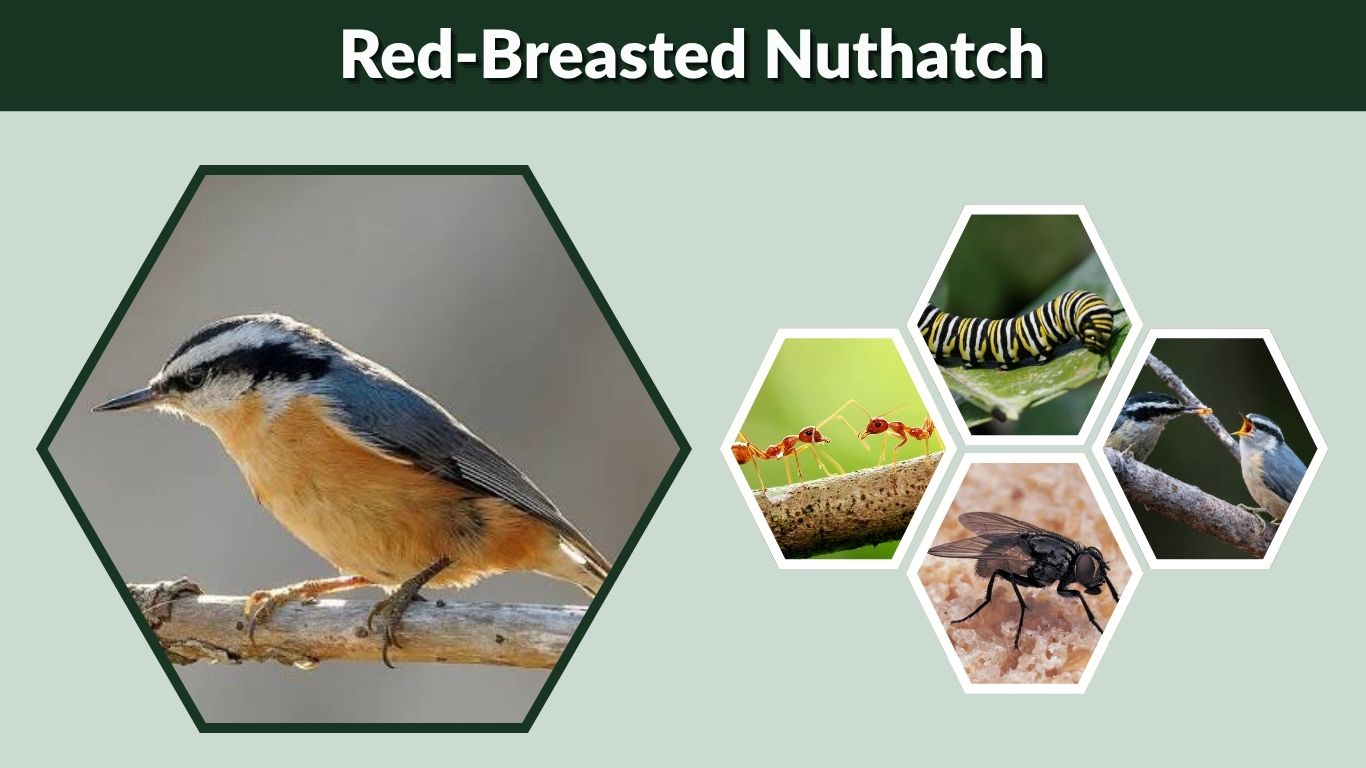
The Red-breasted Nuthatch (Sitta canadensis) is a small, energetic songbird recognized by its blue-gray back, rusty-orange underparts, black eye stripe, and white eyebrow. It is most strongly associated with spruce, fir, pine, and other coniferous forests across Canada and parts of the United States. This bird frequently climbs down tree trunks headfirst while searching bark for insects and seeds. During some winters, large numbers move south beyond their usual range and begin appearing at backyard feeders.
Red-Breasted Nuthatch Quick Facts
Red-breasted Nuthatches are compact birds with short tails, sturdy feet, and narrow bills. Despite their name, their underparts usually look rusty orange, cinnamon, or peach rather than bright red.
| Feature | Description |
| Scientific name | Sitta canadensis |
| Length | 4.3–4.7 inches |
| Wingspan | 6.7–8.3 inches |
| Weight | 0.3–0.5 ounces |
| Back | Blue-gray |
| Underparts | Rusty orange or buff |
| Main habitat | Coniferous and mixed forests |
| Diet | Insects, spiders, and seeds |
| Typical clutch | 5–6 eggs |
| Conservation status | Least Concern |
Audubon describes this species as sparrow-sized, generally measuring 11–12 centimeters long and weighing approximately 8–13 grams.
What Does a Red-Breasted Nuthatch Look Like?
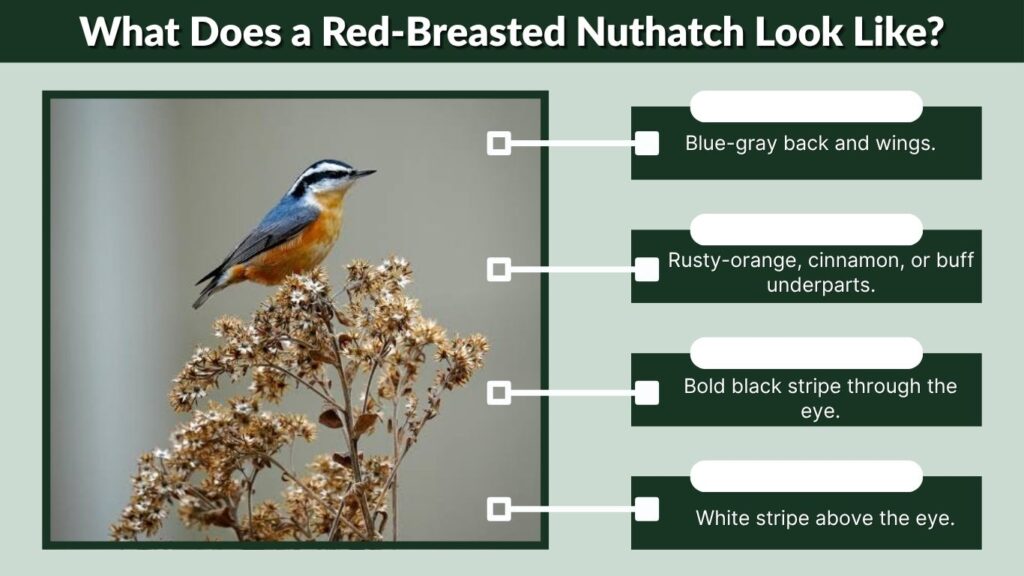
This nuthatch has a compact body, a short square-tipped tail, and a long, narrow bill. Its back and wings are blue-gray, while the throat and face are mostly white. A dark stripe passes through each eye, with a noticeable white eyebrow above it.
Identification Features
- Blue-gray back and wings
- Rusty-orange, cinnamon, or buff underparts
- Bold black stripe through the eye
- White stripe above the eye
- White cheeks and throat
- Short neck and compact body
- Thin, pointed bill
- Short, rounded tail
- Strong feet adapted for climbing
- Frequent headfirst movement down tree trunks
It is the only North American nuthatch with both a broad dark eye stripe and a strong white eyebrow. The white-and-black face pattern, warm breast, and blue-gray back make the species distinctive at close range.
Male vs. Female Red-Breasted Nuthatch
Male and female Red-breasted Nuthatches look similar, but their head and breast colors differ slightly. These differences can be subtle, especially under poor lighting.
| Feature | Male | Female |
| Crown | Deep black | Bluish gray or dark gray |
| Eye stripe | Bold black | Usually softer or grayer |
| Underparts | Rich rusty orange | Paler buff or light orange |
| Size | Similar to female | Similar to male |
| Behavior | Sings and performs courtship displays | Incubates the eggs |
Female Red-Breasted Nuthatch
The female usually has a grayish or bluish-black crown rather than the male’s deep black cap. Her underparts are typically paler and less richly colored. However, individual variation, worn feathers, lighting, and viewing distance may make sex identification difficult.
Juvenile Red-Breasted Nuthatch
Juveniles resemble adults but have duller head markings and paler, less clearly defined underparts. A fledgling may also have a shorter-looking bill, softer feathers, and a less confident climbing style. Its colors become stronger as it molts into adult plumage.
Red-Breasted Nuthatch Call and Song
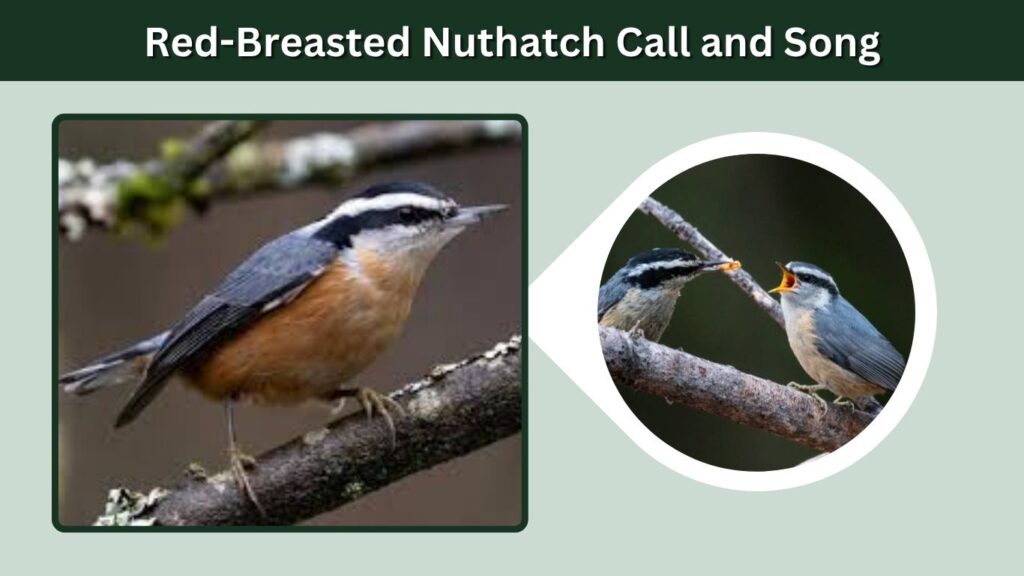
The best-known call is a high, nasal “yank-yank” or “ank-ank.” It sounds thinner, higher, and more horn-like than the call of the White-breasted Nuthatch. The notes may be repeated slowly or delivered as a faster series.
Males also produce a soft, musical courtship song. During courtship, a male may face away from the female, raise his head, lower his wings, sway from side to side, and offer her food.
Where Do Red-Breasted Nuthatches Live?
Red-breasted Nuthatches are closely associated with mature coniferous and mixed forests. Spruce, fir, hemlock, pine, and cedar provide seeds, insects, nesting cavities, and protective cover.
Range and Habitat
Their breeding range extends across much of Canada, Alaska, the northern United States, the Appalachian Mountains, and western mountain regions. During migration and winter, individuals may appear farther south in deciduous woods, parks, gardens, and suburban neighborhoods, though they still favor conifers when available.
Suitable breeding habitat generally includes older trees and decaying wood. Dead trees, broken trunks, and soft rotten branches provide places where pairs can excavate nesting cavities.
Do Red-Breasted Nuthatches Migrate?
Some populations remain near their breeding territories throughout winter, while others move south. Their migrations are irregular and strongly influenced by the availability of conifer seeds.
What Is an Irruption?
An irruption is a large, unpredictable movement of birds beyond their normal winter range. When spruce, fir, or pine cone crops are poor in northern forests, Red-breasted Nuthatches may travel hundreds of miles south in search of food.
During an irruption year, they can suddenly appear at feeders and in locations where they are uncommon during an average winter. When northern seed crops are abundant, many birds remain closer to their nesting areas.
What Do Red-Breasted Nuthatches Eat?
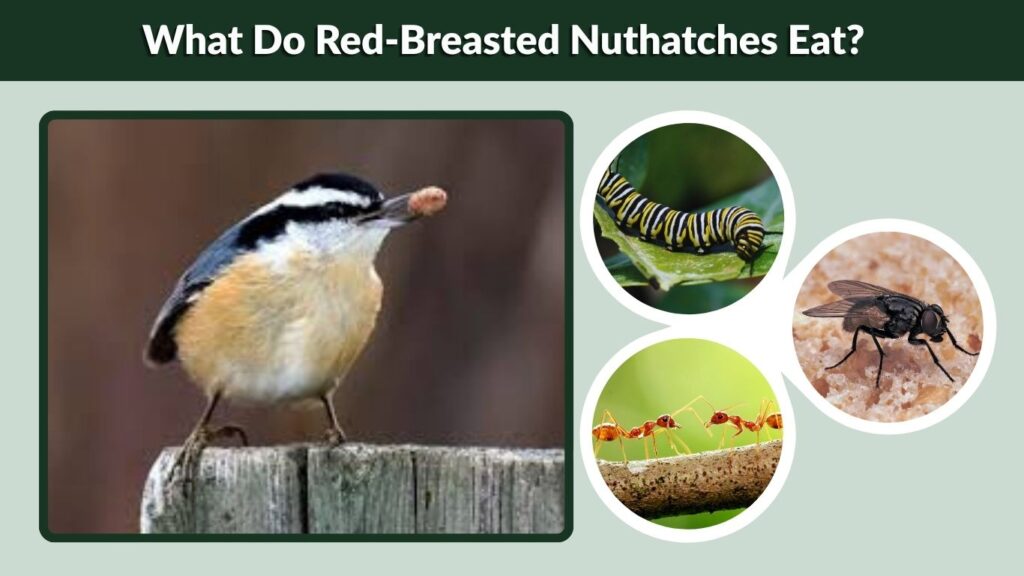
Their diet changes with the seasons. During spring and summer, they eat mainly insects and spiders. In autumn and winter, conifer seeds become increasingly important.
Natural Foods
Common foods include beetles, caterpillars, ants, flies, insect eggs, spiders, pine seeds, spruce seeds, fir seeds, and other plant material. Parents feed their chicks mostly insects and spiders because these foods provide protein needed for growth.
Red-breasted Nuthatches search trunks and branches by moving upward, downward, and sideways. They probe bark crevices, inspect cones, and occasionally catch flying insects in midair. They also store seeds and other food in cracks for later use.
Why Do Red-Breasted Nuthatches Hang Upside Down?
Their powerful feet and curved claws allow them to grip bark while facing downward or moving beneath branches. Unlike woodpeckers, which usually brace themselves with stiff tails, nuthatches rely mainly on their legs and feet.
Moving headfirst provides a different view of the bark. It may allow them to find insects and seeds hidden in crevices that birds moving upward could overlook. Their ability to travel in almost any direction helps them search a tree efficiently.
Red-Breasted vs. White-Breasted Nuthatch
These species share similar climbing behavior, but their size, coloring, habitat, and voices differ.
| Feature | Red-Breasted Nuthatch | White-Breasted Nuthatch |
| Size | Smaller | Larger |
| Breast | Rusty orange or buff | Mostly white |
| Eye stripe | Bold dark stripe | Usually absent |
| Eyebrow | Clear white stripe | No strong white eyebrow |
| Habitat | Mainly coniferous forests | Mainly mature deciduous woods |
| Call | Thin, high nasal yank | Louder, lower nasal yank |
A White-breasted Nuthatch has a mostly white face and underparts, a larger body, and a longer, heavier bill. Its typical call sounds deeper and stronger than the Red-breasted Nuthatch’s thin, toy-horn-like note.
Red-Breasted Nuthatch vs. Black-Capped Chickadee
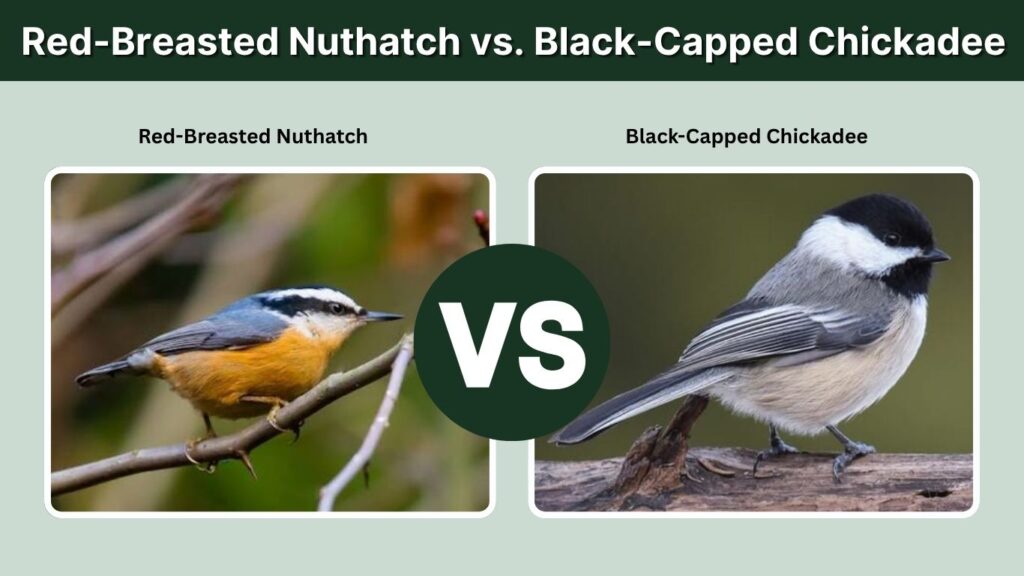
Both birds are small, active, and common around conifers and feeders. However, the Black-capped Chickadee has a black throat patch, rounder head, shorter bill, and mostly white or pale-gray underparts.
The Red-breasted Nuthatch has a black eye stripe, white eyebrow, rusty breast, and more elongated shape. It also climbs headfirst down trunks much more frequently than a chickadee.
Nest and Eggs
Red-breasted Nuthatches are cavity nesters. Both sexes help excavate a hole in a rotten tree, stump, or dead branch. They sometimes use an old woodpecker cavity or a suitable nest box, although naturally excavated sites are more typical.
Resin Around the Nest Entrance
One of their most unusual nesting behaviors is placing sticky conifer resin around the cavity entrance. The pitch may discourage predators, insects, or competing birds. The adults avoid touching it by flying directly through the center of the entrance.
The female generally lays four to seven white eggs marked with reddish-brown spots, with five or six being typical. She incubates them for about 12 days while the male brings food. Both parents feed the nestlings, which normally leave the cavity two to three weeks after hatching.
How to Attract Red-Breasted Nuthatches
A yard containing conifers is most likely to attract these birds. Mature spruce, fir, pine, or hemlock trees provide natural seeds, insects, shelter, and potential nesting areas.
They may visit feeders for:
- Sunflower seeds
- Peanuts
- Suet
- Peanut butter mixtures
- Large seeds and nut pieces
Place feeders near trees so the birds have nearby cover. Leaving safe dead branches or snags can also provide feeding and nesting opportunities. Red-breasted Nuthatches may carry food away and hide it in bark rather than eating everything at the feeder.
FAQs
Are Red-breasted Nuthatches rare?
They are common in suitable northern and mountain conifer forests but may seem rare outside those areas. Their abundance farther south changes considerably from one winter to another because of irregular migrations.
Do Red-breasted Nuthatches stay all winter?
Some remain year-round where conifer seeds are plentiful. Others travel south or move to lower elevations when northern food supplies decline.
What does a Red-breasted Nuthatch sound like?
Its usual call is a thin, nasal “yank-yank,” often compared to a tiny toy horn. It is higher and softer than the White-breasted Nuthatch’s call.
Will Red-breasted Nuthatches use a birdhouse?
They occasionally use nest boxes, especially when suitable natural cavities are limited. A box should be placed near conifers and protected from excessive heat, predators, and disturbance.
What is the scientific name of the Red-breasted Nuthatch?
Its scientific name is Sitta canadensis. It belongs to the nuthatch family, Sittidae, within the order Passeriformes.