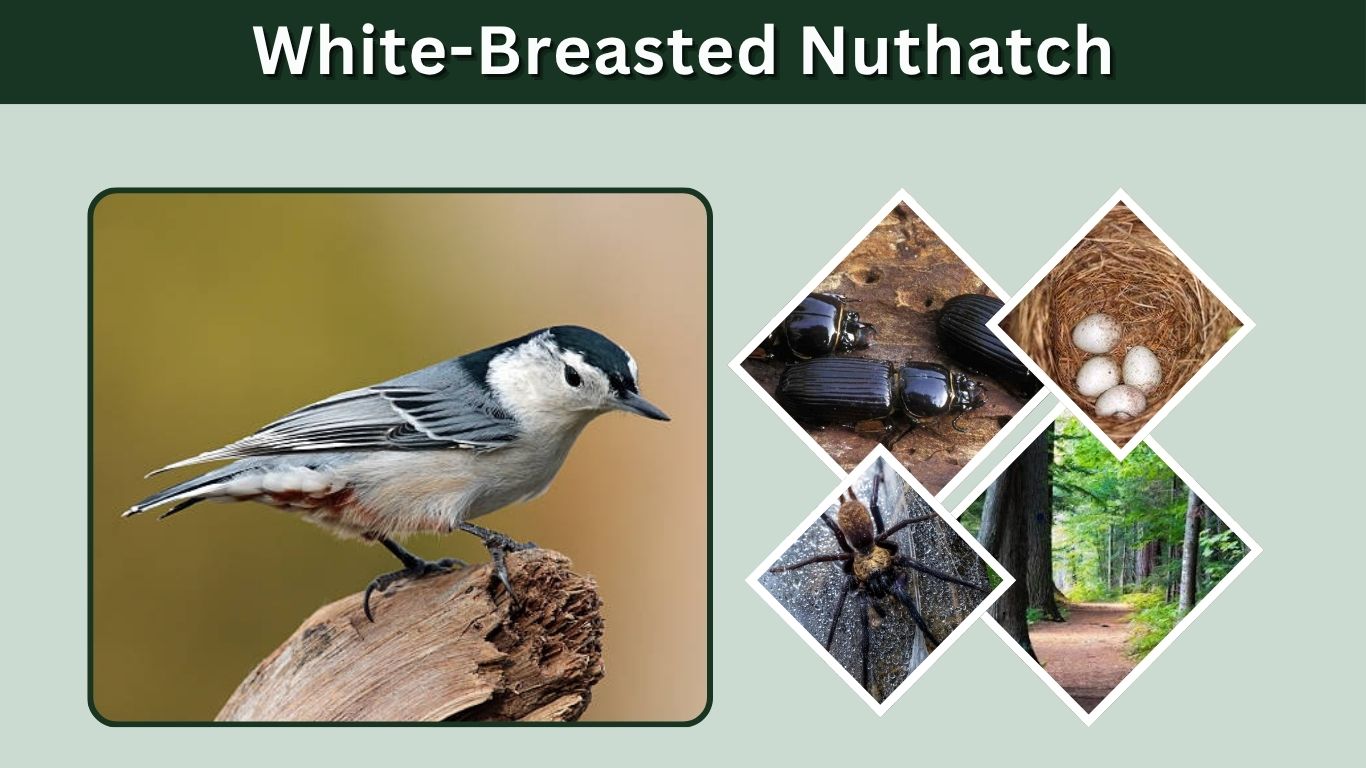
The white-breasted nuthatch is a compact woodland bird known for its white face, blue-gray back, and unusual ability to climb headfirst down tree trunks. Common across much of North America, it can be found in mature forests, parks, wooded neighborhoods, and backyard feeding areas. Its nasal call, strong feet, and habit of storing food make it easy to recognize once you know what to look for. This guide covers white-breasted nuthatch identification, size, habitat, diet, calls, nesting behavior, eggs, male and female differences, migration, lifespan, and other useful facts.
White-Breasted Nuthatch Identification
The white-breasted nuthatch has the scientific name Sitta carolinensis. It is the largest commonly seen nuthatch in North America, although it is still much smaller than a robin.
Key Identification Features
- Blue-gray back and wings
- Clean white face, throat, and breast
- Black or dark gray cap
- Long, pointed, slightly upturned bill
- Short tail
- Rusty or chestnut coloring beneath the tail
- Strong legs and feet adapted for gripping bark
- Habit of moving headfirst down tree trunks
Its body shape is compact and slightly rounded. The bird often appears almost horizontal as it searches tree bark for insects.
Unlike woodpeckers, which usually use their stiff tails as support, nuthatches rely mainly on their strong feet and claws. This allows them to move in nearly any direction across tree trunks and branches.
White-Breasted Nuthatch Size
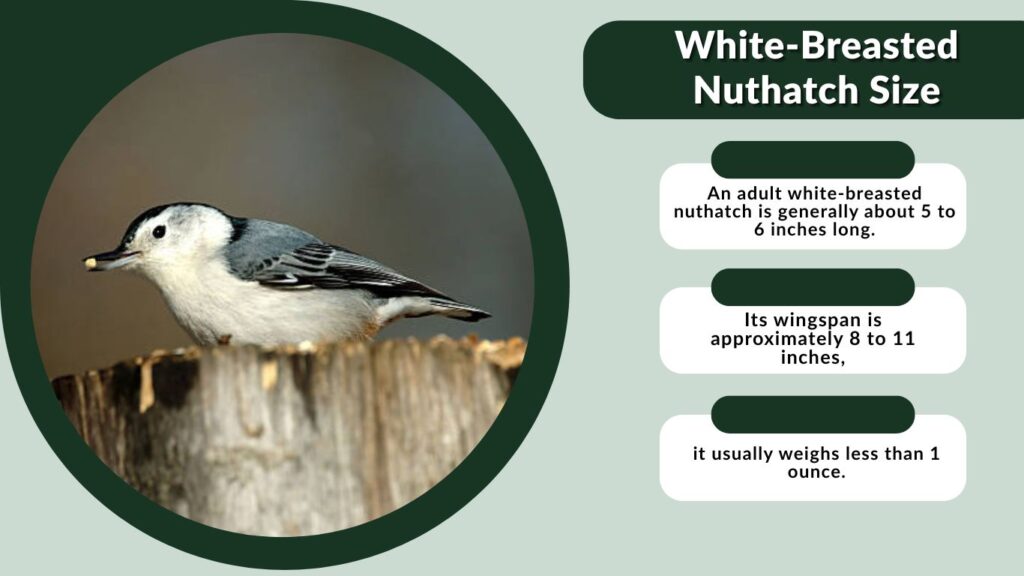
An adult white-breasted nuthatch is generally about 5 to 6 inches long. Its wingspan is approximately 8 to 11 inches, and it usually weighs less than 1 ounce.
The bird has a relatively large head, short neck, and narrow tail. Its long bill gives it a pointed facial profile. Although small, it can look sturdy and energetic while climbing trees or chasing other birds away from food.
Male vs. Female White-Breasted Nuthatch
Male and female white-breasted nuthatches look very similar, making them difficult to distinguish at a distance.
Male White-Breasted Nuthatch
Males usually have a glossy black cap extending from the forehead to the upper back. Their back is blue-gray, while the face, throat, and underparts are mostly white.
The rusty coloring near the lower belly and undertail may also appear slightly stronger in some males.
Female White-Breasted Nuthatch
Females generally have the same overall markings but often show a duller gray or dark gray cap instead of the male’s deep black cap.
However, females in some regions can have fairly dark caps. Lighting, age, and geographic variation can therefore make identification by sex difficult.
| Feature | Male | Female |
| Crown color | Usually glossy black | Usually gray or dull black |
| Back | Blue-gray | Blue-gray |
| Underparts | White | White |
| Size | Similar | Similar |
| Field identification | Darker head | Slightly paler head |
Juvenile and Fledgling Appearance
A juvenile white-breasted nuthatch resembles an adult but usually looks softer and less sharply marked. Its plumage may appear duller, and the cap may be grayish rather than deep black.
Young birds have shorter bills and may show pale edges around the mouth. After leaving the nest, fledglings often follow their parents through trees while giving begging calls.
Parents continue feeding fledglings for a period after they leave the nest. Young birds gradually learn to search bark, branches, and leaves for food.
White-Breasted Nuthatch Habitat and Range
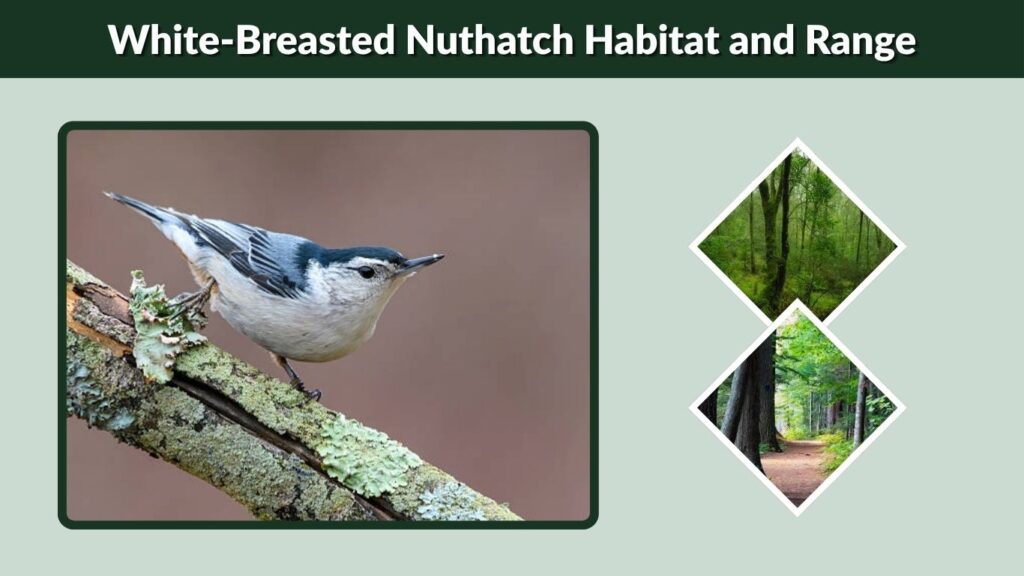
White-breasted nuthatches live across much of the United States, southern Canada, and parts of Mexico. They are common in both eastern and western regions, although local appearance and vocalizations may vary.
Their preferred habitats include:
- Mature deciduous forests
- Mixed woodlands
- Oak and maple forests
- Pine-oak forests
- Parks and cemeteries
- Orchards
- Suburban neighborhoods
- Large gardens with mature trees
These birds depend on trees for nesting, feeding, shelter, and food storage. They are especially common where large trees have rough bark, cavities, or dead branches.
What Do White-Breasted Nuthatches Eat?
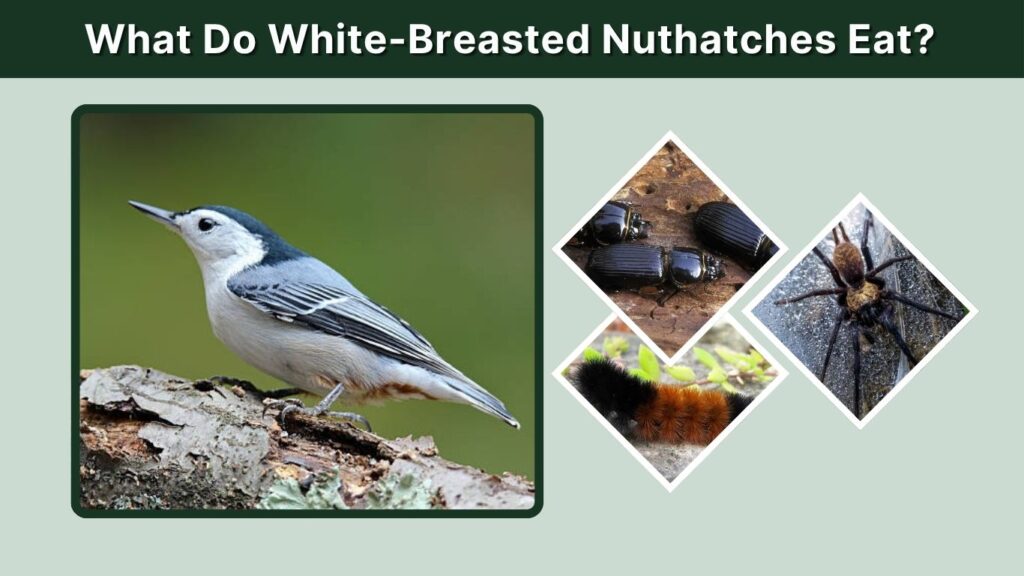
White-breasted nuthatches eat both insects and plant-based foods. Their diet changes with the seasons and available food.
Natural Diet
During spring and summer, they consume insects and other small invertebrates, including:
- Beetles
- Caterpillars
- Ants
- Spiders
- Weevils
- Stink bugs
- Scale insects
- Insect eggs and larvae
In autumn and winter, they rely more heavily on seeds and nuts. Common foods include acorns, sunflower seeds, peanuts, pine seeds, and other tree seeds.
The bird often wedges a seed into a crack in the bark and hammers it open with its bill. This behavior is connected to its name. “Nuthatch” refers to the bird’s habit of hacking or opening nuts.
Backyard Food
White-breasted nuthatches commonly visit bird feeders. They are especially attracted to:
- Black oil sunflower seeds
- Peanuts
- Suet
- Mealworms
- Sunflower hearts
- Mixed nuts
Platform feeders, tube feeders, and suet cages can all attract them. Placing feeders close to mature trees gives the birds quick access to cover.
Food-Storing Behavior
White-breasted nuthatches frequently store food for later. They hide seeds, nuts, and insects in bark cracks, tree crevices, or beneath loose pieces of bark.
A bird may carry a seed away from a feeder and place it in a hidden location. This behavior, known as caching, helps it survive periods when natural food is scarce.
Some stored food may be covered with bark, moss, dirt, or plant material. The bird can return later and recover many of its hidden items.
White-Breasted Nuthatch Call and Sound
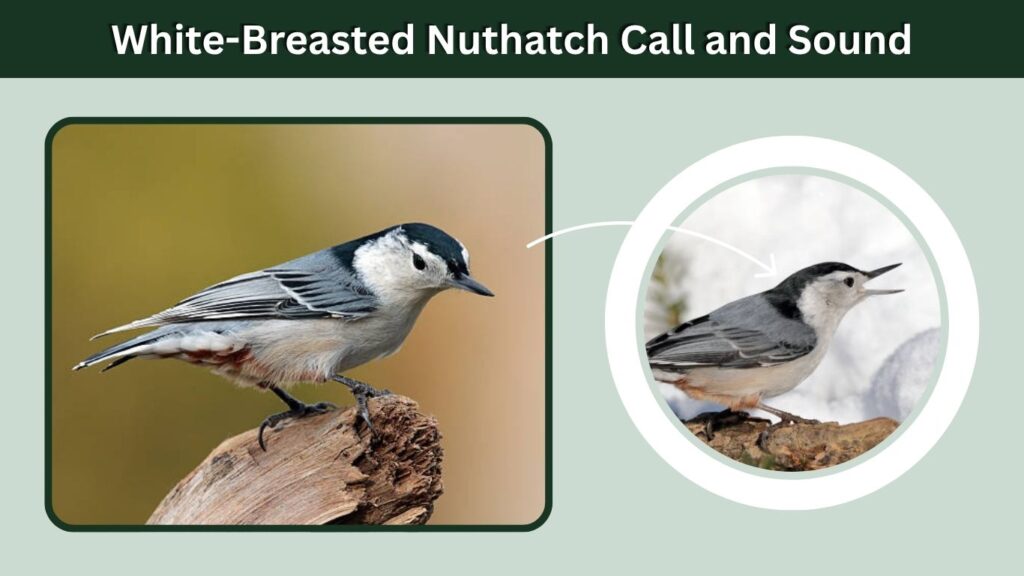
The most familiar white-breasted nuthatch call is a loud, nasal sound often described as “yank-yank” or “honk-honk.”
This call is repeated several times and can be heard as the bird moves through trees. It may sound similar to a tiny toy horn.
The bird also produces:
- Soft contact calls
- Rapid alarm notes
- Whining sounds
- Short whistles
- Repeated nasal songs
Males sing most often during the breeding season. Their song is usually a repeated series of nasal notes used to attract a mate and defend territory.
Different populations may produce slightly different calls. Western birds can sound somewhat different from eastern birds.
Why Do Nuthatches Walk Upside Down?
White-breasted nuthatches are famous for moving headfirst down tree trunks. They can also hang upside down from branches while searching for insects.
Their strong feet, sharp claws, and flexible legs allow them to grip bark securely. By moving downward, they can discover insects hidden in bark crevices that birds climbing upward may miss.
This feeding method reduces competition with woodpeckers and brown creepers. Each bird explores the same tree from a different direction.
White-Breasted Nuthatch Nesting Habits
White-breasted nuthatches are cavity nesters. They usually nest in natural holes in trees or abandoned woodpecker cavities.
They do not normally excavate a complete cavity in hard, healthy wood. However, they may enlarge an existing opening or remove loose, decayed material.
The female builds the nest using materials such as:
- Bark fibers
- Grass
- Leaves
- Fur
- Feathers
- Plant fibers
- Dirt
The nest cup is often lined with soft materials. Adults may rub insects, plant material, or mud around the nest entrance, possibly to discourage predators or competitors.
White-Breasted Nuthatch Eggs and Breeding
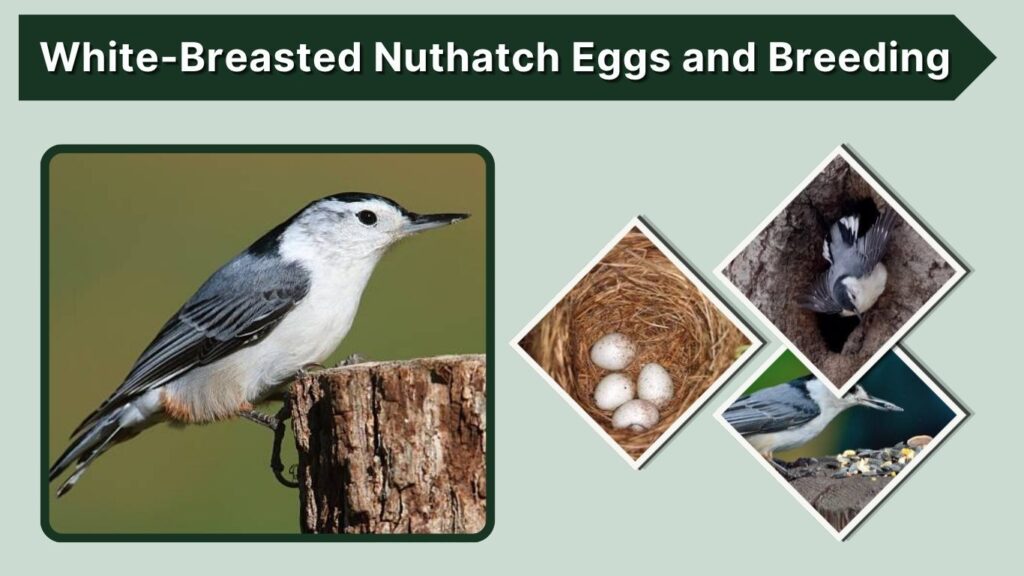
A female white-breasted nuthatch commonly lays about five to nine eggs. The eggs are usually white or creamy and marked with reddish-brown, purple, or gray spots.
The female performs most of the incubation, while the male brings her food. Incubation generally lasts around two weeks.
After hatching, both parents feed the nestlings. The young remain in the cavity for roughly three weeks before fledging.
Most pairs raise one brood per year. Breeding usually begins during spring, although timing depends on location and climate.
Birdhouses and Nest Boxes
White-breasted nuthatches sometimes use nest boxes when suitable natural cavities are limited. A box should be installed near mature woodland or large trees.
A suitable nest box usually has:
- A small entrance hole
- Good drainage
- Ventilation
- Untreated wood
- A secure mounting position
- Protection from strong sunlight and predators
Old nesting material should be removed after the breeding season. Avoid disturbing an active nest containing eggs or chicks.
Do White-Breasted Nuthatches Migrate?
Most white-breasted nuthatches do not make long-distance seasonal migrations. They generally remain within the same region throughout the year.
However, some individuals may move locally when food becomes scarce. Young birds may also travel away from their birth areas to establish new territories.
Because they are year-round residents in many places, they can often be seen at backyard feeders during winter.
Lifespan and Predators
White-breasted nuthatches can live for several years in the wild, although many young birds do not survive their first year.
Potential predators include:
- Hawks
- Owls
- Snakes
- Squirrels
- Raccoons
- Domestic cats
- Larger cavity-nesting birds
Eggs and nestlings are especially vulnerable. Adults use warning calls, quick movements, and protected cavities to reduce danger.
White-Breasted vs. Red-Breasted Nuthatch
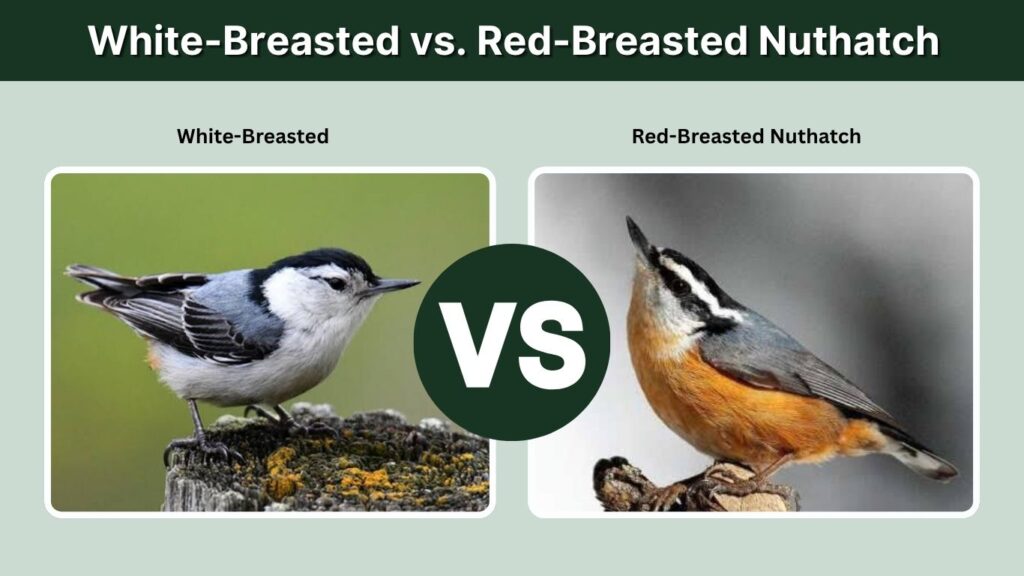
The white-breasted nuthatch is larger and has a bright white face without a strong eye stripe. The red-breasted nuthatch is smaller and has rusty-orange underparts with a dark stripe through the eye.
| Feature | White-Breasted Nuthatch | Red-Breasted Nuthatch |
| Size | Larger | Smaller |
| Underparts | Mostly white | Rusty-orange |
| Face | White and plain | Strong black eye stripe |
| Bill | Longer | Shorter |
| Preferred habitat | Deciduous and mixed forests | Coniferous forests |
| Call | Nasal “yank” | Higher, tin-horn-like call |
White-Breasted Nuthatch vs. Chickadee
Both birds visit feeders and may join mixed winter flocks, but they are easy to separate by movement and shape.
White-breasted nuthatches have longer bills and regularly climb down tree trunks headfirst. Chickadees have shorter bills, rounder heads, black bibs, and a more active hopping style among branches.
Nuthatches also make nasal calls, while chickadees are known for their recognizable “chick-a-dee-dee-dee” vocalization.
Interesting White-Breasted Nuthatch Facts
- It can climb headfirst down a tree trunk.
- It hides food in bark for later use.
- Mated pairs may remain together for long periods.
- It often joins chickadees and woodpeckers in winter feeding flocks.
- It does not migrate far in most regions.
- It may smear material around its nest entrance.
- It helps control insects that live beneath tree bark.
- Its large feet allow it to grip vertical surfaces securely.
- It readily visits feeders containing suet, sunflower seeds, and peanuts.
- Its nasal call can often be heard before the bird is seen.
FAQs
Are white-breasted nuthatches rare?
White-breasted nuthatches are generally common across much of North America. They are easiest to find in mature forests, parks, and neighborhoods with large trees. Their local numbers may be lower where woodland and nesting cavities are limited.
Are white-breasted nuthatches woodpeckers?
No. White-breasted nuthatches belong to the nuthatch family, not the woodpecker family. They search bark for insects like woodpeckers, but they move differently and rely on their feet rather than stiff tail feathers for support.
Do white-breasted nuthatches mate for life?
Pairs may remain together throughout the year and can maintain long-term bonds. However, saying that every pair mates for life would be too absolute. Pairing behavior can change if one bird disappears or fails to return.
What does a white-breasted nuthatch sound like?
Its best-known sound is a loud, nasal “yank-yank” call. It may also make softer whistles, alarm notes, and contact calls. Males repeat nasal phrases more frequently during the breeding season.
How can I attract white-breasted nuthatches?
Provide suet, peanuts, black oil sunflower seeds, and sunflower hearts. Mature trees, safe nesting cavities, clean water, and nearby shrubs also make a yard more attractive. Avoid pesticides that reduce the insects they naturally eat.