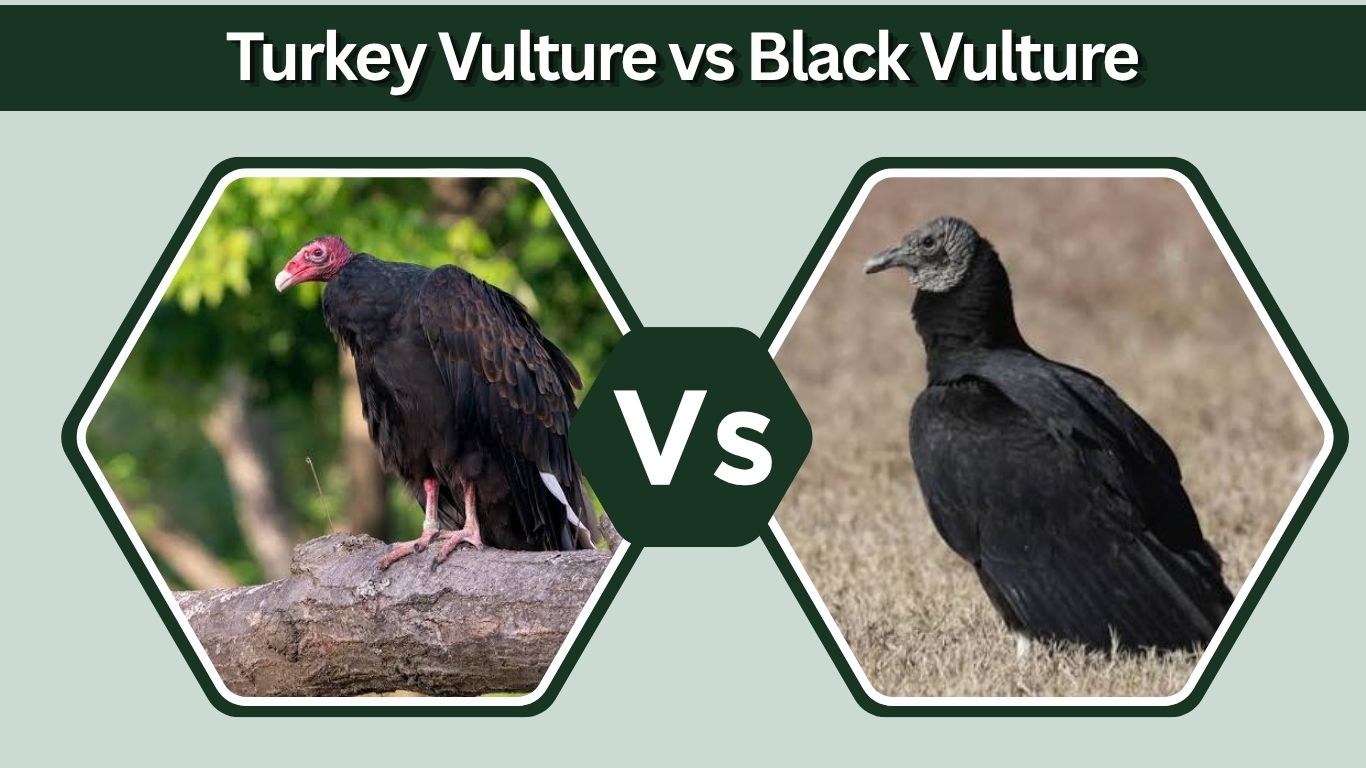
Turkey Vultures and Black Vultures are large scavenging birds commonly seen soaring over roads, fields, forests, and towns. Although both appear dark from a distance, they differ in head color, wing markings, tail length, body shape, flight style, and feeding behavior. An adult Turkey Vulture has a red head and long, two-toned wings, while a Black Vulture has a dark head, compact body, and pale patches limited mainly to its wingtips.
Turkey Vulture vs. Black Vulture: Quick Comparison
The easiest way to identify these birds is to look at the underside of the wings. Turkey Vultures have pale flight feathers extending across much of each wing, whereas Black Vultures have silvery-white patches concentrated near the tips.
| Feature | Turkey Vulture | Black Vulture |
| Scientific name | Cathartes aura | Coragyps atratus |
| Adult head | Red | Dark gray or black |
| Body shape | Long and slender | Short and stocky |
| Tail | Long | Short |
| Wingspan | About 67–70 inches | About 54–59 inches |
| Underwing color | Pale across most flight feathers | White patches near wingtips |
| Soaring position | Wings raised in a shallow V | Wings held mostly flat |
| Flapping | Slow and infrequent | Quick and frequent |
| Food detection | Strong sense of smell | Primarily sight and social cues |
| Social behavior | Often alone or in small groups | Commonly forms larger groups |
10 Differences Between Turkey and Black Vultures
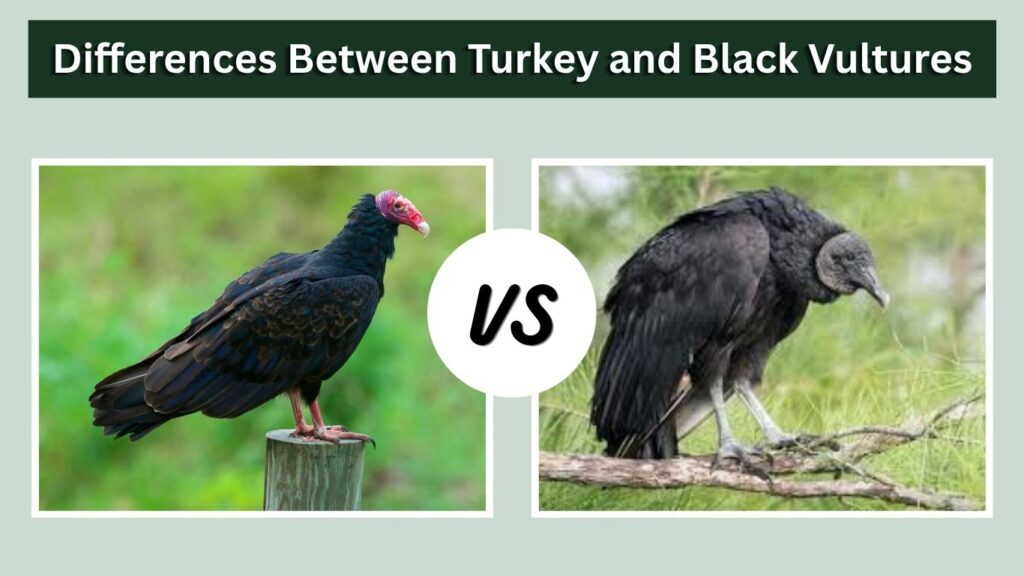
Head color is useful at close range, but wing pattern, flight posture, and tail length are often more dependable when a bird is circling high overhead.
1. Head Color
An adult Turkey Vulture has a bare red head with a relatively pale bill. Its head may appear pinkish-red depending on age, lighting, and distance.
A Black Vulture has a bare, wrinkled head that remains dark gray or black as an adult. The dark head blends more closely with its black body, making it appear uniformly dark when perched.
2. Body Color
Turkey Vultures may look black from far away, but their body feathers are actually dark brown. The contrast between their brown body, red head, and pale bill becomes more noticeable at close range.
Black Vultures have much darker, sooty-black plumage. Their head, body, wings, and tail create a more consistently black appearance, except for the pale patches visible near the wingtips during flight.
3. Wing Pattern
The underside of a Turkey Vulture’s wing has a clear two-toned pattern. The leading portion is dark, while the flight feathers along the trailing edge and wingtips are grayish or silvery.
A Black Vulture’s underwing is mostly black. Only the outer primary feathers form noticeable silvery-white patches, sometimes described as white “stars” near the tips.
4. Flight Posture
Turkey Vultures normally soar with their wings tilted upward in a shallow V, also called a dihedral. They frequently rock or teeter from side to side as they ride rising air currents.
Black Vultures usually hold their broad wings flatter and angle them slightly forward. Their flight appears steadier and more compact than the floating, unstable-looking flight of a Turkey Vulture.
5. Flapping Style
Turkey Vultures spend long periods soaring with very few wingbeats. When they flap, their wingbeats generally appear deep and slow.
Black Vultures flap more frequently. They often perform several quick, powerful wingbeats followed by a short, flat-winged glide. This repeated flap-and-glide pattern is one of the best identification clues at a distance.
6. Tail Length
The Turkey Vulture has a relatively long tail that extends noticeably beyond its feet during flight. Combined with its long wings, this gives the bird a stretched, lanky outline.
The Black Vulture has a short, rounded tail. Its feet may reach close to or beyond the end of the tail, producing a compact, almost tailless silhouette when seen from below.
7. Size and Wingspan
Turkey Vultures are generally longer and have considerably wider wingspans. They measure approximately 25–32 inches long, with wingspans of about 67–70 inches.
Black Vultures measure approximately 24–27 inches long and have wingspans of about 54–59 inches. However, Black Vultures have heavier, stockier bodies, so they may not look dramatically smaller when perched.
| Measurement | Turkey Vulture | Black Vulture |
| Length | 25.2–31.9 inches | 23.6–26.8 inches |
| Wingspan | 66.9–70.1 inches | 53.9–59.1 inches |
| Typical weight | Around 4.4 pounds | About 3.5–4.9 pounds |
8. Finding Food
Turkey Vultures have a highly developed sense of smell that helps them locate carrion, even when it is partly hidden beneath vegetation. They often fly relatively low while searching for scents.
Black Vultures depend more heavily on sight. They watch the ground, observe other scavengers, and sometimes follow Turkey Vultures toward food. Once several Black Vultures arrive, their larger group may push a solitary Turkey Vulture away from the carcass.
9. Social Behavior
Turkey Vultures may soar alone, in small groups, or in larger gatherings around roosts and abundant food.
Black Vultures have especially strong family and group bonds. They commonly fly, feed, and roost in flocks. Family members may share information about food locations, and successful birds can lead others from communal roosts to carcasses.
10. Feeding Behavior
Both species primarily eat carrion and provide an important natural cleanup service. Turkey Vultures generally concentrate on dead animals.
Black Vultures are also scavengers but can behave more aggressively around food. They occasionally take eggs, small animals, newly hatched turtles, or vulnerable newborn livestock. However, confirmed attacks on livestock appear to be much less frequent than many reports suggest.
Turkey Vulture vs. Black Vulture in Flight
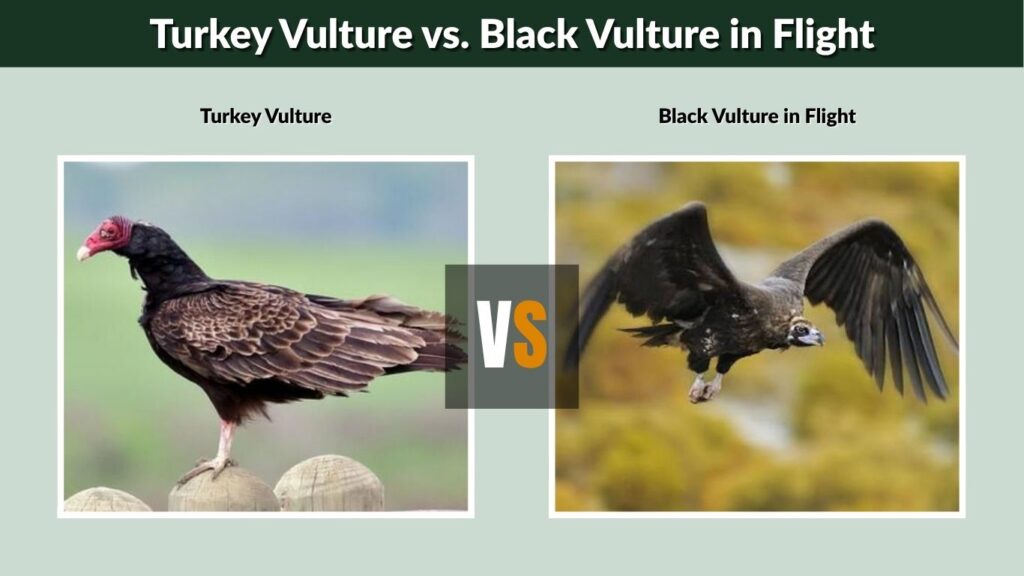
Flight identification is especially helpful because head color may be impossible to see from the ground.
| Flight clue | Turkey Vulture | Black Vulture |
| Wing position | Raised in a shallow V | Mostly flat |
| Underwing | Two-toned across most of wing | Pale only near tips |
| Tail | Long and visible | Very short |
| Wingbeats | Slow and uncommon | Quick and frequent |
| Movement | Rocks from side to side | More direct and steady |
| Shape | Long-winged and lanky | Broad-winged and compact |
A bird that appears to balance unsteadily with long, pale-backed wings is probably a Turkey Vulture. A compact bird using repeated quick flaps and showing two white patches near the wingtips is probably a Black Vulture.
Juvenile Turkey Vulture vs. Black Vulture
Juvenile Turkey Vultures can be confusing because they have dark gray heads rather than the red heads of adults. This can make them resemble Black Vultures when perched.
Look beyond head color. A juvenile Turkey Vulture retains the species’ long tail, long wings, pale flight feathers, shallow V-shaped wing position, and rocking flight. A Black Vulture remains shorter-tailed and shows pale patches only near the outer wingtips.
Do Black Vultures and Turkey Vultures Live Together?
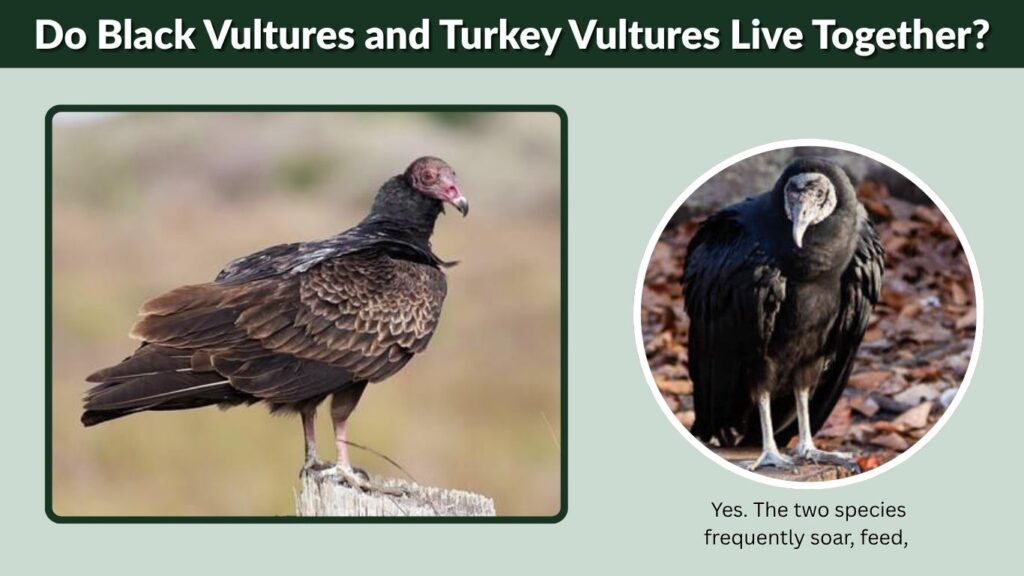
Yes. The two species frequently soar, feed, and roost in the same general areas. Black Vultures may watch Turkey Vultures and follow them after they locate carrion by smell.
Their relationship can become competitive at a carcass. Turkey Vultures are larger in overall length and wingspan, but Black Vultures are highly social and often arrive in groups, allowing them to dominate feeding sites through numbers.
Is a Turkey Buzzard the Same as a Turkey Vulture?
“Turkey buzzard” is a traditional North American name for the Turkey Vulture. Therefore, a Black Vulture vs. turkey buzzard comparison is the same as a Black Vulture vs. Turkey Vulture comparison.
The term can cause confusion because “buzzard” commonly refers to hawks in Europe. In North America, people sometimes use it informally for vultures.
FAQs
Are Black Vultures bigger than Turkey Vultures?
No. Turkey Vultures are normally longer and have wider wingspans. Black Vultures have shorter wings and tails but possess compact, heavy bodies. Consequently, the two species may appear similarly sized when standing together.
Can a Turkey Vulture have a black head?
Yes. Juvenile Turkey Vultures have dark gray or blackish heads. Their heads gradually become red as they mature. Use the long tail, two-toned underwings, and shallow V-shaped flight posture to distinguish them from Black Vultures.
Which is more aggressive, a Black Vulture or Turkey Vulture?
Black Vultures are generally more assertive around food. They commonly gather in groups and may drive Turkey Vultures away from carcasses. They also take live prey more often, although carrion remains their primary food.
Do Black Vultures and Turkey Vultures interbreed?
No confirmed natural hybrids are generally recognized. They belong to different genera and maintain distinct breeding behaviors and species identities, even though they frequently share feeding and roosting areas.
What is the fastest way to identify them in flight?
Look at the underwings. A Turkey Vulture has pale flight feathers across much of each wing and holds its wings in a V. A Black Vulture has white patches near the wingtips and usually holds its wings flat.