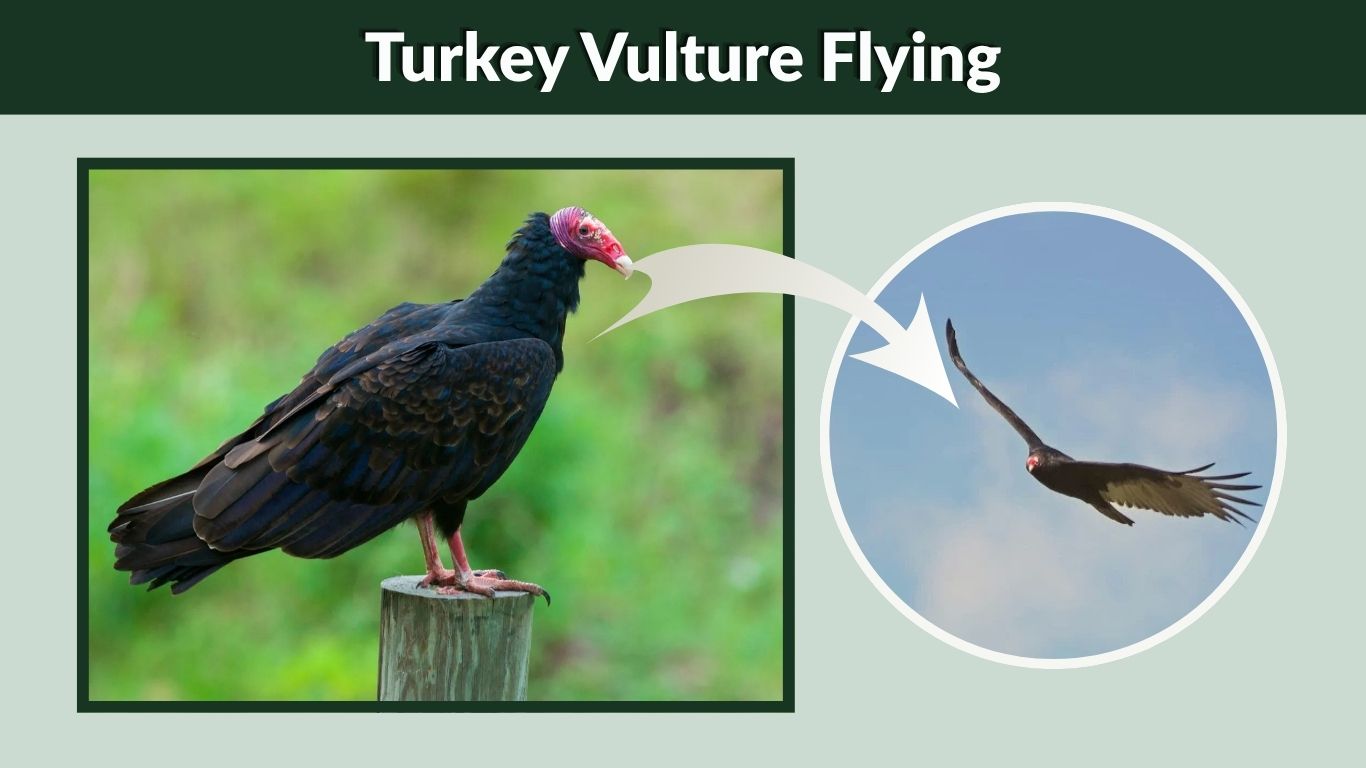
A turkey vulture flying overhead is easy to recognize once you know its distinctive shape. It holds its long wings in a shallow V, rocks gently from side to side, and may circle for several minutes without an obvious wingbeat. This efficient flight allows the bird to search large areas for carrion while conserving energy. Turkey vultures may fly alone, in pairs, or in large soaring groups called kettles.
Turkey Vulture Flight Overview
Turkey vultures are large soaring birds with long, broad wings and relatively long tails. Their wingspan generally measures about 67–70 inches, making them larger than most hawks but smaller than eagles such as the bald eagle.
| Flight feature | Description |
| Wingspan | Approximately 5½–6 feet |
| Wing position | Raised in a shallow V |
| Flight movement | Wobbly or teetering |
| Wingbeats | Slow and relatively uncommon |
| Main flight method | Soaring on thermals and updrafts |
| Typical activity | Primarily during daylight |
| Group formation | Circling kettles rather than organized V-flocks |
| Usual altitude | Often relatively low while searching for food |
How Do Turkey Vultures Fly?
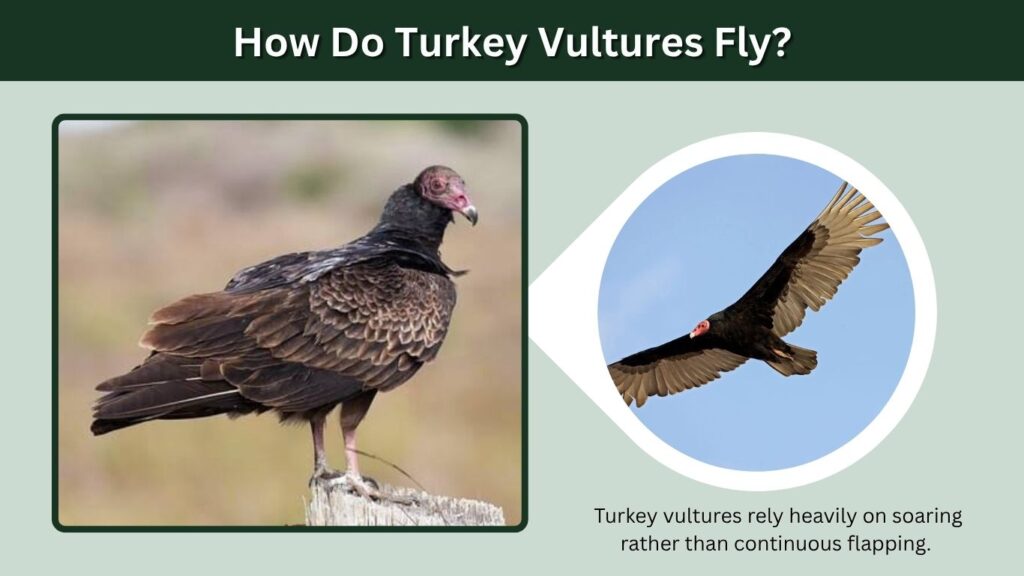
Turkey vultures rely heavily on soaring rather than continuous flapping. Their broad wings catch rising air and support the bird while it searches the ground below.
Using Thermal Air Currents
Thermals are columns of warm air created when the sun heats the ground unevenly. As the warmer air rises, turkey vultures enter the upward current and circle inside it. The rising air carries them higher without requiring constant wingbeats.
After gaining sufficient altitude, the bird glides toward another thermal, gradually losing height along the way. It then begins circling again and repeats the process. This soaring-and-gliding cycle allows turkey vultures to travel considerable distances using relatively little energy. Research describes them as strongly dependent on thermals and other forms of uplift during long-distance migration.
Why Their Flight Looks Wobbly
Turkey vultures hold their wings slightly above horizontal in a position known as a dihedral. From the front, the wings form a shallow V.
They frequently tilt or rock from side to side while soaring. This teetering movement helps them maintain lift and stability, particularly while flying relatively low and following weak, irregular air currents. Their flight may look unstable, but the movement is a highly efficient adaptation.
Why Do Turkey Vultures Fly in Circles?
Circling does not normally mean that a turkey vulture is waiting for an animal or person to die. In most cases, it is using a thermal to gain altitude.
The warm rising air may be narrow close to the ground, requiring the bird to make relatively tight circles. As the thermal becomes wider at higher elevations, the vulture can make larger circles.
While soaring, it may also search or smell for carrion. Turkey vultures have an unusually strong sense of smell and may fly low enough to detect odors released by dead animals, including carcasses hidden beneath forest cover.
How High Do Turkey Vultures Fly?
Turkey vultures can soar thousands of feet above the ground when strong thermals are available. However, they frequently remain much lower while searching for food.
A GPS-tracking study recorded a maximum turkey vulture altitude of 1,378 meters, or about 4,521 feet above ground level. That figure was the highest measurement from the tracked birds rather than a confirmed maximum for the entire species. The same study found that most flight activity occurred below 200 meters, or approximately 656 feet.
Another study of nonmigrating turkey vultures found that approximately 97% of their flight time occurred at or below 151 meters, or 500 feet. Low flight helps the birds inspect the landscape and detect the scent of carrion more effectively.
Why Do Turkey Vultures Sometimes Fly So High?
They may climb higher when:
- Strong thermals provide easy lift
- They are traveling between feeding areas
- They are migrating
- They need a wide view of the landscape
- Other soaring birds reveal a productive thermal
- Weather and wind conditions favor high flight
A high-flying bird is therefore not necessarily circling food. It may simply be traveling or gaining height before a long glide.
How Fast Can a Turkey Vulture Fly?
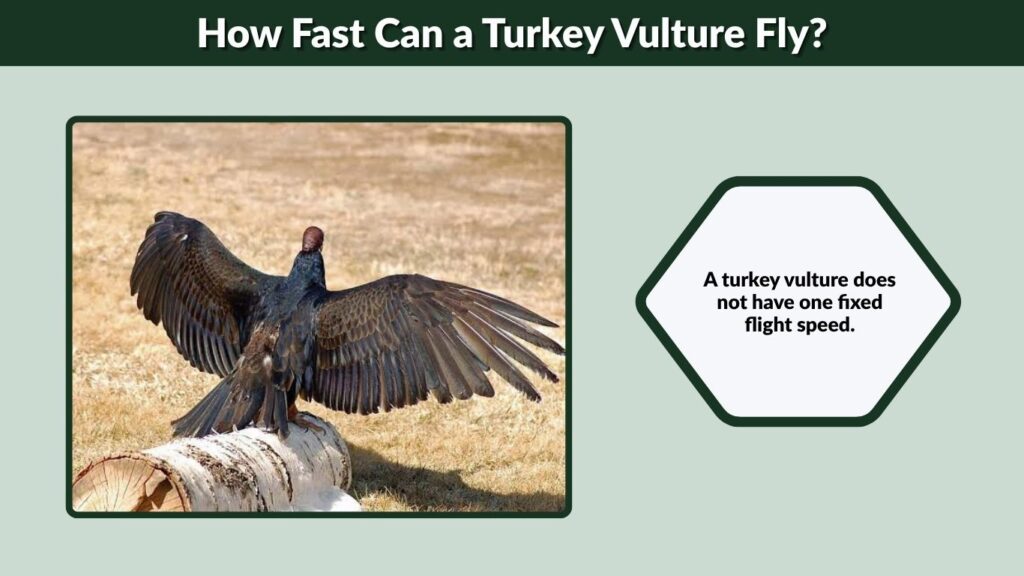
A turkey vulture does not have one fixed flight speed. Its speed changes with wind direction, thermal strength, altitude, whether it is searching for food, and whether it is migrating.
It may appear slow while circling in a thermal, but it can glide much faster when leaving one rising-air column for another. Tailwinds can substantially increase its speed over the ground. Scientific tracking shows that migration speed and daily travel vary with atmospheric uplift, weather, wind, and seasonal conditions.
Claims that turkey vultures always fly at one precise number of miles per hour can therefore be misleading. Airspeed, groundspeed, circling speed, and maximum short-term gliding speed are different measurements.
How Far Can Turkey Vultures Fly Without Flapping?
There is no fixed distance because their ability to glide depends on altitude, wind, terrain, and the availability of the next thermal.
Under favorable conditions, a turkey vulture can remain airborne for extended periods with very few wingbeats. It climbs inside a thermal, glides downward toward another source of lift, and then rises again. Migrating birds may repeat this pattern throughout much of the day.
Their efficient soaring means that traveling a long distance does not necessarily require dramatically more energy than a shorter flight. However, poor weather can interrupt migration because weak thermals make prolonged soaring difficult.
Do Turkey Vultures Fly in Groups?
Turkey vultures often soar together in groups called kettles. A kettle may contain a few birds or, during migration, dozens or hundreds.
The birds are not normally cooperating in the same way as geese flying in an organized V. Each vulture independently circles within the same thermal because the rising air provides efficient lift for all of them.
Turkey vultures also gather at communal overnight roosts. Outside the breeding season, a roost may contain dozens or more than 100 individuals. Migrating flocks can include hundreds of birds.
Do Turkey Vultures Fly at Night?
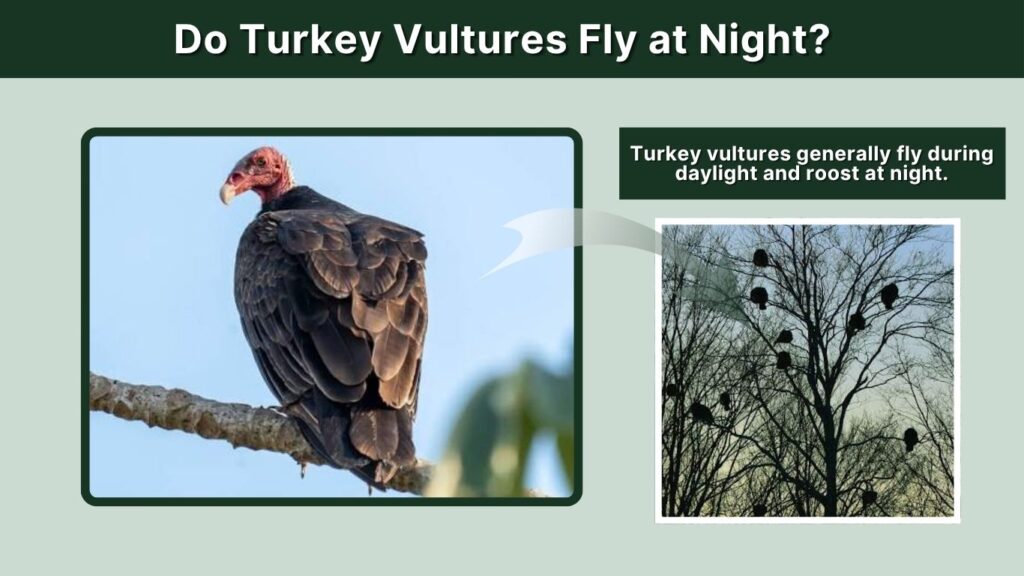
Turkey vultures generally fly during daylight and roost at night. They depend strongly on thermals created by daytime heating, so they commonly wait until the sun has warmed the landscape before becoming highly active.
They may leave their roost during the morning as thermals strengthen and return during the late afternoon or evening. Most observations should therefore occur from midmorning through the afternoon. Unusual wind or human-produced heat sources may occasionally extend activity, but regular nighttime flight is not typical.
Do Turkey Vultures Fly South for Winter?
Many northern turkey vultures migrate south in autumn, but migration varies among populations. Birds living in warmer portions of the species’ range may remain near the same region throughout the year.
Migrating turkey vultures use thermals and updrafts to reduce energy consumption. They commonly travel in flocks and may concentrate along mountain ridges, coastlines, and other routes where rising air is reliable. Weather conditions that weaken thermals can force them to stop until flying conditions improve.
How to Identify a Turkey Vulture Flying Overhead
A flying turkey vulture can be recognized without seeing its red head clearly.
Identification Features
- Wings held in a shallow V
- Frequent rocking from side to side
- Very few wingbeats
- Long wings with fingerlike tips
- Relatively long, rounded tail
- Two-toned underside of the wings
- Dark leading wing area
- Pale gray or silvery flight feathers
- Small-looking head
The light underside extends across most of the trailing flight feathers, creating a silvery appearance when sunlight passes through them.
Turkey Vulture vs Black Vulture in Flight
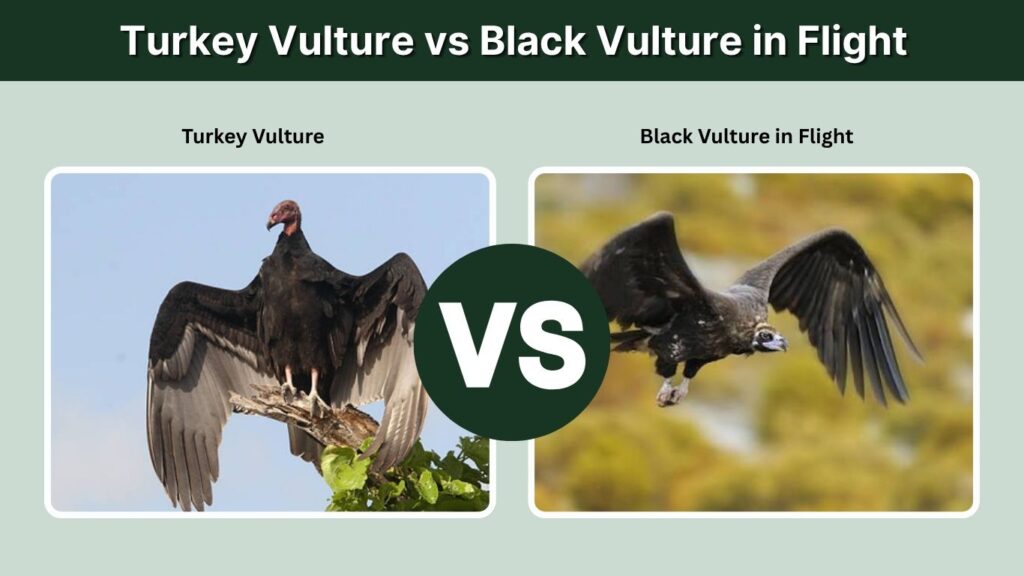
Turkey vultures and black vultures sometimes soar together, but their shapes and flight styles differ.
| Feature | Turkey Vulture | Black Vulture |
| Wing position | Shallow V | Usually flatter |
| Wingbeats | Infrequent | More frequent and powerful |
| Flight style | Teeters from side to side | More stable |
| Tail | Relatively long | Short and square |
| Pale wing area | Along most flight feathers | Mainly near the wingtips |
| Body shape | Long and lanky | Short and compact |
Black vultures may follow turkey vultures because turkey vultures have a better sense of smell and can locate hidden carrion more effectively.
Turkey Vulture vs Hawk Flying
A distant turkey vulture can be mistaken for a hawk. However, most hawks hold their wings flatter, flap more regularly, and do not constantly rock from side to side.
Red-tailed hawks have broader-looking bodies, shorter tails relative to their wings, and slower, heavier wingbeats. The zone-tailed hawk is a difficult exception because it deliberately resembles a turkey vulture in shape and flight behavior. It can be distinguished by the pale band across its tail and differences in its wing markings.
What Does a Turkey Vulture Flying Overhead Mean?
Biologically, a turkey vulture overhead usually means that suitable rising air is present. The bird may be traveling, migrating, searching for carrion, or moving between a roost and a feeding area.
It does not indicate that someone nearby is dying, nor does it prove that a carcass is directly beneath the bird. A circling vulture may be hundreds or thousands of feet above the ground and focused mainly on staying inside a thermal.
FAQs
Can turkey vultures fly in the rain?
They can fly during light rain, but heavy rain and poor weather reduce thermal activity and make efficient soaring more difficult. Migrating turkey vultures often stop traveling when weather conditions no longer provide reliable uplift.
Why do turkey vultures fly low?
Low flight allows them to search roads, fields, forests, and other areas for carrion. It also improves their ability to detect odors rising from dead animals. Low-altitude teetering helps them use small and irregular air currents.
Do turkey vultures fly in pairs?
They may be seen in pairs, particularly near nesting territories, but they also fly alone and in much larger groups. Several birds often gather inside the same thermal because it provides an efficient source of lift.
Why do turkey vultures look sideways while flying?
Their rocking flight continuously changes the angle of their bodies and wings. They may also turn their heads while scanning and smelling the landscape. The tilted posture does not usually indicate that the bird is injured.
Can a turkey vulture take off from the ground?
Yes, but takeoff is easier when wind or rising air is available. A turkey vulture may run, hop, and flap heavily before becoming airborne. Once it gains altitude and finds lift, its flight becomes much more effortless.