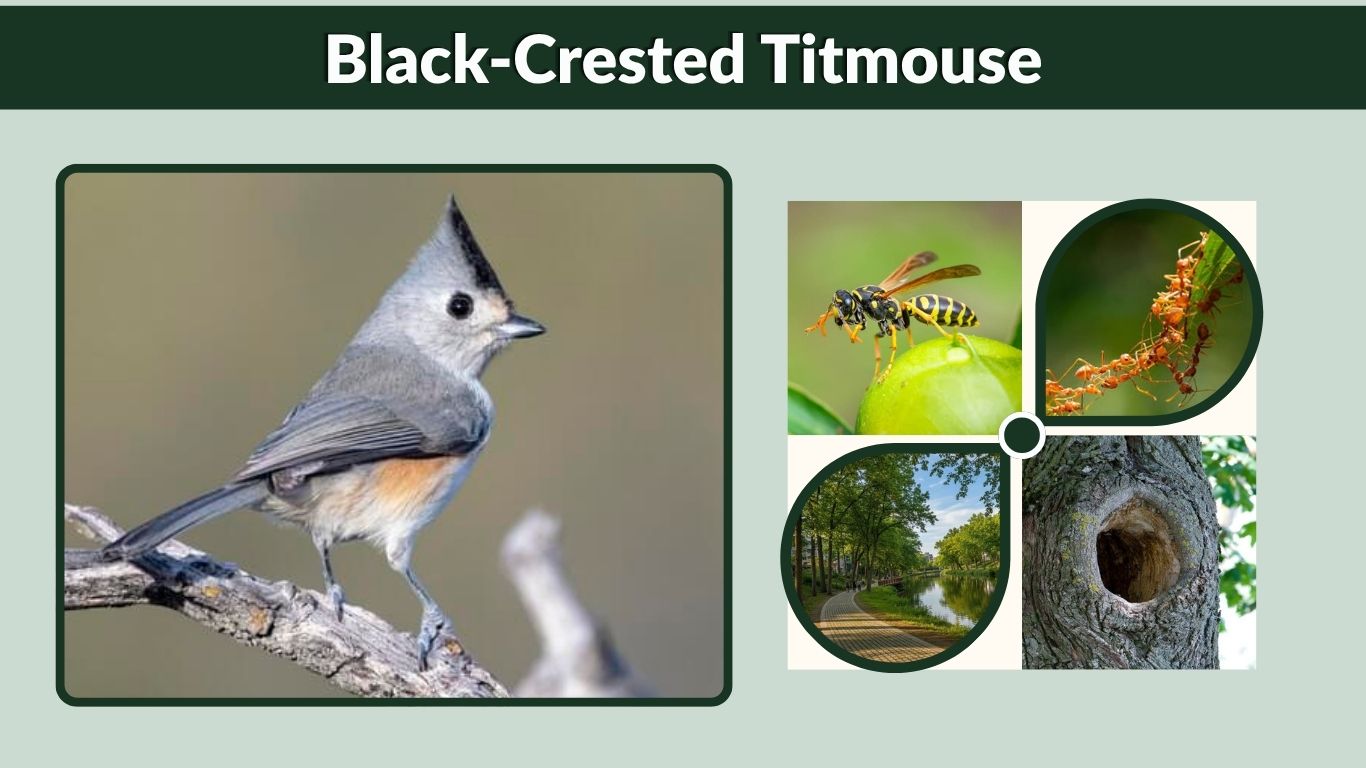
The black-crested titmouse is a lively songbird recognized by its pointed black crest, gray body, pale underside, and rusty-colored sides. It is especially associated with Texas, parts of Oklahoma, and northeastern Mexico, where it inhabits woodlands, brushy areas, parks, and wooded neighborhoods. Closely related to the tufted titmouse, this bird shares many of its behaviors, including visiting feeders, nesting in tree cavities, and carrying seeds away to eat or store. This guide explores the black-crested titmouse’s identification, size, habitat, range, diet, calls, nesting habits, eggs, juvenile appearance, and major differences from the tufted titmouse.
Black-Crested Titmouse Identification
The black-crested titmouse, scientifically known as Baeolophus atricristatus, is a small, active bird with a prominent crest. It often moves quickly through branches while searching leaves, bark, and twigs for food.
Key Identification Features
- Bold, pointed black crest
- Pale gray forehead
- Gray upperparts and wings
- Whitish face and underparts
- Dark eye and short, sturdy bill
- Rusty-orange coloring along the sides
- Relatively long tail
- Strong feet for gripping branches
The sharply contrasting black crest is the bird’s most noticeable feature. Its pale forehead separates the dark crest from the short black bill.
Black-crested titmice are often seen in pairs or small groups. They may hang upside down beneath branches, investigate bark openings, and approach backyard feeders with energetic movements.
Size and Physical Characteristics
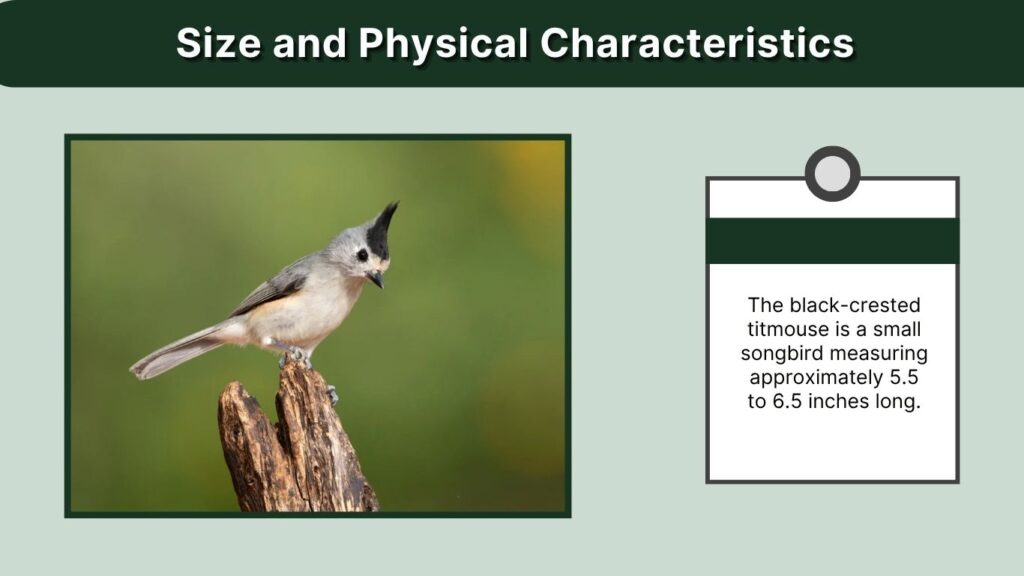
The black-crested titmouse is a small songbird measuring approximately 5.5 to 6.5 inches long. It has a compact body, rounded head, prominent crest, and fairly long tail.
Its wings are short and rounded, which helps it move rapidly among trees and shrubs. The bill is small but strong enough to open seeds and capture insects.
The crest may rise when the bird is alert, excited, or defending its territory. It can appear flatter when the bird is relaxed.
Male vs. Female Black-Crested Titmouse
Male and female black-crested titmice look extremely similar. Both have black crests, gray backs, pale underparts, and rusty-colored sides.
Males may appear slightly larger or display a somewhat darker crest, but these differences are usually too subtle for reliable identification in the field. Behavior during the breeding season may provide better clues.
Males commonly sing, defend nesting territories, and offer food to females during courtship. Females perform most of the nest construction and incubation.
| Feature | Male | Female |
| Crest | Black | Black |
| Body color | Gray and white | Gray and white |
| Side coloring | Rusty-orange | Rusty-orange |
| Size | Sometimes slightly larger | Sometimes slightly smaller |
| Breeding behavior | Sings and defends territory | Builds and incubates |
Juvenile and Baby Black-Crested Titmouse
A juvenile black-crested titmouse resembles an adult but usually has softer and duller plumage. Its crest may be shorter, grayer, or less sharply defined.
Young birds may also have:
- A shorter tail
- A softer-looking bill
- Paler rusty coloring
- Loose or fluffy feathers
- Yellowish edges around the mouth
After leaving the nest, fledglings remain dependent on their parents for food. They follow adults through trees and shrubs while making repeated begging calls.
Juveniles gradually learn to search for insects, open seeds, recognize predators, and locate safe feeding areas.
Black-Crested Titmouse Habitat and Range
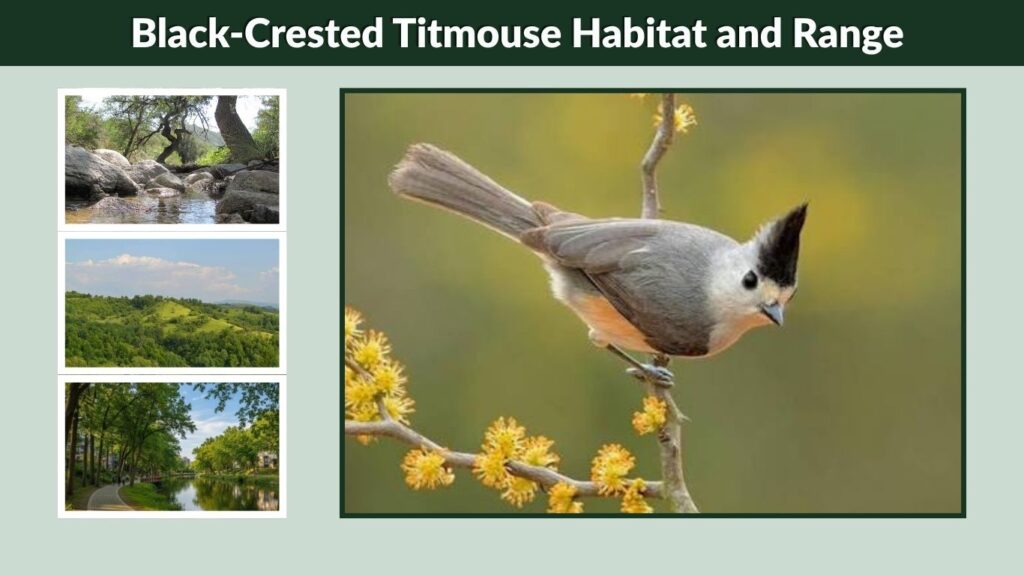
Black-crested titmice primarily inhabit central and western Texas, small portions of southwestern Oklahoma, and northeastern Mexico. They are strongly associated with the Texas Hill Country but may also occur in wooded neighborhoods and suitable brushland elsewhere in their range.
Their preferred habitats include:
- Oak and juniper woodlands
- Mesquite-covered areas
- River corridors
- Brushy thickets
- Open forests
- Savannas with scattered trees
- Parks and large gardens
- Suburban neighborhoods
They need trees or woody vegetation for feeding, shelter, nesting, and protection from predators.
Black-crested titmice generally remain within their breeding range throughout the year rather than completing long-distance migrations.
Black-Crested Titmouse in Texas
Texas is the best-known location for observing the black-crested titmouse in the United States. It is particularly characteristic of central and western portions of the state.
The Texas Hill Country offers suitable oak-juniper woodland, rocky landscapes, shrubs, and mature trees. These habitats provide insects, seeds, nesting cavities, and protected branches.
The bird may also visit residential areas when mature trees and feeders are available. In parts of central Texas, its range overlaps with that of the tufted titmouse.
What Do Black-Crested Titmice Eat?
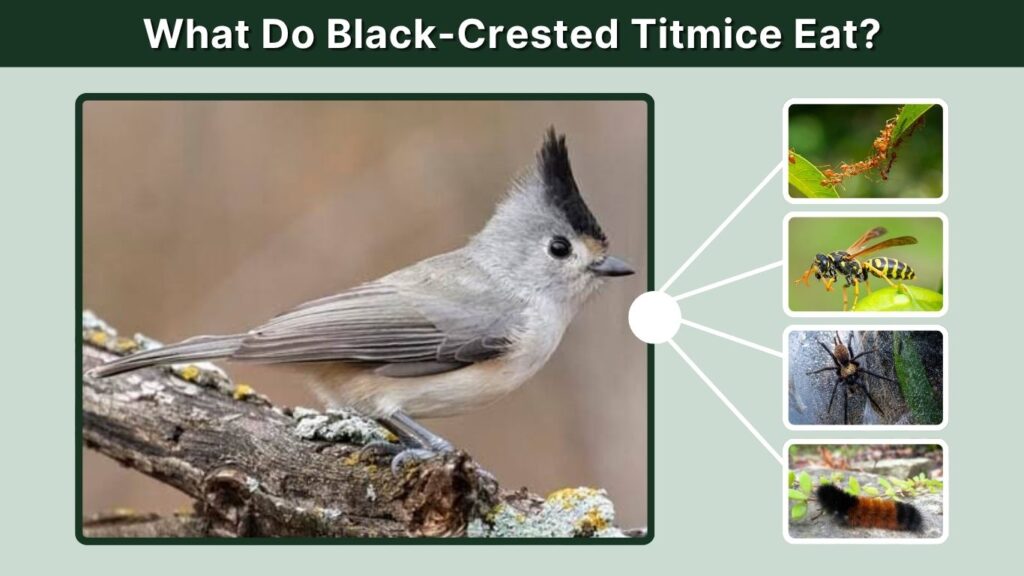
Black-crested titmice are omnivorous birds that eat insects, spiders, seeds, nuts, berries, and other plant material.
Natural Diet
During spring and summer, their diet includes:
- Caterpillars
- Beetles
- Ants
- Wasps
- Spiders
- Insect eggs
- Small larvae
- Other invertebrates
Insects provide the protein adults need during breeding and are especially important for growing chicks.
During autumn and winter, the birds consume more seeds, nuts, berries, and small fruits. They may hold a seed between their feet and strike it repeatedly with the bill until it opens.
Food at Backyard Feeders
Black-crested titmice may visit feeders offering:
- Black oil sunflower seeds
- Shelled sunflower seeds
- Peanuts
- Suet
- Mealworms
- Nut pieces
They commonly grab one seed and fly to a nearby branch before eating it. Some food may be hidden in bark cracks or other protected places for later use.
Black-Crested Titmouse Call, Song, and Sounds
The black-crested titmouse produces several calls used for communication, warnings, courtship, and territory defense.
One common call resembles a rapid “chick-a-dee-dee” phrase. It may also produce clear, repeated whistled notes that sound like “peer-peer” or “peter-peter.” Its vocalizations are similar to those of the closely related tufted titmouse.
Common Sounds
- Clear repeated whistles
- Chick-a-dee-like calls
- Harsh alarm notes
- Soft contact calls
- Rapid scolding sounds
Males sing most actively during the breeding season. Their whistles help establish territory and attract mates.
Titmice may produce loud alarm calls when they notice hawks, snakes, cats, or other potential threats. Nearby birds sometimes respond to these warnings.
Behavior and Personality
Black-crested titmice are energetic, curious, and sometimes bold. They frequently investigate feeders, tree cavities, branches, and unfamiliar objects.
They search for food by hopping along limbs, examining leaf clusters, pecking at bark, and occasionally hanging upside down. They may briefly hover while capturing an insect or reaching food.
During winter, they may join mixed-species feeding groups with chickadees, kinglets, nuthatches, and woodpeckers. Traveling in a group helps birds locate food and detect predators.
Pairs may remain together for extended periods and defend a territory around their nesting location.
Black-Crested Titmouse Nesting Habits
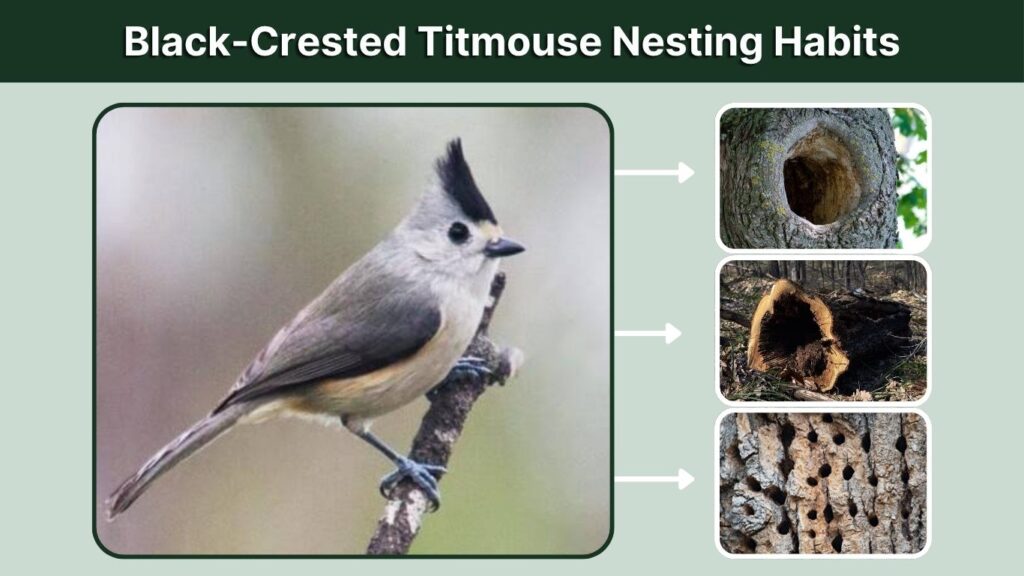
Black-crested titmice are cavity-nesting birds. They usually use an existing hole rather than excavating a complete cavity in solid wood.
Common nesting locations include:
- Natural tree cavities
- Abandoned woodpecker holes
- Openings in dead trees
- Hollow fence posts
- Suitable nest boxes
The female constructs most of the nest. Materials may include dry grass, leaves, strips of bark, moss, animal hair, feathers, and plant fibers.
The nest has a soft inner cup that cushions the eggs and helps keep the chicks warm.
Eggs and Reproduction
A black-crested titmouse commonly lays approximately four to seven eggs. The eggs are usually white or creamy with reddish-brown or purplish spots.
The female incubates the eggs while the male brings her food. Incubation lasts for around two weeks, although conditions can influence the exact period.
Both parents feed the nestlings after they hatch. Caterpillars and other soft-bodied insects make up much of the chicks’ food.
Young birds remain in the nest for roughly two to three weeks before fledging. Some pairs may raise more than one brood when the breeding season is long and conditions are favorable.
Using Nest Boxes
Black-crested titmice may accept properly designed nest boxes, especially where natural cavities are limited.
A suitable birdhouse should have:
- A small entrance hole
- Untreated, durable wood
- Ventilation near the top
- Drainage holes in the floor
- A secure roof
- Protection from predators
- Placement near trees or woodland
The box should be installed before the breeding season. Avoid opening or moving it repeatedly once birds begin building a nest.
Old nesting material can be removed after the young have fledged and the box is no longer active.
Black-Crested Titmouse vs. Tufted Titmouse
The black-crested and tufted titmice are closely related and have similar body shapes, behaviors, calls, and diets. The easiest difference is the color of the crest and forehead.
| Feature | Black-Crested Titmouse | Tufted Titmouse |
| Crest | Black | Gray |
| Forehead | Pale gray or whitish | Usually dark or black |
| Face | Pale | Pale |
| Sides | Rusty-orange | Peach or rusty |
| Main U.S. range | Central and western Texas | Eastern United States |
| Habitat | Dry woodland and brush | Deciduous and mixed woodland |
The black-crested titmouse has a sharply black crest that contrasts with its pale forehead. The tufted titmouse generally has a gray crest and a distinct dark patch directly above its bill.
Black-Crested and Tufted Titmouse Hybrids
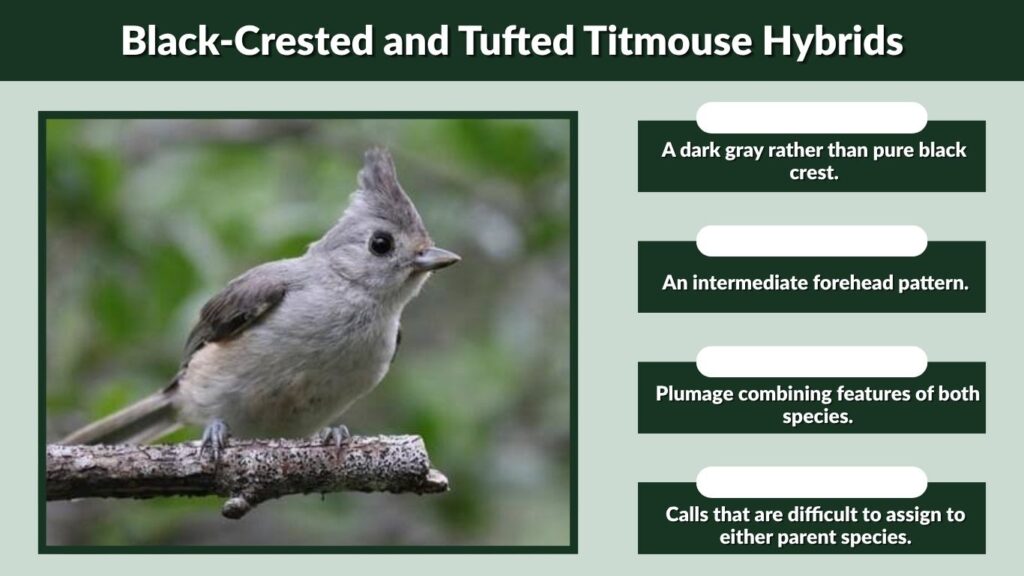
The ranges of black-crested and tufted titmice meet in parts of central Texas. Where they overlap, the two birds can interbreed.
Hybrid birds may show a mixture of characteristics, such as:
- A dark gray rather than pure black crest
- An intermediate forehead pattern
- Plumage combining features of both species
- Calls that are difficult to assign to either parent species
This variation can make identification challenging in overlap zones. A bird may need to be examined by crest color, forehead markings, location, voice, and other characteristics together rather than relying on a single feature.
How to Attract Black-Crested Titmice
You can make a yard more suitable by providing food, water, shelter, and nesting opportunities.
Offer sunflower seeds, peanuts, mealworms, and suet in clean feeders. Planting native trees and shrubs supports caterpillars and other insects that titmice feed to their chicks.
A shallow birdbath gives birds a place to drink and bathe. Mature trees, dead branches that are safe to retain, and properly installed nest boxes may provide nesting sites.
Avoid excessive pesticide use because it can reduce the insects needed by adult birds and nestlings.
Interesting Black-Crested Titmouse Facts
- Its bold black crest separates it from the tufted titmouse.
- Texas is the center of its U.S. distribution.
- It nests inside existing tree cavities.
- Males and females look nearly identical.
- It eats insects, spiders, seeds, nuts, and berries.
- It may carry feeder seeds away individually.
- It sometimes hides food for later use.
- Hybrids occur where its range meets that of the tufted titmouse.
- It can hang upside down while searching branches for food.
- It generally remains within its range throughout the year.
FAQs
Are black-crested titmice rare?
Black-crested titmice are not generally considered rare within suitable parts of Texas and northeastern Mexico. However, they have a more restricted U.S. range than tufted titmice, so people outside that region are unlikely to encounter them.
Do black-crested titmice migrate?
Most black-crested titmice are year-round residents. They may move locally in response to food availability or weather, but they do not normally undertake long seasonal migrations.
What does a black-crested titmouse sound like?
It produces clear whistles, chick-a-dee-like phrases, contact notes, and harsh alarm calls. Its repeated whistled song can sound similar to that of the tufted titmouse.
Can male and female black-crested titmice be distinguished?
The sexes have nearly identical plumage. Males may sometimes appear slightly larger or darker, but behavior during courtship, singing, nest building, and incubation is generally more useful for distinguishing them.
Do black-crested titmice use birdhouses?
Yes. They may use nest boxes with suitable entrance holes, internal space, drainage, ventilation, and safe placement near trees. Boxes are particularly useful where natural nesting cavities are scarce.