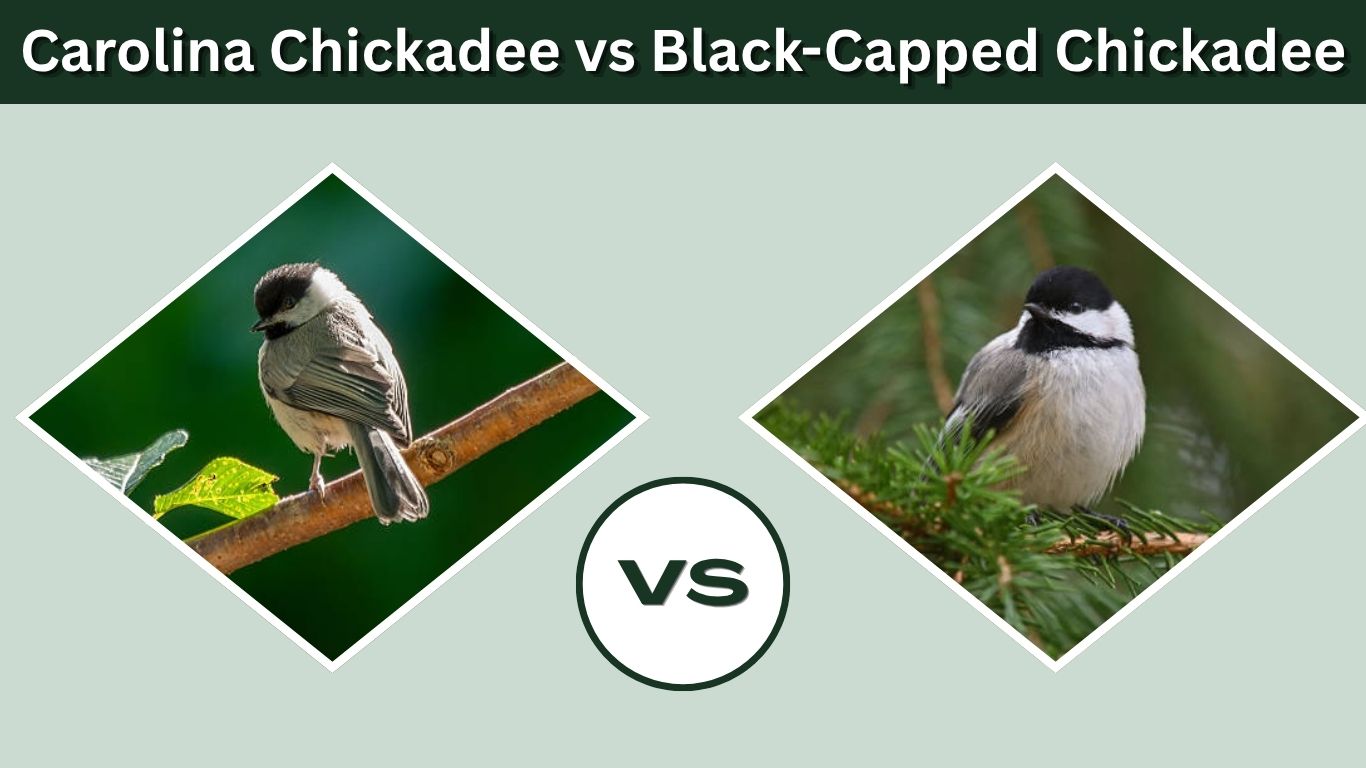
The Carolina Chickadee and Black-capped Chickadee are remarkably similar birds. Both have black caps, black throat patches, white cheeks, gray backs, and energetic feeding behavior. However, they differ in size, wing markings, songs, calls, and geographic range. The Black-capped Chickadee is generally larger and has brighter white wing edges, while the Carolina Chickadee usually looks smaller and grayer. Location is often the easiest identification clue, although hybrids can make identification difficult where their ranges meet.
Carolina Chickadee vs Black-Capped Chickadee Comparison
Although these species can look almost identical at first, several features help separate them. Range is usually the strongest clue. When both species are possible, examine the wings, body size, cheek and neck pattern, and vocalizations before deciding.
| Feature | Carolina Chickadee | Black-capped Chickadee |
| Scientific name | Poecile carolinensis | Poecile atricapillus |
| Length | 3.9–4.7 inches | 4.7–5.9 inches |
| Main range | Southeastern United States | Northern United States and Canada |
| Wing markings | Grayish, less prominent edges | Brighter white feather edges |
| Nape | Often grayish | Usually cleaner and whiter |
| Typical song | Often four whistled notes | Usually two or three whistled notes |
| Chickadee call | Faster and higher | Generally slower and clearer |
The Black-capped Chickadee averages longer and heavier, but individual measurements overlap. Plumage and voice should therefore be considered alongside location.
Appearance and Identification Differences
Both birds have rounded bodies, relatively large heads, small bills, black caps and bibs, and bold white cheeks. Their sexes also look similar, so identifying males and females in the field is usually difficult. The most useful visual differences appear on the wings, nape, sides, and overall proportions.
Wing Pattern
The Black-capped Chickadee normally has broader, brighter white edges on its secondary feathers and wing coverts. These pale edges may form a noticeable white panel across the folded wing.
The Carolina Chickadee has grayer, less contrasting edges. Its folded wings often appear more uniformly gray, without the strongly frosted look of a fresh-plumaged Black-capped Chickadee. Feather wear and lighting can reduce this difference, especially in summer.
Cheeks and Nape
Both species have white cheeks surrounded by a black cap and throat. On a Carolina Chickadee, the white cheek may become gray toward the back of the head, creating a dull grayish collar or nape.
The Black-capped Chickadee generally has a cleaner white cheek and a sharper contrast between the pale face and gray back. This is a subtle field mark and is most useful when photographs show the side and back of the head clearly.
Size and Shape
Black-capped Chickadees are typically larger, with a somewhat longer tail and heavier-looking head. Carolina Chickadees are usually more compact and delicate. However, judging size on a single bird without a direct comparison can be unreliable.
| Measurement | Carolina Chickadee | Black-capped Chickadee |
| Length | 3.9–4.7 in (10–12 cm) | 4.7–5.9 in (12–15 cm) |
| Weight | 0.3–0.4 oz (8–12 g) | 0.3–0.5 oz (9–14 g) |
| Wingspan | 5.9–7.9 in (15–20 cm) | 6.3–8.3 in (16–21 cm) |
These measurements confirm that Black-capped Chickadees are generally larger, although the smallest Black-capped individuals can overlap with the largest Carolina Chickadees.
Carolina vs Black-Capped Chickadee Calls and Songs
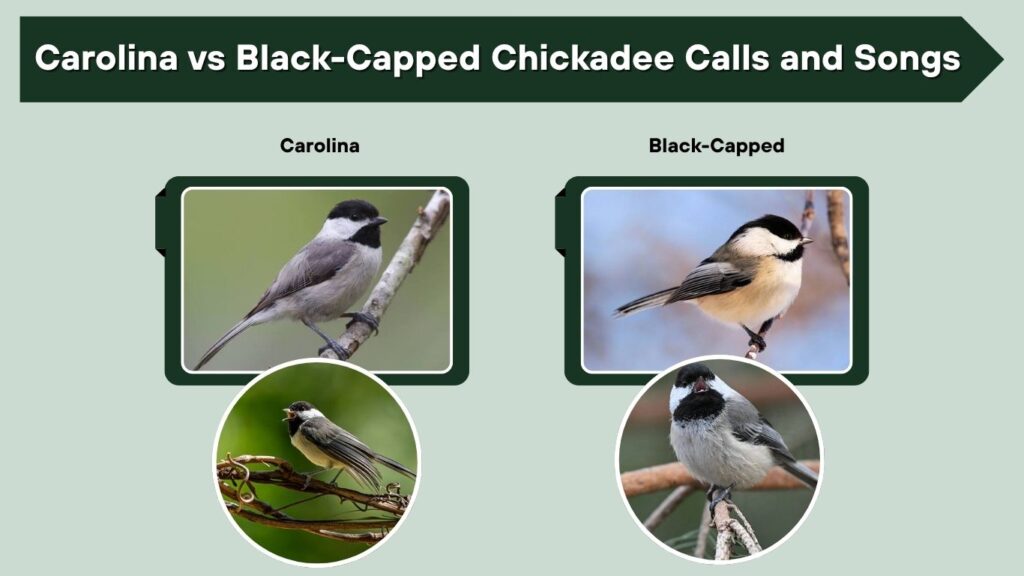
Listening is often more helpful than examining plumage. Their whistled songs usually have different structures, while their familiar “chickadee-dee-dee” calls vary in speed and tone. Regional variations, learned songs, and hybrid birds can complicate identification near the contact zone.
Carolina Chickadee Song
A Carolina Chickadee often sings a four-note whistle commonly represented as “fee-bee-fee-bay.” The first and third notes are usually higher. However, the species has numerous song variations, so not every individual produces this exact pattern.
Its chickadee call is usually faster and more hurried than the comparable Black-capped Chickadee call. Carolina Chickadees also make raspy notes, gargles, and high-pitched alarm sounds.
Black-Capped Chickadee Song
Across most of its range, the Black-capped Chickadee sings a clear two- or three-note whistle described as “fee-bee” or “hey, sweetie.” Regional differences occur, particularly in the Pacific Northwest, where songs may contain three or four notes.
Its namesake call often sounds slower and more clearly separated than that of the Carolina Chickadee. The number of “dee” notes can increase when the bird detects a greater threat.
| Sound Feature | Carolina Chickadee | Black-capped Chickadee |
| Common song | Four-note whistle | Two- or three-note whistle |
| Example | “Fee-bee-fee-bay” | “Fee-bee” or “hey, sweetie” |
| Chickadee call | Rapid and hurried | Slower and more measured |
| Reliability | Good outside overlap zone | Good outside overlap zone |
Range and Hybrid Zone
The Carolina Chickadee occupies the southeastern United States, while the Black-capped Chickadee occurs across much of the northern United States and Canada. Both are primarily resident birds, so location remains useful throughout the year.
Their ranges meet in a narrow east-central band extending roughly from New Jersey west toward Kansas. In this contact zone, the birds sometimes interbreed. Hybrids may combine the plumage characteristics of both parents and can sing either species’ song or an intermediate version.
Birds near the hybrid zone may also learn one another’s vocalizations. Therefore, an unusual-looking chickadee that produces both songs cannot always be identified confidently without genetic evidence. Recording it as “Black-capped/Carolina Chickadee” may be more accurate than forcing a species-level identification.
Habitat and Behavior

Both chickadees inhabit wooded environments and are comfortable around people. They can appear in forests, parks, suburban neighborhoods, gardens, and yards containing mature trees. They forage actively among leaves, twigs, and bark, sometimes hanging upside down while searching for insects.
Feeding Habits
Both species eat insects, spiders, seeds, berries, and other small foods. They readily visit bird feeders offering:
- Black oil sunflower seeds
- Peanut pieces
- Suet
- Sunflower hearts
A chickadee commonly takes one seed and carries it to a nearby branch rather than remaining on the feeder. Both species may also store food in bark crevices for later use.
Nesting Behavior
Carolina and Black-capped Chickadees are cavity nesters. They use natural holes, old woodpecker cavities, decaying trees, or appropriately designed nest boxes. Their nesting behavior is therefore not usually enough to separate the species without considering range, voice, and plumage.
How to Identify Them in Pictures
A photograph can make subtle plumage differences easier to examine. Use several features rather than relying on one mark.
- Check the location: Determine which species regularly occurs in the region.
- Examine the wings: Bright white feather edges suggest Black-capped; dull gray edges favor Carolina.
- Look behind the cheek: A grayish nape is more typical of Carolina.
- Compare proportions: Black-capped usually appears larger, longer-tailed, and heavier-headed.
- Consider the season: Worn summer feathers can make white wing markings less noticeable.
- Use audio when available: A recording of the bird’s song may provide stronger evidence than a distant photograph.
FAQs
Can Carolina and Black-capped Chickadees mate?
Yes. They hybridize where their ranges meet in the east-central United States. Their offspring may show mixed plumage, unusual songs, or characteristics that resemble either parent. Because hybrids can also learn different songs, visual and vocal identification may remain uncertain.
Which chickadee has more white on its wings?
The Black-capped Chickadee normally has broader and brighter white edging on its wing feathers. Carolina Chickadees have grayer and less noticeable edges. This difference is clearest in fresh plumage and may become difficult to see when feathers are worn.
Are Carolina Chickadees smaller than Black-capped Chickadees?
Carolina Chickadees are generally smaller. They measure approximately 3.9–4.7 inches long, while Black-capped Chickadees measure about 4.7–5.9 inches. Because their measurements overlap slightly, size should be combined with range, wing pattern, and voice.
How are their songs different?
The Carolina Chickadee often sings a four-note “fee-bee-fee-bay” whistle. The Black-capped Chickadee usually sings a simple two- or three-note “fee-bee” or “hey, sweetie.” Songs can vary geographically, and hybrids may produce intermediate or misleading versions.
What is the easiest way to tell them apart?
Begin with the range map. Away from the overlap zone, location usually identifies the species quickly. Where both are possible, examine wing edging and body size, listen to the song and call, and accept that some hybrids cannot be identified confidently in the field.