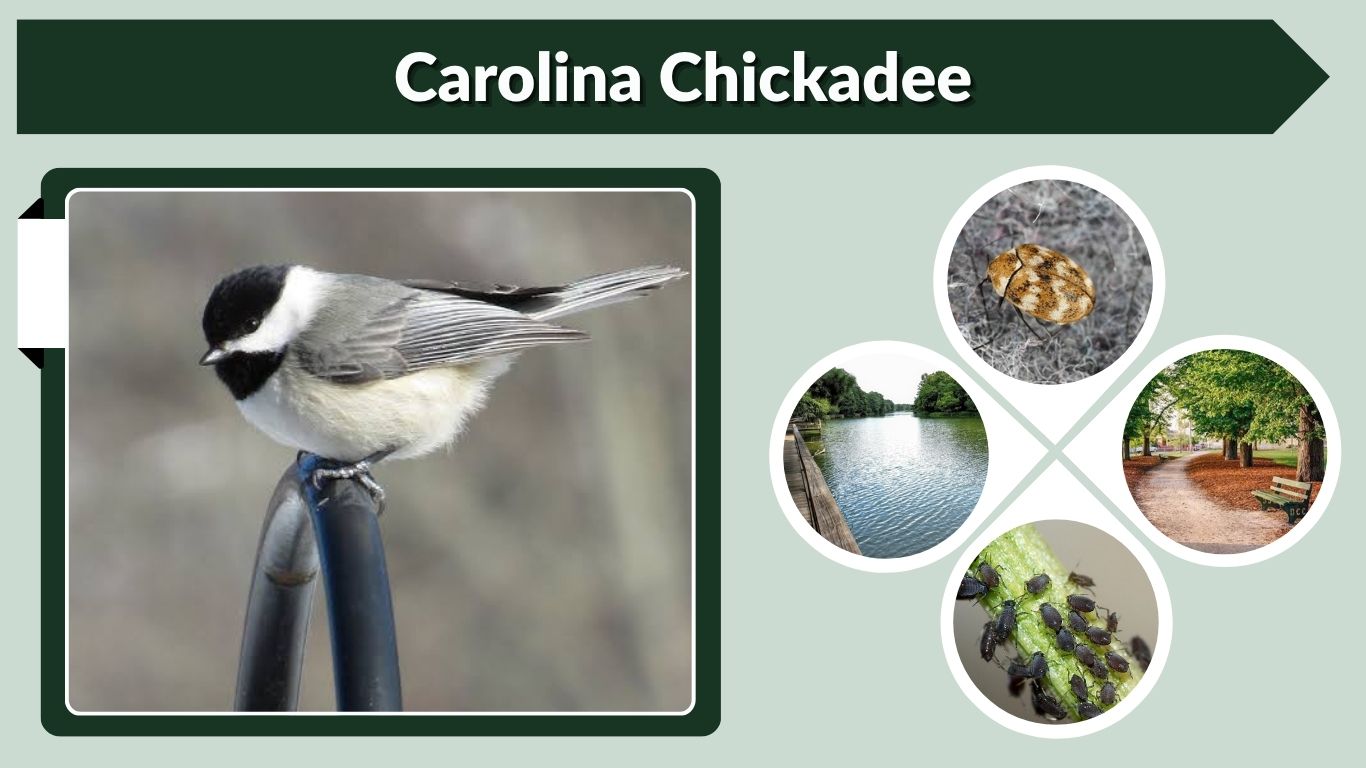
The Carolina Chickadee is a tiny, energetic songbird recognized by its black cap, white cheeks, gray back, and cheerful calls. A permanent resident of the southeastern United States, it lives in forests, parks, wooded neighborhoods, and gardens with mature trees. Carolina Chickadees forage acrobatically among branches, searching for insects, spiders, seeds, and berries. They also visit feeders and readily use suitable nest boxes. Because they closely resemble Black-capped Chickadees, location, voice, and subtle plumage differences are often needed for identification. This guide covers their appearance, size, range, sounds, diet, nesting habits, eggs, behavior, and backyard care.
What Is a Carolina Chickadee?
The Carolina Chickadee, scientifically named Poecile carolinensis, is a small member of the tit and chickadee family, Paridae. It is a curious, active bird that remains within its general range throughout the year rather than making long seasonal migrations.
Identification
- Black cap extending from the forehead to the back of the head
- Black throat patch or “bib”
- Bright white cheeks
- Soft gray back, wings, and tail
- Whitish chest and belly
- Light buff or gray coloring along the sides
- Large, rounded head with a short neck
- Small, thick, pointed bill
- Fairly long, narrow tail
- Quick, acrobatic movements among branches
Carolina Chickadees have a compact, nearly round appearance when their feathers are fluffed. Their black cap and bib create a strong contrast with the white face, while the wings usually appear relatively plain and gray.
Size and Wingspan
Carolina Chickadees measure approximately 3.9–4.7 inches long and weigh about 0.3–0.4 ounces. Their wingspan ranges from roughly 5.9 to 7.9 inches. They are smaller than most sparrows and slightly smaller on average than Black-capped Chickadees.
| Measurement | Typical range |
| Body length | 3.9–4.7 inches |
| Wingspan | 5.9–7.9 inches |
| Weight | 0.3–0.4 ounces |
| Egg length | About 0.6 inches |
| Clutch size | 3–10 eggs |
Carolina Chickadee Range and Habitat
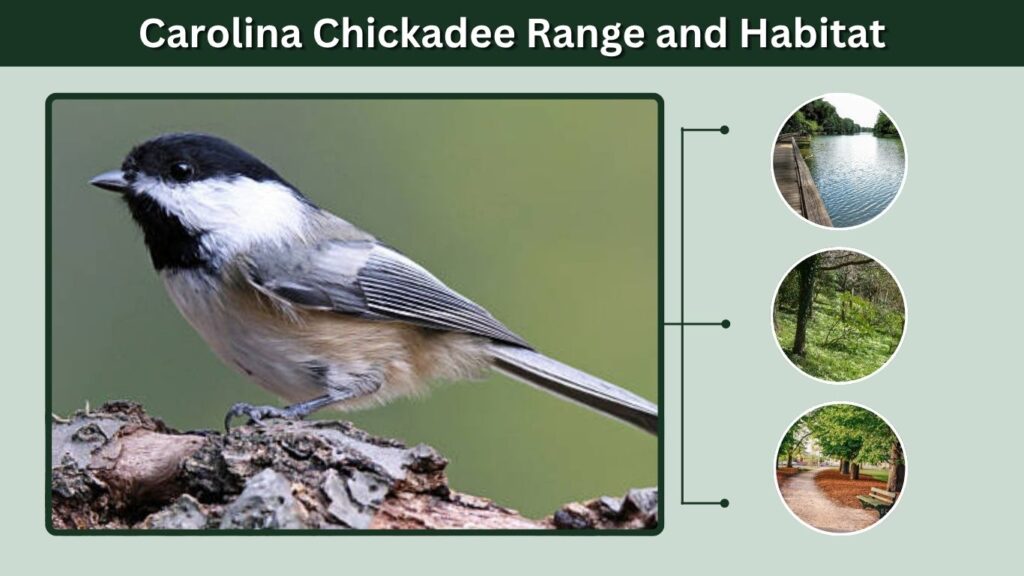
Carolina Chickadees inhabit much of the southeastern United States. They are generally nonmigratory, although individuals may occasionally move beyond the normal range. Their distribution meets that of the Black-capped Chickadee in a narrow contact zone.
Where Do Carolina Chickadees Live?
Their range extends across the Southeast and reaches westward into parts of Oklahoma. Carolina and Black-capped Chickadees meet along a relatively narrow area extending approximately from New Jersey west toward Kansas. In parts of the Appalachian Mountains, Carolina Chickadees occupy lower elevations while Black-capped Chickadees occur higher up.
Preferred Habitat
Carolina Chickadees live in deciduous and mixed forests, river groves, woodland edges, parks, and well-wooded suburban neighborhoods. They may also inhabit pine woods when oaks and other leafy trees are present. Dead trees, decaying branches, and existing cavities are valuable because the birds use them for nesting and nighttime shelter.
Do Carolina Chickadees Migrate?
Carolina Chickadees are year-round residents. They usually remain within the same general region in every season rather than traveling between distant breeding and wintering areas. During winter, they commonly form small flocks and may associate with titmice, nuthatches, kinglets, creepers, and woodpeckers.
Carolina Chickadee Sound and Song
Carolina Chickadees communicate constantly with mates, family members, and flock companions. Their vocalizations include clear whistled songs, rapid chickadee calls, alarm notes, and harsher sounds used during social interactions.
What Does a Carolina Chickadee Sound Like?
Its best-known song is often described as a four-syllable “see-bee-see-bay”, with the first and third notes higher in pitch. The familiar call is a quick, buzzy version of “chick-a-dee-dee-dee.” Compared with the Black-capped Chickadee, the Carolina’s call generally sounds faster and higher.
Meaning of the Calls
Chickadee vocalizations help maintain contact, identify danger, defend personal space, and coordinate flock movements. A dominant bird may produce a gargling call when another chickadee comes too close. Because the species has several calls, the surrounding behavior is often needed to understand what a particular sound means.
Carolina Chickadee Diet
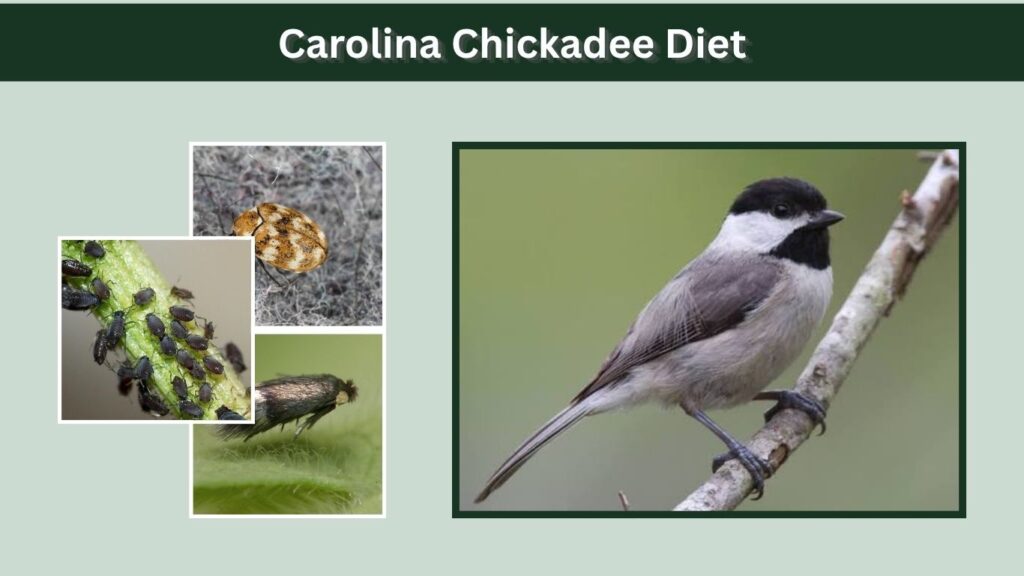
These birds feed by hopping along small branches, hanging upside down, hovering near leaves, and occasionally catching insects in flight. They also store food in bark cracks and other hidden locations for later use.
What Do Carolina Chickadees Eat?
Their natural diet includes caterpillars, beetles, moths, aphids, true bugs, insect eggs, spiders, berries, small fruits, and seeds. Insects and spiders dominate during the warmer months, when adults also need protein-rich prey for their growing chicks. Plant foods become more important during winter.
Foods to Offer at Feeders
Carolina Chickadees visit feeders containing black-oil sunflower seeds, peanut pieces, and suet. They often take one item and carry it to a secluded branch before eating. Peanuts should remain dry and free of mold, while feeders should be cleaned regularly to reduce disease transmission.
Carolina Chickadee Nesting, Eggs, and Young
Carolina Chickadees are cavity-nesting birds. A pair may enlarge soft, decaying wood, occupy an unused natural hole, use an old woodpecker cavity, or move into a properly designed nest box.
Carolina Chickadee Nest
Nest cavities are typically positioned 2–25 feet above the ground. Both birds may help prepare the cavity, but the female builds the nest using moss and pieces of bark, followed by a soft lining of animal hair or plant fibers.
Eggs and Incubation
A typical clutch contains 3–10 white eggs marked with reddish-brown dots or small blotches. Incubation lasts approximately 12–15 days, and the pair normally raises one brood per season. Newly hatched chicks are nearly naked and depend entirely on their parents.
Fledglings and Parental Care
Both parents bring food to the nestlings. Young birds remain in the cavity for roughly 16–19 days before leaving. Juvenile Carolina Chickadees resemble adults but may appear softer, duller, and fluffier while their feathers continue developing.
Carolina Chickadee vs. Black-Capped Chickadee
These two species are difficult to distinguish because both have black caps, black bibs, white cheeks, gray backs, and pale underparts. Range and vocalizations are generally more useful than appearance alone.
| Feature | Carolina Chickadee | Black-capped Chickadee |
| Main range | Southeastern United States | Northern United States and much of Canada |
| Typical song | Four-note “see-bee-see-bay” | Two- or three-part “see-beee” |
| Wing pattern | Plainer and grayer | Stronger white wing edging |
| Body size | Slightly smaller on average | Slightly larger and longer-tailed |
| Flanks | Usually less buff | Often richer buff coloring |
| Bib edge | Often straighter | Frequently rougher or uneven |
Identification becomes especially difficult where their ranges meet. The species can hybridize there, and each may learn the other’s song, producing birds with intermediate voices and physical features.
Male vs. Female Carolina Chickadee
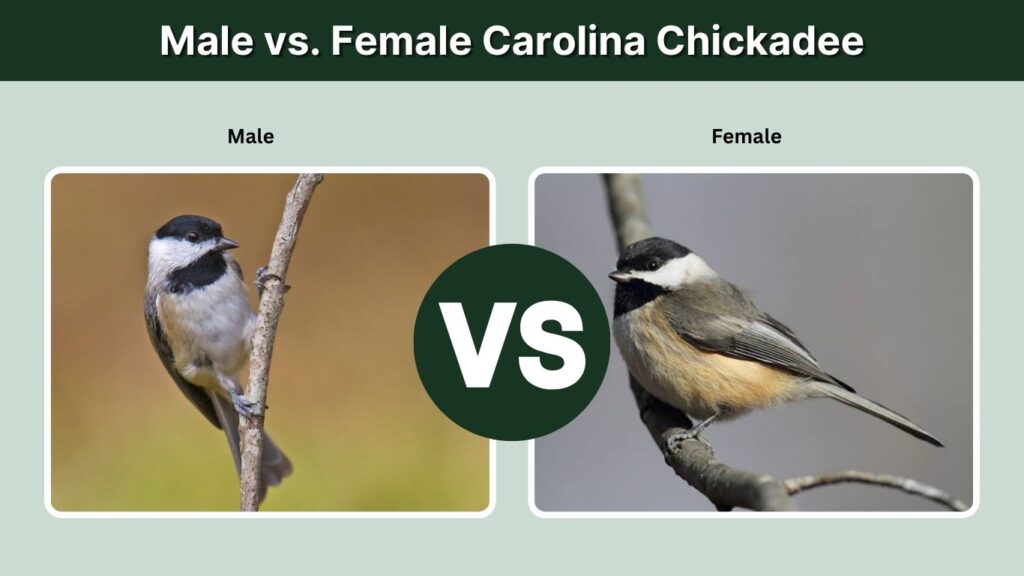
Male and female Carolina Chickadees have almost identical plumage. Both display the same black cap, white cheeks, gray upperparts, and pale underparts, so sex usually cannot be determined reliably from appearance alone.
Behavioral Differences
During nesting, the female constructs the finished nest and incubates the eggs. The male may bring food to her and later joins her in feeding the nestlings. Males may also appear more involved in territorial displays, but observing one behavior briefly does not always confirm the bird’s sex.
Attracting Carolina Chickadees
A bird-friendly yard provides natural food, safe nesting locations, clean water, and protection from predators. Mature native trees and shrubs are especially useful because they support insects and provide branches for feeding.
Nest Boxes and Birdhouses
Carolina Chickadees may use nest boxes installed before the breeding season. A box should be placed in or near wooded habitat and protected with a predator guard. Avoid opening or moving an occupied box, and clean it only after the young have left.
Making a Yard Chickadee-Friendly
Grow native trees and shrubs, leave safe dead branches where practical, limit pesticide use, and provide a shallow birdbath. Feeders can offer sunflower seeds, peanut pieces, and suet, but natural vegetation remains important because nesting adults need abundant insects for their young.
FAQs
How long do Carolina Chickadees live?
Many wild chickadees do not survive to old age, but some live much longer. The oldest recorded Carolina Chickadee was at least 10 years and 11 months old when recaptured during a banding operation in West Virginia.
Are Carolina Chickadees found in North Carolina?
Yes. North Carolina lies well within the species’ year-round southeastern range. Carolina Chickadees can be found in forests, parks, wooded suburbs, and gardens containing mature trees.
Do Carolina Chickadees mate for life?
Pairs may remain together for several years, although this varies among populations and individuals. Nest failure, loss of a mate, or changes in territory can lead a bird to form a new pairing.
Can Carolina and Black-capped Chickadees breed together?
Yes. They sometimes hybridize in the narrow region where their ranges overlap. Hybrid birds may show intermediate physical characteristics and may sing the song of either parent species.
What predators eat Carolina Chickadees?
Hawks, owls, snakes, squirrels, raccoons, and domestic cats may prey on adults, eggs, or nestlings. Predator guards on birdhouses and keeping pet cats indoors can make backyard nesting locations safer.