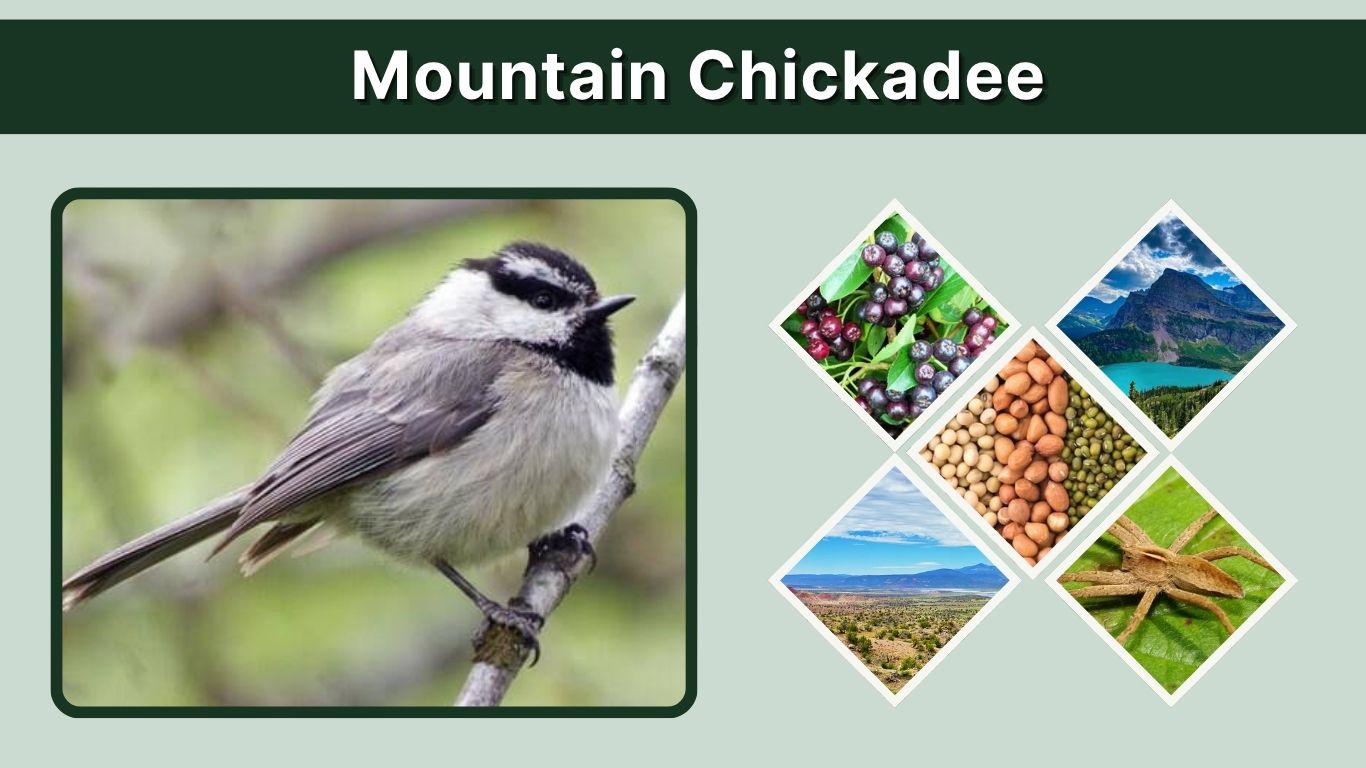
The Mountain Chickadee is a small, active songbird of western North America’s high-elevation forests. Its black cap, white cheeks, gray body, and distinctive white eyebrow make it one of the easiest chickadees to recognize. These hardy birds remain in mountain forests throughout winter, surviving cold conditions by storing seeds and remembering where they placed them. Mountain Chickadees also visit backyard feeders and occasionally use nest boxes. This guide covers their identification, size, range, habitat, diet, calls, nesting behavior, remarkable memory, lifespan, and differences from the similar Black-capped Chickadee.
What Is a Mountain Chickadee?
The Mountain Chickadee, scientifically named Poecile gambeli, belongs to the family Paridae, which includes chickadees, tits, and titmice. It is primarily associated with coniferous forests across the mountainous regions of western North America.
Identification
- Black cap divided by a bold white eyebrow stripe
- Black throat patch or bib
- Large white cheeks
- Gray back, wings, and tail
- Pale gray or whitish underparts
- Buffy or grayish sides
- Short, pointed black bill
- Rounded head and compact body
- Long, narrow tail
- Quick and acrobatic movements
The white eyebrow is the Mountain Chickadee’s most useful field mark. Its width varies geographically and may become less noticeable when the feathers are worn during summer.
Size and Wingspan
Mountain Chickadees are approximately 4.7–5.5 inches long and weigh about 0.3–0.4 ounces. Their wingspan generally measures 7.5–8.7 inches. Males and females are similar in both size and plumage.
| Measurement | Typical range |
| Length | 4.7–5.5 inches |
| Wingspan | 7.5–8.7 inches |
| Weight | 0.3–0.4 ounces |
| Clutch size | Usually 7–9 eggs |
| Nest height | Usually 5–25 feet |
Mountain Chickadee Range and Habitat
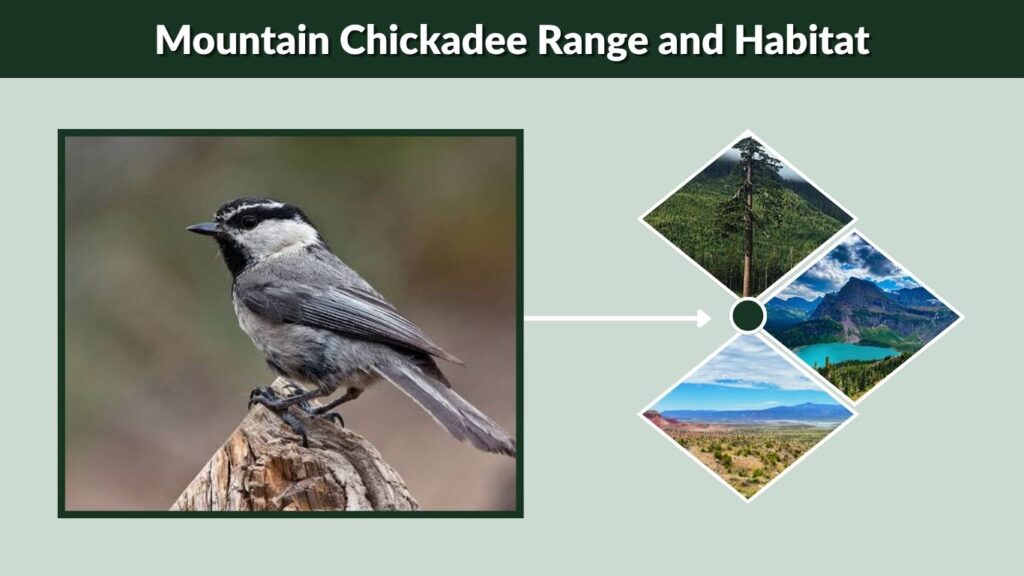
Mountain Chickadees are strongly connected to the western mountains. They usually remain in the same broad region throughout the year, although some birds descend to lower elevations when winter conditions become severe.
Where Do Mountain Chickadees Live?
Their range extends through western Canada and the mountainous western United States, including the Rocky Mountains, Sierra Nevada, Cascades, Great Basin, and parts of the Southwest. They are commonly observed in states such as Colorado, California, Arizona, Utah, Nevada, Idaho, Montana, Oregon, Washington, and New Mexico.
Preferred Habitat
Mountain Chickadees inhabit dry mountain forests dominated by pine, spruce, fir, and Douglas-fir. They may also occupy aspen groves within coniferous regions, as well as pine-oak and pinyon-juniper woodlands at lower elevations. They generally favor higher evergreen slopes, while Black-capped Chickadees are more likely to use streamside areas and deciduous trees where both species occur.
Do Mountain Chickadees Migrate?
Mountain Chickadees are mostly permanent residents rather than long-distance migrants. Some individuals, especially young birds, move downhill during winter and may appear in valleys, foothills, or areas with planted conifers. During the colder months, they often join mixed flocks containing nuthatches, kinglets, and other small forest birds.
Mountain Chickadee Call and Song
Mountain Chickadees are highly vocal birds. Their calls help flock members stay together, respond to predators, defend territories, and communicate between mates.
What Does a Mountain Chickadee Sound Like?
The typical song is a clear, whistled “fee-bee-bee,” with the final notes lower than the first. Some listeners interpret the rhythm as sounding like “cheese-bur-ger,” although the exact number and arrangement of notes can vary. The song is heard most frequently during spring and summer.
Chick-a-Dee Call
The familiar contact and alarm call is a raspy variation of “chick-a-dee-dee.” Birds use it while moving with a flock, confronting rivals, or mobbing a predator. Mountain Chickadees may repeat portions of the call depending on the situation.
Defensive Nest Sounds
A female or large nestling disturbed inside a cavity may hiss and strike the nest’s interior. This behavior can resemble the sound of a snake and may frighten away a curious predator.
Mountain Chickadee Diet
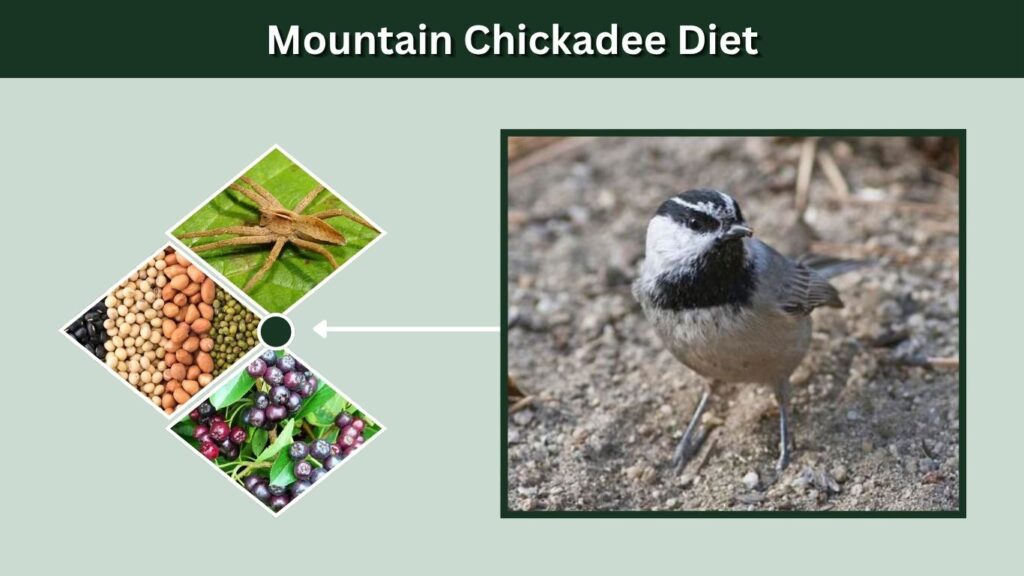
Mountain Chickadees eat a combination of animal and plant foods. Their diet changes with the seasons as insects become abundant in summer and seeds become increasingly important during winter.
What Do Mountain Chickadees Eat?
Their diet includes caterpillars, beetles, insect eggs, pupae, spiders, seeds, berries, and small fruits. They search bark cracks, pine needles, cones, twigs, and foliage for food. These agile birds frequently hang upside down or hover briefly while collecting an insect from a branch.
Food Caching
Mountain Chickadees store individual seeds and other food items in bark, lichens, and branch crevices. They later rely on spatial memory to locate these scattered supplies during snowy periods when fresh food is difficult to find. Researchers report that a bird may hide tens of thousands of items during warmer months.
Foods to Offer at Feeders
Mountain Chickadees readily visit feeders containing black-oil sunflower seeds, shelled sunflower pieces, peanuts, and suet. Feeders should be kept clean, and spoiled or moldy food should be removed. Native trees and shrubs also provide insects, natural seeds, protective cover, and possible nesting locations.
Mountain Chickadee Nesting and Eggs
Mountain Chickadees nest inside enclosed cavities rather than building exposed nests on branches. Suitable holes can be limited in managed forests where dead and decaying trees have been removed.
Nest Location and Construction
A pair may use a natural tree cavity, an abandoned woodpecker hole, or a cavity they enlarge in soft wood. Both sexes may participate in excavation. The female builds a soft nest from bark fibers, moss, animal hair, and feathers. Nest sites are usually 5–25 feet above the ground, although lower locations are sometimes used.
Eggs and Incubation
A female usually lays 7–9 eggs, although clutches may contain 5–12. The eggs are white with reddish-brown dots or may occasionally be unmarked. The female performs most or all incubation for approximately 14 days.
Chicks and Fledglings
The male initially brings much of the food while the female remains with the newly hatched chicks. Both parents later collect insects for the growing nestlings. Young Mountain Chickadees generally leave the cavity at around three weeks of age.
Mountain Chickadee Memory
Mountain Chickadees have become important research subjects because they depend heavily on memory to recover food caches. This ability can directly affect their chances of surviving harsh mountain winters.
How Good Is Their Memory?
Experiments using electronically controlled feeders show that individual chickadees can learn and remember which feeder contains their reward. Researchers assess performance by counting how many incorrect feeders a bird visits before selecting the correct one. A 2024 study connected differences in performance with 97 genetic regions associated with spatial learning and memory.
High-Elevation Birds
Research in the Sierra Nevada found that chickadees from higher elevations performed better in spatial-memory tests than birds living only 600 metres lower. The high-elevation birds also had larger hippocampi and nearly twice as many hippocampal neurons, suggesting that severe winter conditions may favor stronger food-location memory.
Mountain Chickadee vs. Black-Capped Chickadee
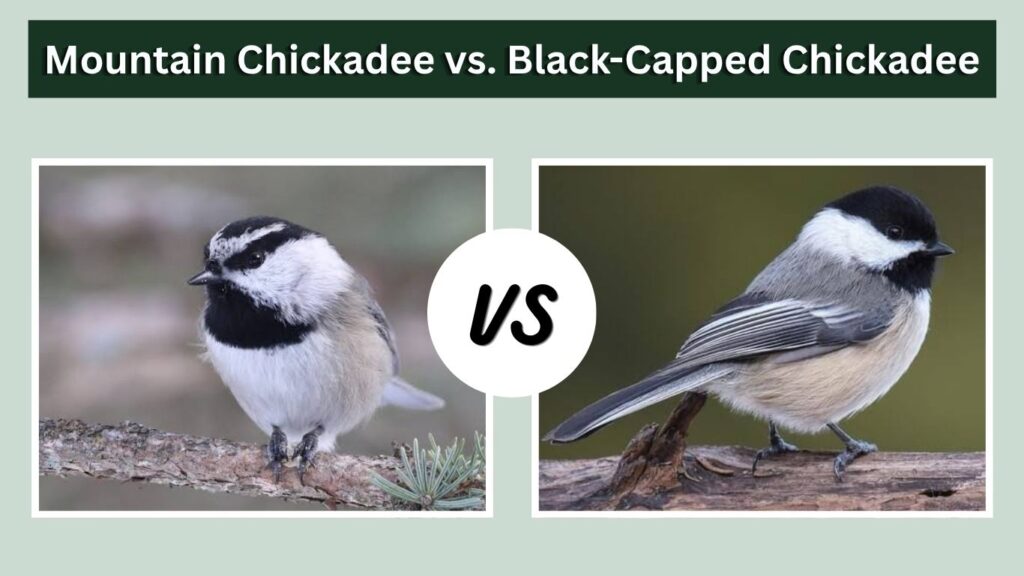
These birds share a black cap, white cheeks, gray upperparts, and a black throat. Range and head markings provide the easiest ways to separate them.
| Feature | Mountain Chickadee | Black-capped Chickadee |
| Head marking | Bold white eyebrow | No white eyebrow |
| Primary habitat | Western mountain conifers | Northern mixed and deciduous forests |
| Typical song | Three-note “fee-bee-bee” | Usually two-note “fee-bee” |
| Range | Mountainous western North America | Alaska, Canada, and northern United States |
| Winter movement | May descend to lower elevations | Mostly remains within regional range |
The Mountain Chickadee’s white eyebrow is normally diagnostic. Where both species occur, Mountain Chickadees tend to remain higher on evergreen slopes, while Black-capped Chickadees often favor lower streamside vegetation and deciduous trees.
Male vs. Female Mountain Chickadee
Male and female Mountain Chickadees look almost identical. Both possess the characteristic white eyebrow, black cap, black bib, gray back, and pale underside.
Behavioral Differences
Sex is easier to determine during nesting. The female lays and incubates the eggs and spends more time warming newly hatched chicks. The male supplies food during early nesting, although both parents eventually feed the young.
FAQs
How long do Mountain Chickadees live?
Many wild birds die within their first few years, but some survive much longer. The oldest recorded Mountain Chickadee was a male at least 10 years and 1 month old when found alive in Utah.
Why do Mountain Chickadees have white eyebrows?
The white eyebrow is a natural plumage feature that distinguishes this species from most other North American chickadees. Its width varies among regional populations and individual birds.
Are Mountain Chickadees found in Colorado?
Yes. Mountain Chickadees are common year-round residents in Colorado’s coniferous mountain forests. They may move into lower foothills and valleys during severe winter weather.
Do Mountain Chickadees use birdhouses?
They may use nest boxes when the entrance and interior dimensions are appropriate. Boxes should be installed near wooded habitats and protected from squirrels, cats, raccoons, and other predators.
Are Mountain Chickadees endangered?
Mountain Chickadees remain widespread and are classified as a species of least conservation concern. However, some surveys indicate regional declines, and the removal of dead trees can reduce the number of available nesting cavities.