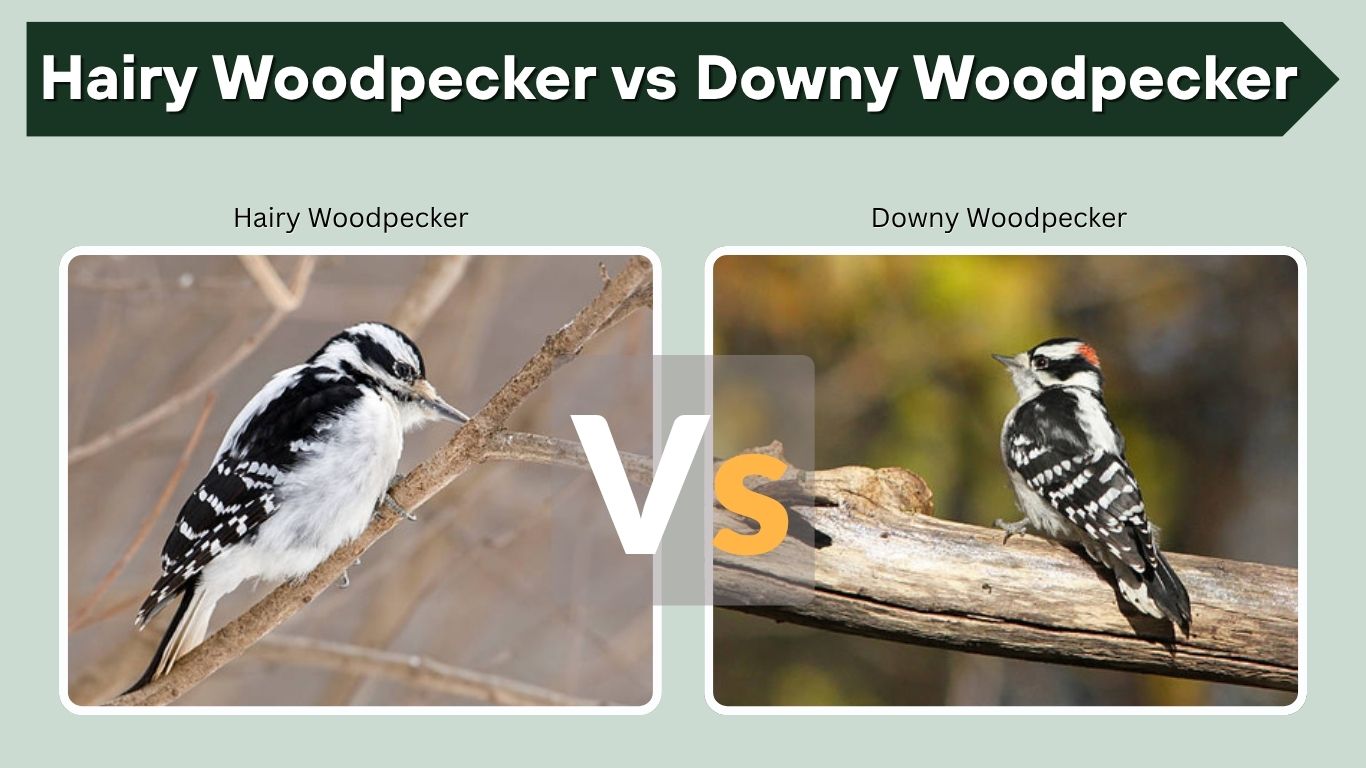
The Hairy Woodpecker and Downy Woodpecker are among the most easily confused birds in North America. Both have black-and-white plumage, white backs, spotted wings, and similar head patterns. Adult males of both species also have a small red patch behind the crown. However, differences in body size, bill length, tail markings, calls, drumming, and feeding behavior make accurate identification possible. This guide explains how to distinguish a Downy Woodpecker from a Hairy Woodpecker in your backyard or in the field.
Downy vs Hairy Woodpecker Comparison
At first glance, these two woodpeckers can appear almost identical. The Hairy Woodpecker is essentially a larger, more powerful-looking bird, while the Downy Woodpecker has a smaller body and a noticeably shorter bill.
| Feature | Downy Woodpecker | Hairy Woodpecker |
| Length | 5.5–6.7 inches | 7.1–10.2 inches |
| Wingspan | 9.8–11.8 inches | 13–16.1 inches |
| Weight | 0.7–1 ounce | 1.4–3.4 ounces |
| Bill | Short and delicate | Long and heavy |
| Outer tail feathers | Usually have black spots | Usually plain white |
| Main call | High, soft “pik” | Stronger, sharper “peek” |
| Whinny | Descends near the end | Usually remains level |
| Typical feeding area | Small limbs and plant stems | Trunks and large branches |
The Downy is roughly two-thirds the size of a Hairy Woodpecker. Nevertheless, size can be difficult to judge when only one bird is present, so bill proportions and tail markings are generally more useful.
Size Difference Between Downy and Hairy Woodpeckers
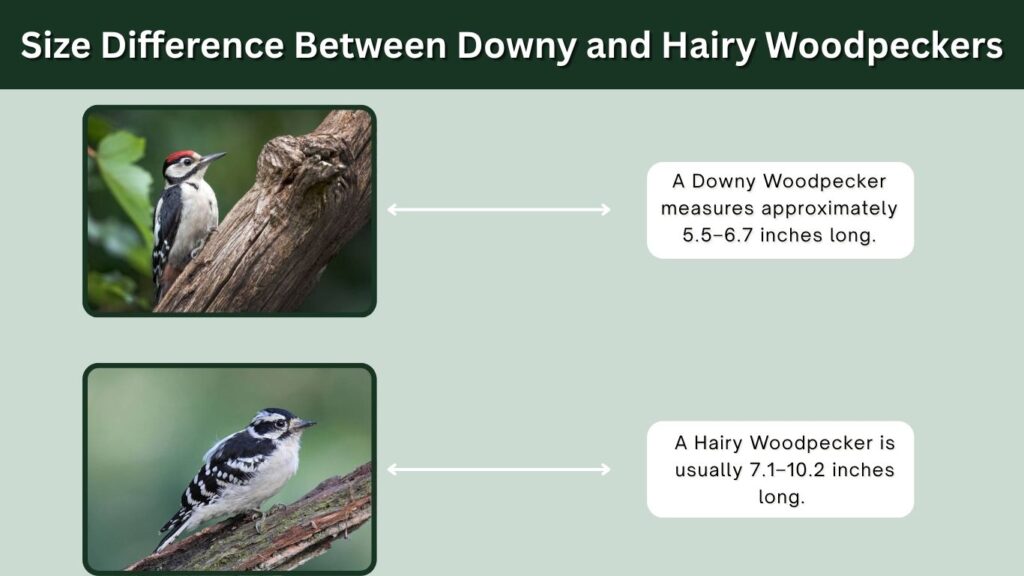
Body size is the most obvious difference when the birds are seen together.
Downy Woodpecker Size
A Downy Woodpecker measures approximately 5.5–6.7 inches long. It is only slightly larger than many sparrows and has a compact body, rounded head, and delicate appearance.
Its small size allows it to forage on narrow branches, weed stalks, seed heads, and other surfaces that may not support a heavier bird.
Hairy Woodpecker Size
A Hairy Woodpecker is usually 7.1–10.2 inches long and is closer to an American Robin in overall size. It has a stronger body, larger head, longer tail, and more powerful bill.
The Hairy Woodpecker often looks noticeably heavier and more upright when clinging to a tree trunk. It is approximately one-third larger than a Downy Woodpecker.
Bill Size: The Best Identification Clue
Bill length is usually the most dependable feature in a Hairy vs Downy Woodpecker identification.
Downy Woodpecker Bill
The Downy Woodpecker has a short, narrow bill. It is approximately one-third to one-half the length of the bird’s head and often looks unusually small compared with the face.
Soft feathers around the base of the bill can make it look even shorter. When viewing a picture of a Downy Woodpecker, the bill rarely projects far beyond the head.
Hairy Woodpecker Bill
The Hairy Woodpecker has a long, strong bill that is nearly equal to the length of its head. It projects clearly beyond the face and gives the bird a sharper, more powerful profile.
When size is difficult to estimate, compare the bill with the distance from the base of the bill to the back of the head. A nearly head-length bill strongly suggests a Hairy Woodpecker.
Downy vs Hairy Woodpecker Tail Markings
The white outer tail feathers provide another valuable field mark, especially when the bird faces away or spreads its tail against a tree.
Downy Woodpecker Tail
A Downy Woodpecker normally has small black bars or spots on its white outer tail feathers. These markings may appear as dark dots near the edges of the folded tail.
The spots are not always visible because branches, shadows, feather position, or distance may hide them. Their presence, however, strongly supports a Downy identification.
Hairy Woodpecker Tail
A Hairy Woodpecker generally has clean, unmarked white outer tail feathers. The contrast between the black central tail and plain white outer feathers is especially noticeable when the bird is seen from behind.
An apparently plain white tail supports Hairy Woodpecker, although the bill should also be checked before making a final identification.
Male and Female Downy vs Hairy Woodpeckers
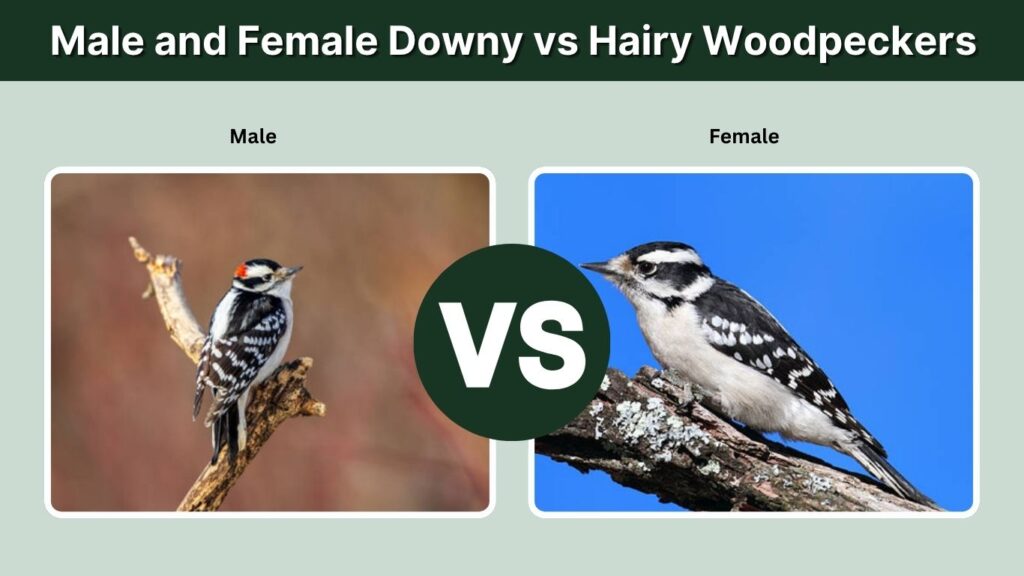
Sex does not significantly change the features used to separate these species.
Male Woodpeckers
Adult males of both species have a red patch on the back of the head. The patch is small and located behind the crown rather than covering the entire top of the head.
A male Hairy still has the larger body, long bill, and usually unmarked outer tail. A male Downy retains the short bill and usually spotted outer tail feathers.
Female Woodpeckers
Female Downy and Hairy Woodpeckers lack the male’s red patch. Their heads are entirely black and white, making them appear even more similar.
To separate females, ignore the absence of red and concentrate on bill length, overall size, and tail markings. A small female with a short bill is a Downy, while a larger female with a long bill is likely a Hairy.
Downy vs Hairy Woodpecker Calls
The two species produce similar single notes and rattling calls, but careful listening reveals several differences.
Downy Woodpecker Sound
The Downy Woodpecker commonly gives a sharp, high-pitched “pik” note. Its longer whinny consists of a fast series of high notes that noticeably descends in pitch near the end.
A useful memory aid is that the Downy’s call goes “down” at the end.
Hairy Woodpecker Sound
The Hairy Woodpecker’s contact call is a sharper, stronger “peek” note. It is generally lower and more forceful than the Downy’s call.
The Hairy also produces a rattling whinny, but it usually remains at a relatively even pitch rather than dropping noticeably at the end.
Hairy vs Downy Woodpecker Drumming
Both species drum on trees and other resonant surfaces to announce territories, communicate with mates, and support courtship. Drumming is not the same as drilling into wood to find food.
The Downy’s drum is short and relatively slow, averaging around 17 strikes per second. The Hairy Woodpecker’s drum is faster, stronger, and more forceful, with a typical sequence lasting around one second. Sound alone takes practice, but the faster pace can help identify a Hairy when the bird cannot be seen.
Habitat and Feeding Behavior
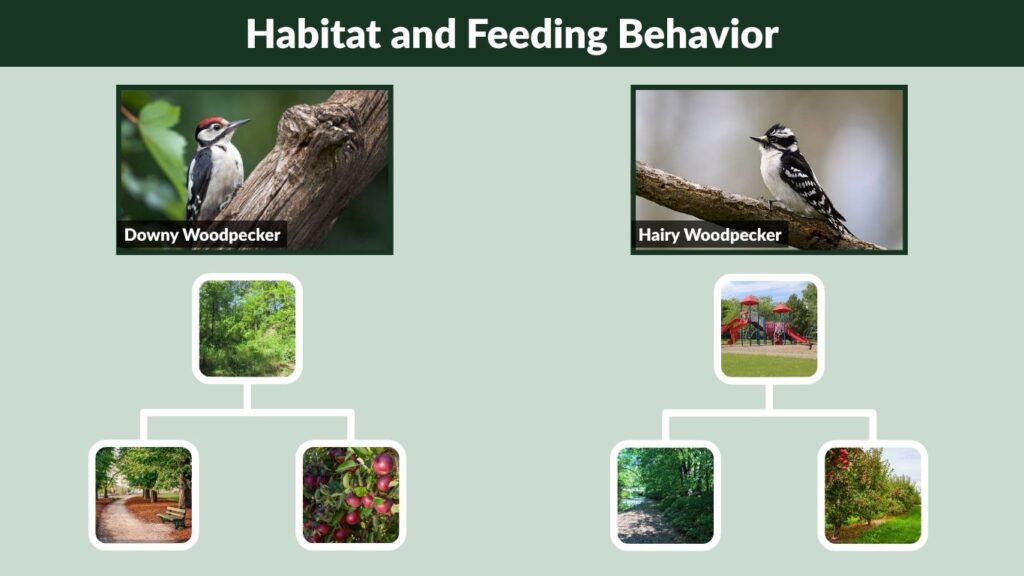
These species overlap across much of North America and can visit the same parks, forests, yards, and suet feeders. Their preferred feeding positions can provide additional clues.
Downy Woodpecker Habitat and Behavior
Downy Woodpeckers are common in open deciduous woodlands, forest edges, orchards, parks, backyards, and areas with shrubs or tall weeds.
They frequently search small limbs, plant stems, seed heads, and thin branches. Their light weight allows them to hang from surfaces that would be difficult for a larger woodpecker to use.
Hairy Woodpecker Habitat and Behavior
Hairy Woodpeckers occur in forests, woodlots, parks, wooded suburbs, burned forests, and areas containing dead or insect-damaged trees.
They usually forage on trunks and major branches, where they use their longer bills to reach insects beneath bark or inside wood. They may visit backyard suet and sunflower feeders but often appear less frequently than Downy Woodpeckers.
How to Identify Them Quickly
When comparing a Downy Woodpecker vs Hairy Woodpecker, check the bird in this order:
- Look at the bill: Short means Downy; nearly head-length means Hairy.
- Estimate the body size: Sparrow-sized suggests Downy; robin-sized suggests Hairy.
- Inspect the outer tail: Black spots suggest Downy; plain white suggests Hairy.
- Listen to the whinny: Descending indicates Downy; level suggests Hairy.
- Notice where it feeds: Thin branches favor Downy; trunks and large limbs favor Hairy.
No single clue is perfect in every view. Combining two or three features gives the most reliable identification.
FAQs
Which is bigger, a Downy or Hairy Woodpecker?
The Hairy Woodpecker is considerably larger. It measures approximately 7.1–10.2 inches long, compared with 5.5–6.7 inches for the Downy. The Hairy also has a wider wingspan, heavier body, larger head, and longer bill.
What is the easiest way to distinguish them?
Compare the bill with the size of the head. A Downy Woodpecker’s bill appears short and delicate, while a Hairy Woodpecker’s bill is nearly as long as its head. This feature is usually easier to judge than overall body size.
Do female Downy and Hairy Woodpeckers have red heads?
Adult females of both species lack the red patch seen on adult males. Female identification therefore depends on body size, bill length, and tail markings rather than head color. Juveniles may temporarily show red in a different position.
Can Downy and Hairy Woodpeckers visit the same feeder?
Yes. Both species may visit backyard feeders offering suet, sunflower seeds, or peanuts. Downy Woodpeckers are usually more frequent feeder visitors, while Hairy Woodpeckers may be more cautious or remain closer to wooded cover.
Are Downy and Hairy Woodpeckers closely related?
Despite their nearly identical appearance, they are separate species. Their similarity is unusually strong, but differences in body size, bill proportions, sounds, tail markings, and behavior allow birdwatchers to identify them accurately.