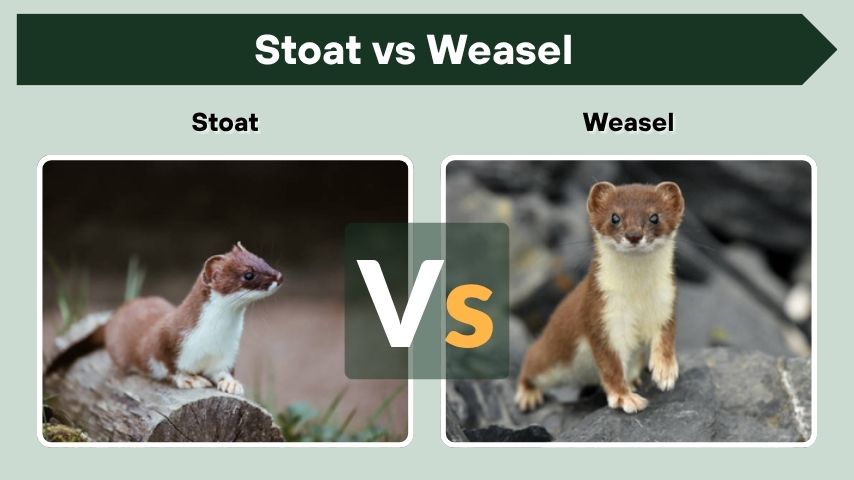
Stoats and weasels look so similar that many people confuse them at first sight. Both are small, fast, slim predators from the mustelid family, and both have long bodies, short legs, and sharp hunting skills. The easiest way to tell them apart is usually the tail. A stoat is generally larger and has a longer tail with a black tip, while a weasel is smaller with a shorter plain tail. This guide explains their size, appearance, habitat, and key differences.
Stoat vs Weasel: Quick Difference
The main difference between a stoat and a weasel is the tail. A stoat usually has a longer tail with a black tip, while a weasel has a much shorter tail without a black end. Stoats are also generally bigger than weasels. However, young stoats and large weasels can sometimes look confusingly similar in the wild.
Main Identification Points
- Stoats are usually larger than weasels.
- Stoats have a longer tail with a black tip.
- Weasels have a shorter, plain-colored tail.
- Stoats may turn white in winter in colder regions.
- Weasels are usually slimmer and smaller.
- Both animals are fast, agile hunters.
- The tail is usually the best clue for identification.
Stoat vs Weasel Size
A stoat is usually longer and heavier than a least weasel. Stoats have a more noticeable tail, while weasels look shorter and more compact. Size can help, but it should not be the only clue. A small stoat may look like a large weasel, especially if you only see the animal for a few seconds.
Stoat vs Weasel Tail
The tail is the most useful difference. A stoat has a longer tail with a clear black tip. A weasel has a shorter tail that is usually brown, without a black end. If you see the animal clearly from the side or back, the tail can quickly help you decide whether it is a stoat or a weasel.
What Is a Stoat?
A stoat is a small wild carnivore with a long body, short legs, and a strong hunting instinct. It is also known as an ermine when it has a white winter coat. Stoats are found in many habitats, including fields, woodland edges, hedgerows, grasslands, and farmland. They are quick, bold, and skilled at catching small prey.
Stoat Appearance
A stoat usually has a brown upper body and a pale or cream-colored underside. Its body is long and flexible, helping it move through grass, burrows, and narrow spaces. The most famous feature is its tail, which is longer than a weasel’s tail and has a black tip. In colder places, a stoat may turn white in winter.
Stoat Habitat
Stoats live in areas where they can find cover and prey. They are often seen near woodland edges, fields, stone walls, hedgerows, and rough grassland. They do not need deep forests to survive. They prefer places where mice, voles, rabbits, birds, and eggs are available.
Stoat Behavior
Stoats are energetic hunters. They can run, climb, swim, and enter burrows. Their hunting style is fast and persistent. A stoat may appear playful when it jumps or twists, but this movement can also be part of hunting or avoiding danger. Stoats are wild animals and should not be approached or handled.
What Is a Weasel?
A weasel is also a small carnivorous mammal from the mustelid family. In many comparisons, “weasel” means the least weasel, which is smaller than a stoat. Weasels have slim bodies, short legs, small heads, and short tails. They are difficult to spot because they move quickly and often stay close to cover.
Weasel Appearance
A weasel usually has a brown back and a pale underside. Its body is very slim, allowing it to move through tight spaces and small burrows. Compared with a stoat, a weasel looks smaller and has a shorter tail. The tail normally does not have the black tip that makes stoats easier to identify.
Weasel Habitat
Weasels live in grasslands, fields, hedges, woodland edges, farms, and gardens where small prey is common. They often hunt mice and voles, so they may be found in places with long grass or thick ground cover. Because they are so small, they can disappear into vegetation very quickly.
Weasel Behavior
Weasels are fierce hunters for their size. They are active, alert, and very fast. Their slim bodies help them chase prey into holes and tunnels. Although they are tiny, they are strong predators. Like stoats, weasels are wild animals and should be watched from a distance.
Stoat vs Weasel Comparison Table
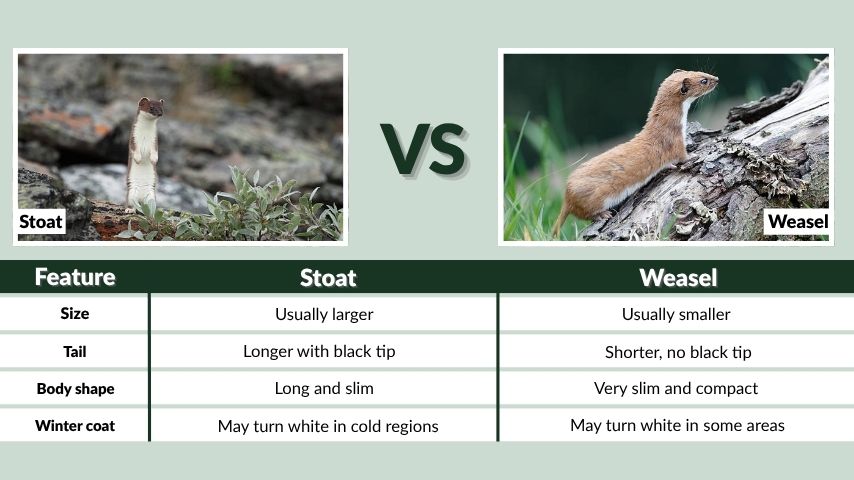
A comparison table makes it easier to understand the difference between these two animals. While both are small mustelids, the tail, size, and winter coat are the most useful clues. The table below gives a simple side-by-side view for quick identification, especially when you are comparing photos or trying to identify one in the wild.
| Feature | Stoat | Weasel |
| Size | Usually larger | Usually smaller |
| Tail | Longer with black tip | Shorter, no black tip |
| Body shape | Long and slim | Very slim and compact |
| Winter coat | May turn white in cold regions | May turn white in some areas |
| Other name | Ermine in white winter coat | Often called least weasel |
| Best clue | Black-tipped tail | Short plain tail |
| Habitat | Fields, hedges, woodland edges | Fields, grassland, hedges |
| Behavior | Bold, fast hunter | Tiny, quick hunter |
Best Field Clue
The black-tipped tail is usually the best field clue for a stoat. If the animal is small, brown, and quick, but you can clearly see a black tip on a longer tail, it is more likely to be a stoat. If the tail is short and plain, it is more likely to be a weasel.
Why Size Can Be Misleading
Size is helpful, but it can be misleading. A young stoat may look small, while a large weasel may look bigger than expected. Distance, camera angle, and movement can also make size hard to judge. That is why the tail is usually a better clue than body length alone.
Stoat vs Weasel Pictures: What to Look For
Pictures can help you identify a stoat or weasel, but they can also be confusing. A hidden tail, poor lighting, young animal, or blurry photo can make identification difficult. When looking at stoat vs weasel pictures, focus on the tail, body length, color pattern, and location rather than relying on size alone.
Visual Identification Tips
- Look for a black tip on the tail.
- Compare the tail length with the body.
- Notice whether the animal looks very tiny or more medium-sized.
- Check if the underside is pale or cream-colored.
- Look for a white winter coat in colder regions.
- Consider where the photo was taken.
- Do not rely on one blurry image for identification.
Baby Stoat vs Weasel
A baby stoat can be especially hard to tell apart from a weasel. Young stoats are smaller than adults, so size may not help much. If the tail is visible, look for the black tip. If the tail is hidden, it may be impossible to identify the animal confidently from a photo alone.
Ermine vs Stoat vs Weasel
An ermine is not a separate animal from a stoat. It usually means a stoat in its white winter coat. A white stoat still has a black tip on the tail. A weasel may also turn pale or white in some places, but it usually lacks the black-tipped tail.
Stoat vs Weasel vs Ferret vs Mink
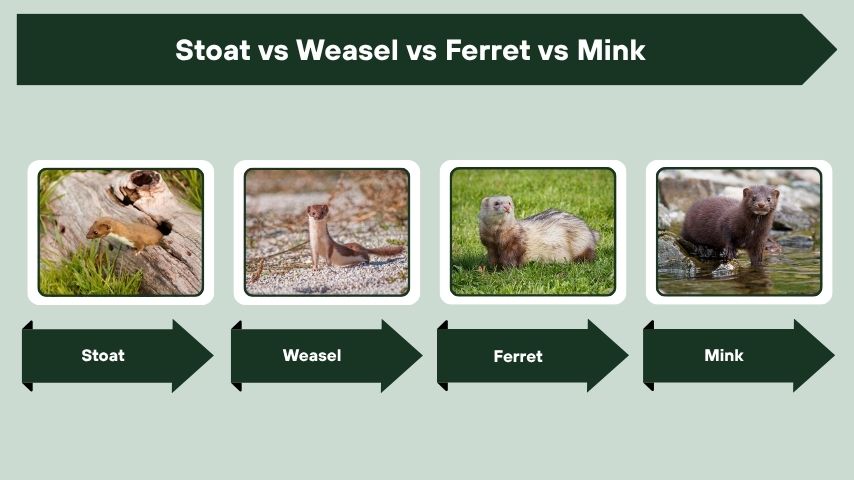
Stoats and weasels are often compared with ferrets and mink because all of them have long bodies and short legs. However, they are not the same animal. Ferrets are usually larger and commonly domesticated. Mink are darker, larger, and strongly linked with water. Stoats and weasels are smaller wild hunters.
Ferret vs Stoat vs Weasel
A ferret is usually much bigger and heavier than both a stoat and a weasel. Domestic ferrets may have many coat colors, including cream, sable, white, and mixed patterns. Stoats and weasels are wild animals with more natural brown-and-pale coloring. Ferrets are also more commonly kept as pets, while stoats and weasels are not.
Mink vs Stoat vs Weasel
A mink is usually larger and darker than a stoat or weasel. Mink often live near rivers, streams, ponds, lakes, and wetlands. Their bodies are strong, and their fur is usually dark brown. If you see a dark mustelid near water, mink may be more likely than stoat or weasel.
Stoat vs Weasel vs Pine Marten
A pine marten is much larger than a stoat or weasel. It has a longer, bushier tail and often a creamy or yellowish throat patch. Pine martens are also strong climbers and spend more time in woodland habitats. If the animal looks cat-sized compared with a tiny weasel, it is not likely to be a weasel.
Stoat vs Weasel in the UK and New Zealand
Stoat and weasel identification can depend on location. In the UK, both animals are native and may be seen in the countryside, gardens, farms, hedgerows, and woodland edges. In New Zealand, stoats, weasels, and ferrets are introduced predators and are important in conservation discussions because they threaten native birds and eggs.
Stoat vs Weasel UK
In the UK, the easiest way to separate a stoat from a weasel is still the tail. Stoats are usually bigger and have a black-tipped tail. Weasels are smaller, shorter, and have a plain tail. Both can be seen moving quickly through grass, hedges, or along walls.
Stoat vs Weasel NZ
In New Zealand, stoats and weasels are not just identification topics; they are also pest and conservation concerns. Stoats are usually larger and more commonly discussed because of their impact on native birds. Weasels are smaller, but they are also introduced predators. Correct identification can help with reporting and pest control.
Why Local Context Matters
The same animal can be viewed differently depending on the country. In one place, people may simply want to identify wildlife. In another, the animal may be part of conservation management. Knowing your location helps narrow down which species are likely and why the identification matters.
How to Identify Mustelids Quickly
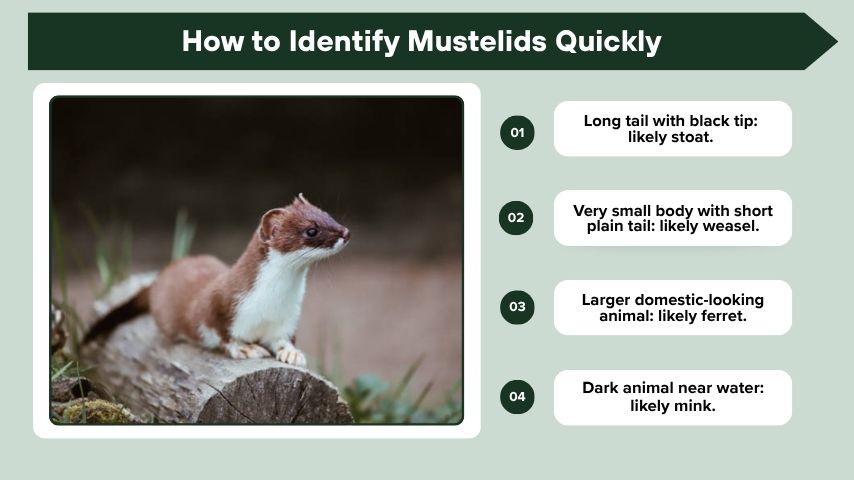
Stoats, weasels, ferrets, mink, martens, and polecats all belong to or are related to the wider mustelid group, except animals like mongooses, which are different. Because many of them have long bodies and short legs, beginners often confuse them. A quick checklist can help you identify the animal more confidently.
Quick Mustelid Checklist
- Long tail with black tip: likely stoat.
- Very small body with short plain tail: likely weasel.
- Larger domestic-looking animal: likely ferret.
- Dark animal near water: likely mink.
- Larger climber with bushy tail: likely pine marten.
- Dark body with masked face: likely polecat.
- Similar shape but different family: possibly mongoose, depending on region.
Stoat vs Polecat
A polecat is larger, darker, and heavier than a stoat. It often has a masked face and a stronger body shape. Stoats are slimmer, smaller, and have the black-tipped tail. If the animal looks much bigger than a stoat and has dark facial markings, it may be a polecat.
Stoat vs Mongoose
A mongoose is not a stoat or weasel. Mongooses belong to a different animal family and are more common in warmer regions. They may look similar to some people because of their long bodies, but their behavior, range, and physical features are different from stoats and weasels.
FAQs
What is the main difference between a stoat and a weasel?
The main difference is the tail. A stoat usually has a longer tail with a black tip, while a weasel has a shorter tail without a black end. Stoats are also generally larger than weasels, but size can be misleading if the animal is young or far away.
Is an ermine the same as a stoat?
Yes, an ermine is usually a stoat in its white winter coat. The animal is still the same species, but the term “ermine” is often used when the coat turns white in colder seasons. The black tail tip usually remains visible, which helps with identification.
Which is bigger, a stoat or a weasel?
A stoat is usually bigger than a weasel. It has a longer body and a longer tail. However, size alone is not always reliable because young stoats and large weasels may overlap. The black-tipped tail is usually the better clue.
How can I tell a stoat from a weasel in pictures?
Look at the tail first. A stoat normally has a longer tail with a black tip, while a weasel has a short plain tail. Also check body size, posture, location, and coat color. If the tail is hidden, identification may be uncertain.
Are stoats, weasels, and ferrets the same?
No, they are different animals, although they are related. Stoats and weasels are small wild hunters, while ferrets are usually larger and often domesticated. Ferrets can have many coat colors, but stoats and weasels have more natural wild color patterns.