
The Japanese weasel is a small, quick, and secretive carnivorous mammal native to Japan. Known in Japanese as “itachi,” this animal appears in wildlife guides, local folklore, idioms, and even modern news stories. Although it may look cute, the Japanese weasel is a wild predator with sharp teeth, strong hunting instincts, and an important role in Japan’s ecosystems.
What Is a Japanese Weasel?
The Japanese weasel is a member of the weasel family, Mustelidae. Its scientific name is Mustela itatsi. It has a long, narrow body, short legs, a pointed face, rounded ears, and a long tail. Like other weasels, it is built for moving through grass, brush, rocks, riverbanks, and narrow hiding places.
Japanese weasels are often described as orange-brown, golden-brown, or reddish-brown, with a lighter underside and darker facial markings. Their slim body shape helps them chase small prey into tight spaces.
Japanese Weasel Scientific Name
The scientific name of the Japanese weasel is Mustela itatsi. The word “itatsi” comes from “itachi,” the Japanese word for weasel. This makes the animal’s scientific name closely connected to its Japanese language name.
Is It the Same as a Ferret?
No. A Japanese weasel is not the same as a domestic ferret. Ferrets are domesticated animals, while Japanese weasels are wild carnivores. They may belong to the same broader family, but their behavior, legal status, and suitability as pets are very different.
Weasel in Japanese Language
The Japanese word for weasel is itachi. It is commonly written as Itachi in Japanese script. In everyday Japanese, itachi is used as a general term for weasels and is not limited to the Japanese weasel species alone.
How Do You Say Weasel in Japanese?
You say weasel in Japanese as itachi.
Useful forms include:
- Weasel: itachi
- Japanese weasel: Nihon itachi
- Weasel in Japanese: itachi
- Japanese word for weasel: itachi
- Sickle weasel yokai: kamaitachi
The word appears in animal names, folklore, idioms, and popular culture. Some anime and game characters also use weasel-related names or imagery.
Japanese Weasel Size and Appearance
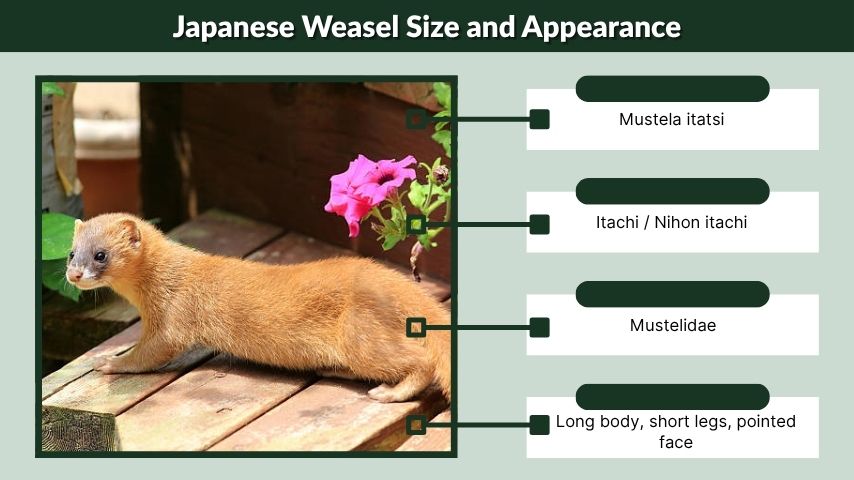
Japanese weasels are small mammals, but they are energetic and powerful for their size. Males are usually larger than females. Their body is long and flexible, allowing them to twist, turn, and slip through dense vegetation or narrow gaps.
| Feature | Japanese Weasel Description |
|---|---|
| Scientific name | Mustela itatsi |
| Japanese name | Itachi / Nihon itachi |
| Animal family | Mustelidae |
| Body shape | Long body, short legs, pointed face |
| Fur color | Brown, reddish-brown, golden-brown, lighter underside |
| Diet type | Carnivorous, opportunistic predator |
| Native range | Mainly Honshu, Shikoku, Kyushu, and nearby islands |
| Pet suitability | Not suitable as a normal pet |
Japanese White Weasel or Snow Weasel
Some people search for “Japanese white weasel” or “Japanese snow weasel,” but the Japanese weasel is usually brown or golden-brown rather than pure white. In snowy regions, lighting and winter scenery can make the animal look paler in photos.
Japan also has other mustelids, including martens and introduced or related weasel species. A white-looking animal may be another mustelid, an unusual color variation, or simply a photo taken in snow.
Japanese Weasel Habitat

Japanese weasels live in a variety of habitats. They are often associated with lowlands, riverbanks, wetlands, grasslands, farms, forests, and suburban edges. They need cover for hiding and hunting, along with access to prey.
They may be found near streams, irrigation channels, rice fields, brushy roadsides, wooded parks, and rural homes. Because they are small and secretive, people may live near them without seeing them often.
Where Are Japanese Weasels Found?
The Japanese weasel is native to Japan, especially Honshu, Shikoku, Kyushu, and some nearby islands. It has also been introduced to other places, including some Japanese islands, often for rodent control.
This introduced status is important. On islands where the weasel is not native, it can affect local wildlife by preying on native animals. That is why the Japanese weasel can be both a native predator in one region and an invasive concern in another.
What Do Japanese Weasels Eat?

Japanese weasels are carnivores. They hunt small animals and may adjust their diet based on habitat and season. Like many weasels, they are opportunistic, which means they eat what is available and catchable.
Their diet can include:
- Mice and other small mammals
- Frogs and amphibians
- Fish and aquatic animals
- Insects and other invertebrates
- Small birds or eggs
- Reptiles
- Crayfish or similar wetland prey
Near rivers and wetlands, they may feed more on aquatic prey. In fields or suburban edges, rodents and small ground animals may be more important.
Do Japanese Weasels Help Control Pests?
Yes, in some places they may help reduce rodents and other small pests. This is one reason weasels have been introduced to certain islands. However, introducing predators can create ecological problems if native birds, reptiles, or amphibians are not adapted to them.
A predator that is useful in one setting can become harmful in another.
Japanese Weasel Behavior
Japanese weasels are active, alert, and fast-moving. They are usually solitary and are more likely to be seen briefly crossing roads, slipping through grass, or moving along waterways than sitting in the open.
They depend on stealth and speed. Their narrow bodies allow them to follow prey into burrows, brush, and tight spaces. They can be bold when hunting, but they generally avoid people.
Are Japanese Weasels Aggressive?
Japanese weasels are wild predators, not cuddly pets. They may defend themselves if cornered, grabbed, or trapped. Like other wild mammals, they can bite if handled.
Most encounters with people are brief. If you see one, observe from a distance and do not try to pick it up.
Japanese Weasel as a Pet
A Japanese weasel is not a good pet. It is a wild animal with strong hunting instincts, sharp teeth, scent glands, and a need for natural movement and hunting behavior. Even if it looks cute, it is not domesticated like a ferret.
Can You Adopt a Japanese Weasel in the USA?
In general, you should not expect to adopt a Japanese weasel as a pet in the USA. Wildlife import, exotic pet ownership, and state regulations can be strict. Even where certain mustelids are legal, the Japanese weasel is not a normal companion animal.
People who want a weasel-like pet usually look into domestic ferrets, but even ferrets are restricted in some places. Always check local laws before considering any exotic or unusual animal.
Why Japanese Weasels Should Stay Wild
Japanese weasels should remain in appropriate wild habitats because they need space, natural food, and ecological interactions. Keeping one in a home would be stressful for the animal and risky for people.
Good wildlife practice means watching, photographing, and respecting the animal from a distance.
Japanese Weasel vs. Japanese Marten

The Japanese weasel is sometimes confused with the Japanese marten. Both are mustelids, both have long bodies, and both occur in Japan. However, martens are generally larger, more arboreal, and have a different body shape and face.
Main Differences
A Japanese weasel is usually smaller and lower to the ground, with a narrow body suited for hunting small prey in grass, riverbanks, and burrows. A Japanese marten is larger, often more associated with forests, and may spend more time climbing.
If you see a small brown animal quickly crossing a path near water or grass, it may be a weasel. If it is larger, fluffier, and forest-associated, it may be a marten.
Japanese Weasel in Osaka and Cities
Searches for “Japanese weasel Osaka” show that people sometimes notice weasels in urban or suburban areas. Japanese weasels can live near human settlements if there is cover, water, and prey.
Urban edges, drainage channels, parks, vacant lots, gardens, and river corridors can all support small wildlife. Seeing a weasel in or near a city does not necessarily mean it is lost. It may be using green corridors or hunting rodents.
What to Do If You See One
If you see a Japanese weasel near your home, do not approach or feed it. Feeding wild animals can make them dependent on people and may increase conflict.
Better steps include:
- Watch from a safe distance.
- Keep pets indoors or supervised.
- Seal small holes around buildings.
- Secure trash and pet food.
- Do not try to trap or handle it yourself.
- Contact local wildlife authorities if it is injured or trapped indoors.
Japanese Weasel Stealing Shoes
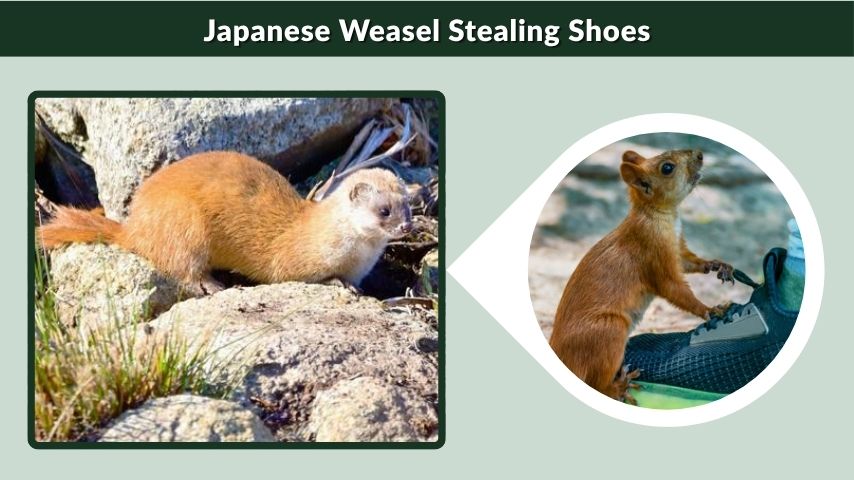
One unusual Japanese weasel story became widely shared after shoes went missing from a kindergarten in Fukuoka. Security cameras eventually showed a weasel taking children’s indoor shoes. The case became memorable because people first suspected a human thief, but the culprit turned out to be a wild animal.
Why would a weasel steal shoes? It may have been attracted to the light, soft material or looking for nesting material. Wild animals sometimes carry off unusual objects when building nests or exploring human spaces.
This story helped make the Japanese weasel seem funny and mischievous, but it is still a wild animal, not a pet or cartoon character.
Japanese Weasel in Mythology
Weasels have a place in Japanese folklore and mythology. The most famous weasel-related yokai is the kamaitachi, often translated as “sickle weasel.”
What Is Kamaitachi?
Kamaitachi is a legendary yokai associated with cutting winds. In many stories, it appears as a weasel-like creature with sickle-shaped claws. It moves quickly, rides on whirlwinds, and cuts people before vanishing.
In some regional versions, the kamaitachi appears as a group of three weasels: one knocks a person down, another cuts them, and a third applies medicine so the wound does not hurt immediately.
Japanese Sickle Weasel and Blade Weasel
Searches like “Japanese sickle weasel,” “Japanese blade weasel,” “weasel with knives Japanese myth,” and “Japanese scythe weasel” all point toward kamaitachi. The word combines kama, meaning sickle, and itachi, meaning weasel.
This yokai is not the same as the real Japanese weasel, but the folklore shows how strongly weasels appear in Japanese imagination.
Japanese Weasel Meaning and Symbolism
In Japanese culture, the weasel can symbolize speed, sneakiness, suddenness, or mystery. Because real weasels move quickly and are hard to see clearly, they are easy animals to turn into legends.
The yokai version exaggerates these traits. A real weasel slips through grass; a mythical sickle weasel rides the wind. A real weasel has sharp teeth and claws; a yokai weasel has blade-like claws.
This connection between real behavior and supernatural storytelling is common in folklore.
Are Japanese Weasels Endangered?
The Japanese weasel is listed as Near Threatened by the IUCN. It still occurs in Japan, but its situation is complicated by habitat changes, competition with related species, and ecological concerns in areas where it has been introduced.
In its native range, it is part of the natural ecosystem. In introduced island habitats, it may threaten native wildlife. Conservation discussions therefore depend on location.
FAQs
What is a Japanese weasel?
A Japanese weasel is a small carnivorous mammal native to parts of Japan. Its scientific name is Mustela itatsi. It has a long body, short legs, brownish fur, and sharp hunting instincts. It feeds on small animals and often lives near water, fields, forests, and suburban edges.
How do you say weasel in Japanese?
Weasel in Japanese is itachi. It may be written as イタチ in katakana or 鼬 in kanji. The Japanese weasel is often called Nihon itachi, meaning Japanese weasel. The famous yokai kamaitachi also includes the word itachi.
What do Japanese weasels eat?
Japanese weasels eat small animals such as mice, frogs, fish, insects, reptiles, birds, eggs, and aquatic prey. Their diet changes depending on where they live and what food is available. They are opportunistic carnivores and can hunt in grasslands, wetlands, forests, and suburban areas.
Can a Japanese weasel be a pet?
A Japanese weasel is not suitable as a normal pet. It is a wild predator, not a domesticated animal. It may bite, produce strong odor, become stressed in captivity, and be illegal to keep depending on local wildlife laws. A domestic ferret is a more realistic weasel-like pet where legal.
What is the Japanese weasel yokai?
The most famous weasel-related yokai is kamaitachi, or “sickle weasel.” It is a supernatural creature said to ride on whirlwinds and cut people with sickle-like claws. Kamaitachi belongs to folklore and mythology, while the Japanese weasel is a real wild animal.