
The least weasel (Mustela nivalis) is the smallest carnivorous mammal in the world, yet it is one of nature’s most efficient hunters. Found across North America, Europe, Asia, and parts of North Africa, this tiny predator thrives in a variety of environments. Despite its small size, the least weasel can take down prey larger than itself and plays a vital role in controlling rodent populations. Understanding its identification, habitat, size, and feeding habits provides insight into how this remarkable animal survives and contributes to ecosystem balance.
What Is a Least Weasel?
The least weasel belongs to the mustelid family, which also includes otters, ferrets, minks, and badgers. Its slender body and exceptional agility allow it to move through narrow tunnels and burrows in search of food. Although often overlooked because of its size, the species is a highly skilled predator with adaptations that make it successful in diverse habitats.
Scientific Classification
The least weasel is scientifically known as Mustela nivalis. It belongs to the family Mustelidae and is considered one of the most widespread carnivorous mammals. Researchers recognize several subspecies that vary slightly in size and coloration depending on their geographic location.
Key Characteristics
The species is known for several distinctive features:
- Long, slender body shape
- Short legs and small rounded ears
- Sharp teeth designed for hunting
- Excellent sense of smell and hearing
- Fast and agile movements
These characteristics help the least weasel locate and capture prey efficiently, even in confined spaces.
Least Weasel Identification
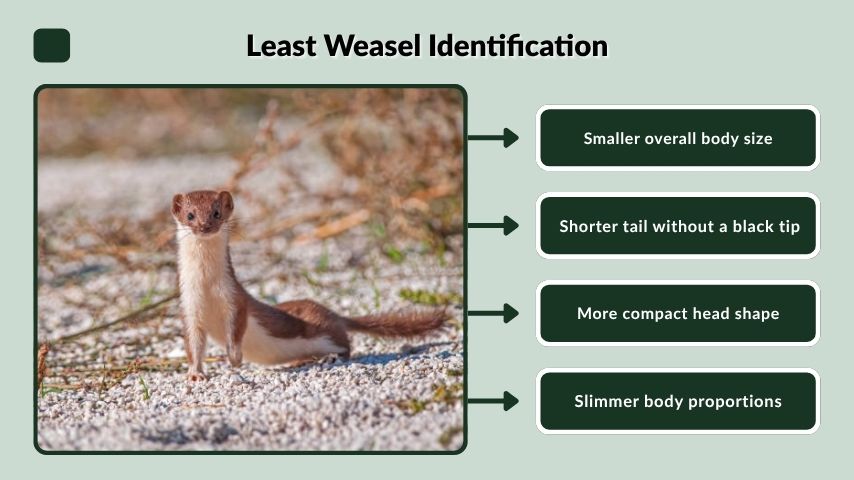
Identifying a least weasel can be challenging because it resembles other members of the weasel family. However, several physical traits make it easier to recognize in the wild. Careful observation of its body structure, coloration, and tail can help distinguish it from similar species.
Physical Appearance
The least weasel has a narrow body with a small head and relatively short tail. Its body is perfectly adapted for entering rodent burrows, allowing it to pursue prey underground. The fur is typically brown on the upper body and white on the underside, creating a clear color contrast.
Seasonal Coat Changes
In colder northern regions, the least weasel may develop a completely white winter coat. This seasonal adaptation provides camouflage against snow-covered landscapes and helps the animal avoid predators while hunting. In milder climates, individuals often retain their brown coloration throughout the year.
How to Distinguish a Least Weasel
Several features can help separate the least weasel from a stoat or ermine:
- Smaller overall body size
- Shorter tail without a black tip
- More compact head shape
- Slimmer body proportions
These differences are especially useful when observing weasels in regions where multiple species occur together.
Least Weasel Size
Although it is the smallest carnivore on Earth, the least weasel is a powerful hunter. Its compact body provides advantages that larger predators do not possess, particularly when pursuing rodents through narrow tunnels and dense vegetation.
Average Body Length
Adult least weasels generally measure between 11 and 26 centimeters in body length. Males are noticeably larger than females, a characteristic known as sexual dimorphism. The tail is relatively short compared to other weasel species and typically measures only a few centimeters long.
Weight and Growth
Most adults weigh between 25 and 250 grams depending on age, sex, and location. Females tend to be much smaller than males. Despite their lightweight bodies, least weasels possess strong muscles and remarkable speed, enabling them to overpower prey larger than themselves.
Why Small Size Is an Advantage
The least weasel’s small size offers several survival benefits. It can access underground burrows that larger predators cannot enter, helping it reach hidden prey. Its compact body also requires less food than larger carnivores, allowing it to survive in areas where resources may be limited. These adaptations have contributed significantly to the species’ widespread success across different continents.
Least Weasel Habitat

The least weasel occupies a wide range of habitats across the Northern Hemisphere. Its adaptability allows it to survive in environments ranging from open grasslands to forest edges. The most important habitat requirement is the presence of abundant prey, particularly rodents. Because of its flexible nature, the species can often be found near agricultural land, where food sources are readily available throughout the year.
Natural Habitat
Least weasels commonly live in areas that provide both cover and hunting opportunities. They frequently use existing burrows and natural shelters rather than creating their own dens. Suitable habitats include grassy fields, hedgerows, and woodland margins where rodents are abundant.
Geographic Distribution
The species has one of the broadest distributions among small carnivores. It occurs across much of Europe, Asia, North America, and parts of North Africa. Its ability to adapt to different climates has helped it establish populations in a wide variety of ecosystems.
Common Shelter Locations
Least weasels often seek refuge in:
- Abandoned rodent burrows
- Rock crevices
- Hollow logs
- Dense vegetation
- Farm buildings and hay stacks
These shelters provide protection from predators and harsh weather conditions.
Least Weasel Diet
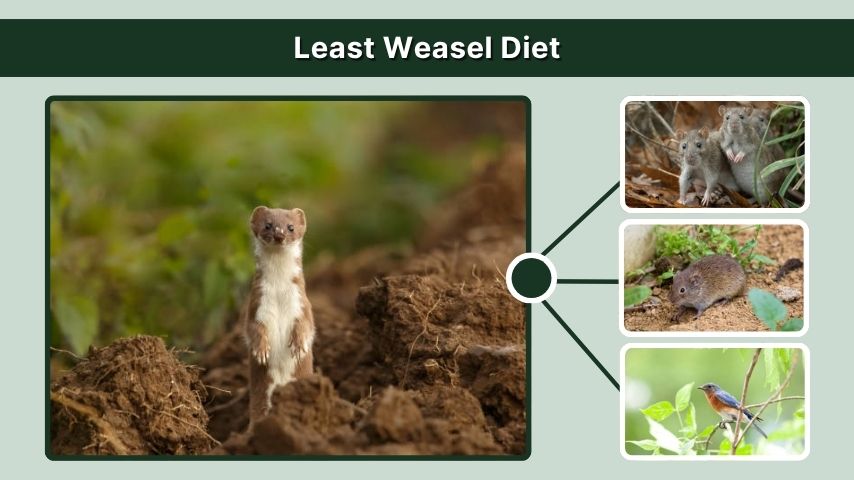
The least weasel is a strict carnivore with a diet focused primarily on small mammals. Due to its high metabolism, it must hunt frequently to meet its energy requirements. Its hunting success is one of the reasons it is considered an important natural controller of rodent populations.
What Does a Least Weasel Eat?
Rodents make up the majority of the least weasel’s diet. However, it may consume other prey when available. The species is known for its willingness to attack animals larger than itself.
Common food sources include:
- Mice
- Voles
- Rats
- Small birds
- Bird eggs
- Insects and other small animals
Hunting Behavior
Least weasels rely on stealth, speed, and surprise when hunting. Their slim bodies allow them to chase prey through narrow tunnels and underground burrows. Once prey is located, the weasel delivers a quick and precise bite, usually targeting the neck area to immobilize the animal.
Ecological Benefits
By controlling rodent populations, least weasels provide significant ecological and agricultural benefits. Farmers often benefit from their presence because they naturally reduce the number of crop-damaging rodents without the need for chemical pest control methods.
Least Weasel Lifecycle
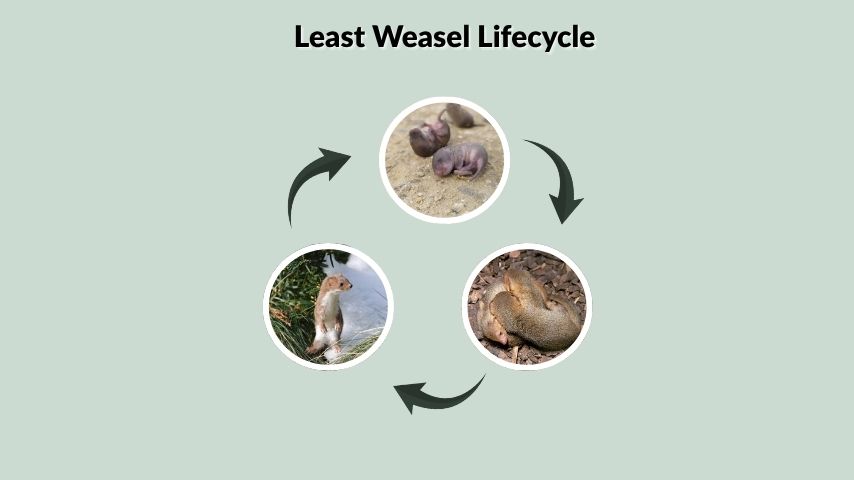
The lifecycle of the least weasel is relatively short but highly productive. Rapid growth and early maturity allow populations to recover quickly when environmental conditions are favorable. Reproduction is closely linked to food availability, ensuring that young are born when resources are most abundant.
Breeding and Reproduction
Mating usually occurs during the warmer months when food is plentiful. Males may travel considerable distances in search of receptive females. After successful mating, females prepare a secure nest where they will raise their young.
Birth and Early Development
Female least weasels typically give birth to a litter containing several kits. Newborns are blind, hairless, and completely dependent on their mother. During the first few weeks of life, rapid growth occurs as the young develop their fur, eyesight, and hunting instincts.
Adult Life and Lifespan
Young weasels become independent at an early age and quickly learn to hunt on their own. In the wild, most individuals live only a few years due to predation, food shortages, and environmental challenges. Despite their short lifespan, they reproduce efficiently and maintain stable populations across much of their range.
Interesting Least Weasel Facts
The least weasel may be tiny, but it possesses remarkable abilities that have fascinated wildlife researchers for decades. Its combination of speed, intelligence, and adaptability makes it one of the most successful small predators in the animal kingdom.
Amazing Facts About Least Weasels
- It is the world’s smallest carnivorous mammal.
- It can hunt prey larger than its own body.
- Its body is perfectly designed for entering rodent tunnels.
- Some populations develop a white winter coat.
- It has an extremely fast metabolism.
- It is active throughout the year.
- It plays a major role in natural pest control.
- It is found across multiple continents.
FAQs
What is the size of the least weasel?
The least weasel is the smallest carnivorous mammal in the world. Adults typically measure between 11 and 26 centimeters (4.3 to 10.2 inches) in body length and weigh between 25 and 250 grams, depending on age, sex, and geographic location.
What does a weasel eat?
Least weasels are carnivores that primarily feed on small mammals such as mice, voles, and rats. They may also eat birds, eggs, insects, and other small animals when the opportunity arises. Their diet helps naturally control rodent populations.
Where do least weasels live?
Least weasels inhabit a variety of environments, including grasslands, meadows, farmland, forest edges, and shrublands. They are widely distributed across North America, Europe, Asia, and parts of North Africa.
How can you identify a least weasel?
A least weasel can be identified by its long, slender body, short legs, brown upper fur, white underparts, and short tail without a black tip. It is smaller than a stoat and often appears extremely agile and quick-moving.
How long do least weasels live?
In the wild, least weasels generally live for one to three years, although some individuals may survive longer under favorable conditions. Their lifespan is influenced by predation, food availability, disease, and environmental conditions.