
The long-tailed weasel is a small but fierce predator known for its slender body, quick movements, long tail, and bold hunting style. Also called Mustela frenata, this animal is one of the most widespread weasels in North America. It lives in many habitats, from forests and grasslands to farms, wetlands, deserts, and suburban edges. Though it is rarely seen because of its secretive behavior, the long-tailed weasel plays an important role in controlling rodents and other small animals. Its size may be small, but its energy, speed, and hunting ability make it one of nature’s most efficient hunters.
What Is a Long-Tailed Weasel?
The long-tailed weasel is a small carnivorous mammal in the mustelid family. This family also includes otters, mink, ferrets, badgers, martens, and wolverines. Like other mustelids, the long-tailed weasel has a long body, short legs, sharp teeth, and a strong hunting instinct.
Its scientific name is Mustela frenata. The name “long-tailed” comes from one of its most noticeable features: a tail that is longer than the tail of many other weasel species. The tail usually has a black tip, which helps distinguish it from similar animals.
Long-Tailed Weasel Appearance
A long-tailed weasel has a narrow body, small head, rounded ears, short legs, and a long tail with a black tip. In summer, its fur is usually brown above and pale yellowish or whitish below. In colder northern regions, some individuals turn white in winter, except for the black tail tip.
This seasonal color change helps the animal blend into snowy environments. In warmer regions, such as Florida, Texas, and parts of California, long-tailed weasels may remain brown year-round.
Long-Tailed Weasel Size
The long-tailed weasel is small, but males are usually larger than females. Its slim body makes it look longer than it is. Depending on sex and region, it may measure roughly 11 to 22 inches from nose to tail tip.
The tail can make up a large part of its total length. This is one of the easiest ways to separate it from shorter-tailed weasels. Despite its small body, the long-tailed weasel is strong, agile, and capable of catching prey larger than itself.
Long-Tailed Weasel Identification Table
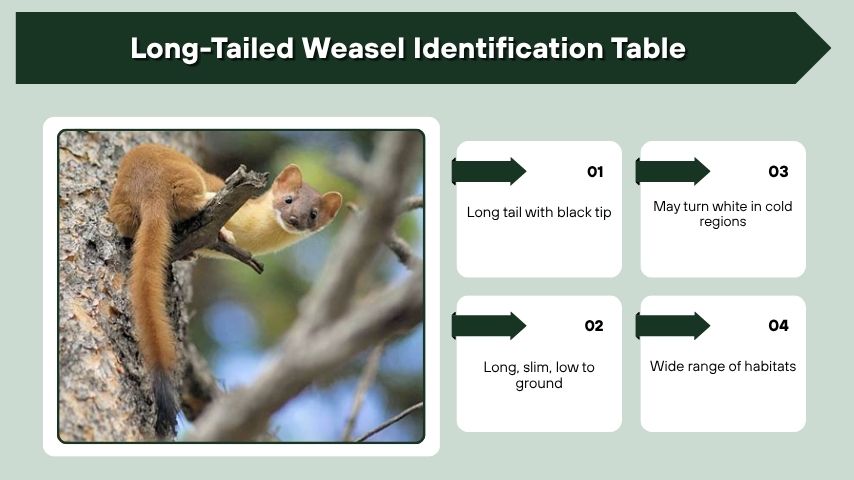
Long-tailed weasels are sometimes confused with short-tailed weasels, least weasels, mink, or stoats. This table explains the key differences.
| Feature | Long-Tailed Weasel | Short-Tailed Weasel / Stoat | Least Weasel | Mink |
| Tail length | Long tail with black tip | Shorter tail with black tip | Very short tail, usually no black tip | Longer, bushier tail |
| Body shape | Long, slim, low to ground | Slim and compact | Very tiny and slender | Heavier and more aquatic |
| Winter color | May turn white in cold regions | Often turns white in winter | Often turns white in northern areas | Usually stays dark brown |
| Habitat | Wide range of habitats | Fields, forests, wetlands | Grasslands and open areas | Wetlands, streams, ponds |
| Size | Small but larger than least weasel | Smaller than long-tailed weasel | Smallest weasel | Larger and darker |
Long-Tailed Weasel Range
The long-tailed weasel has a wide range across North America, Central America, and parts of South America. In the United States, it can be found in many regions, including California, Colorado, Florida, Texas, Oregon, Washington State, Massachusetts, New Hampshire, New York, Pennsylvania, Ohio, Michigan, North Carolina, Georgia, and many other states.
Because it is secretive and fast-moving, many people do not realize long-tailed weasels live near them. They may be present in rural areas, parks, fields, woodland edges, farms, and even suburban landscapes with enough cover and prey.
Long-Tailed Weasel in California
The long-tailed weasel in California can be found in many habitats, including grasslands, oak woodlands, chaparral edges, riparian areas, and agricultural regions. In places like Southern California and San Diego County, sightings may occur near brushy habitat, canyon edges, or open land with rodent populations.
California’s varied climate means long-tailed weasels may not turn white in winter in many areas. Their brown summer-like coat is often more useful in dry or mild environments.
Long-Tailed Weasel in Florida and Texas
In Florida and Texas, long-tailed weasels are usually brown throughout the year. They may live near wetlands, forests, grasslands, farmlands, and brushy edges. Because both states have warm climates, winter whitening is generally not expected.
These weasels are rarely seen, but they may be active around areas with abundant mice, rats, voles, rabbits, and other small prey.
Long-Tailed Weasel in Winter
In northern parts of its range, the long-tailed weasel may turn white in winter. This white coat helps it blend into snow while hunting and avoiding predators. The black tail tip usually remains visible.
In regions with little or no snow, the animal often stays brown. This difference explains why people may search for both “white long tailed weasel” and “brown long tailed weasel.”
Long-Tailed Weasel Habitat
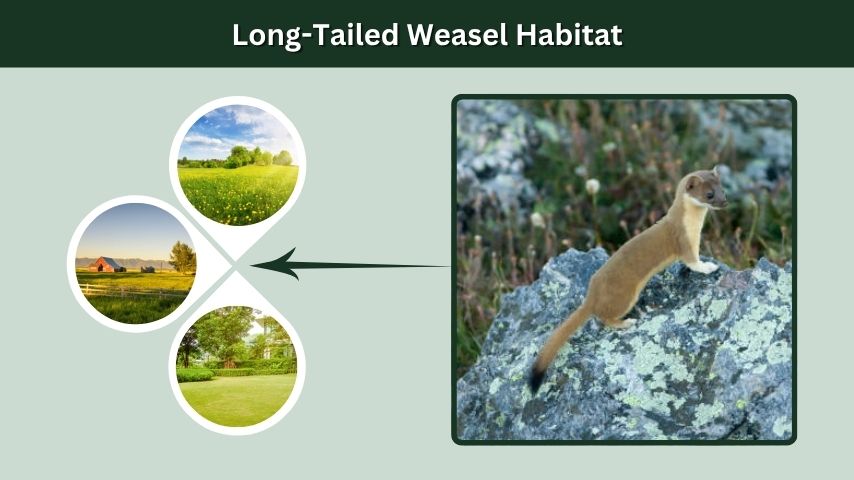
Long-tailed weasels are highly adaptable. They can live in many habitats as long as there is enough cover and prey. They avoid completely open areas with no protection, but they can hunt along edges, brush piles, fences, rock walls, and vegetation.
Their flexible habitat use is one reason they are so widespread.
Common Habitats
Long-tailed weasels may live in:
- Grasslands and meadows
- Forest edges
- Brushy fields
- Farms and barns
- Marshes and wetlands
- Desert edges
- Riverbanks and stream corridors
- Suburban green spaces
- Woodlots and hedgerows
- Rock piles and stone walls
They often use abandoned burrows, hollow logs, brush piles, and spaces under rocks or roots for shelter. They may also use dens made by rodents or other small mammals.
Why Cover Matters
Cover is important because long-tailed weasels are both predators and prey. They hunt small animals, but they may also be hunted by hawks, owls, foxes, coyotes, bobcats, snakes, and larger carnivores.
Dense grass, shrubs, logs, rocks, and burrows help them move safely while searching for food.
Long-Tailed Weasel Diet
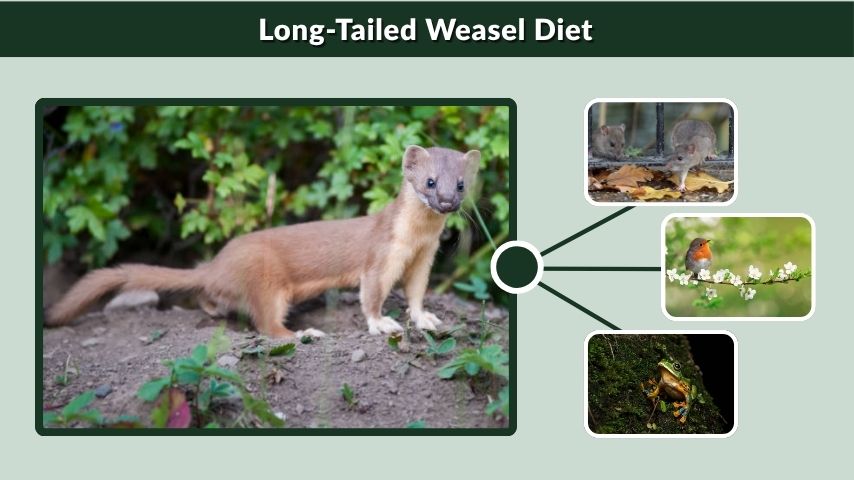
The long-tailed weasel diet is mostly meat. It is an active predator that hunts frequently because its body burns energy quickly. Small mammals are its main food, but it may also eat birds, eggs, reptiles, amphibians, insects, and carrion when available.
Rodents are especially important. This makes the long-tailed weasel valuable in natural rodent control.
What Do Long-Tailed Weasels Eat?
Long-tailed weasels commonly eat:
- Mice
- Voles
- Rats
- Shrews
- Chipmunks
- Ground squirrels
- Young rabbits
- Birds
- Bird eggs
- Lizards
- Frogs
- Insects
- Carrion when needed
They are capable hunters and may enter burrows to catch prey underground. Their long, narrow bodies allow them to follow rodents into tight spaces.
Hunting Behavior
The long-tailed weasel is fast, bold, and persistent. It may hunt by moving through grass, brush, burrows, logs, and rock piles. It uses smell, hearing, and quick reflexes to locate prey.
Once it finds prey, it attacks quickly. Weasels often kill with a bite to the neck or skull area. They may store extra food when prey is abundant, which helps them survive when hunting becomes difficult.
Long-Tailed Weasel Behavior
Long-tailed weasels are energetic and secretive. They may be active during the day or night, though many are most active around dawn, dusk, or nighttime. Their activity depends on weather, prey availability, season, and local disturbance.
They are usually solitary animals. Adults maintain territories and may defend them from others of the same sex.
Are Long-Tailed Weasels Nocturnal?
Long-tailed weasels are not strictly nocturnal. They can be active both day and night. However, because they are secretive and move quickly through cover, people often miss them even when they are nearby.
You may catch a brief glimpse of one crossing a road, darting along a fence line, or moving through grass with a bounding motion.
Long-Tailed Weasel Sounds
Long-tailed weasels are usually quiet, but they can make sounds when alarmed, threatened, or interacting with other weasels. Sounds may include squeaks, chirps, hisses, or chattering noises.
Most people are more likely to notice tracks, scat, or quick movement than hear a long-tailed weasel vocalize.
Long-Tailed Weasel Tracks and Signs
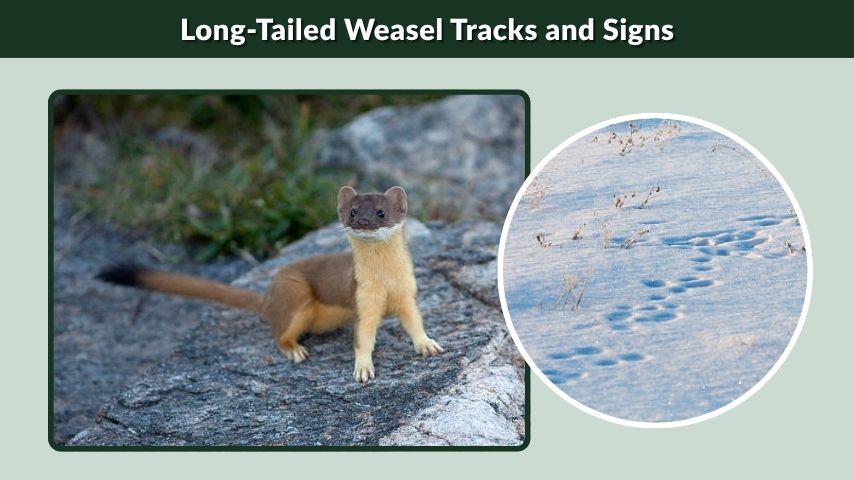
Because long-tailed weasels are hard to see, tracks and signs can help reveal their presence. Their tracks are small and often appear in pairs or groups because of their bounding movement.
In snow, long-tailed weasel tracks may show a repeated pattern of small prints with spaces between bounds.
Long-Tailed Weasel Tracks in Snow
Tracks in snow may look like paired footprints, often leading between brush, logs, rocks, and burrow entrances. A weasel’s body is low to the ground, so in soft snow there may be marks where the body or tail brushed the surface.
The trail may suddenly disappear into a hole, under a log, or beneath a structure. This is typical because weasels frequently travel through tunnels and hidden spaces.
Long-Tailed Weasel Scat
Long-tailed weasel scat is usually small, narrow, twisted, and may contain fur, bones, feathers, or insect parts. It may be found near rocks, logs, burrows, or travel routes.
Scat identification can be difficult because many small carnivores leave similar signs. Tracks, habitat, and other clues should be considered together.
Long-Tailed Weasel vs Stoat, Ermine, and Short-Tailed Weasel
Many people search for long-tailed weasel vs stoat or ermine vs long-tailed weasel. The names can be confusing because “stoat” usually refers to the short-tailed weasel, and “ermine” often refers to a stoat or weasel in its white winter coat.
The long-tailed weasel is closely related but usually larger, with a longer tail.
Long-Tailed Weasel vs Short-Tailed Weasel
The short-tailed weasel, also called the stoat, has a shorter tail than the long-tailed weasel. Both may have black-tipped tails and may turn white in winter in colder regions.
The long-tailed weasel is generally larger, longer-bodied, and has a tail that is noticeably longer in proportion to its body.
Long-Tailed Weasel vs Least Weasel
The least weasel is much smaller and has a very short tail. It often lacks the black tail tip seen in long-tailed weasels. Least weasels are tiny predators that mainly hunt small rodents.
If the animal has a long tail with a black tip, it is more likely a long-tailed weasel or short-tailed weasel than a least weasel.
Long-Tailed Weasel vs Mink
Mink are larger, darker, heavier-bodied, and more closely tied to water. They often live near streams, ponds, marshes, and wetlands. A long-tailed weasel is slimmer, smaller, and usually has a more distinct brown-and-white pattern in summer.
If the animal looks dark brown, thick-bodied, and is swimming or moving along water, mink may be more likely.
Are Long-Tailed Weasels Dangerous?
Long-tailed weasels are not usually dangerous to people. They are wild predators, but they are small and generally avoid humans. If cornered, trapped, or handled, they can bite in self-defense.
The bigger concern may be poultry, small pets, or captive animals if a weasel gains access to a coop or enclosure.
Long-Tailed Weasels and Pets
A long-tailed weasel is unlikely to attack a dog or cat because those animals are much larger. However, small outdoor pets such as rabbits, guinea pigs, chicks, or poultry can be at risk if they are not protected.
Secure cages, strong wire, and closed gaps are important because weasels can squeeze through surprisingly small openings.
What to Do If You See One
If you see a long-tailed weasel, observe it from a distance. Do not try to touch, trap, or corner it. In most cases, it will move away quickly.
If one is entering a chicken coop or causing repeated problems, focus on exclusion. Seal holes, strengthen fencing, and remove attractants such as spilled feed or rodent infestations.
Long-Tailed Weasel Reproduction and Lifespan
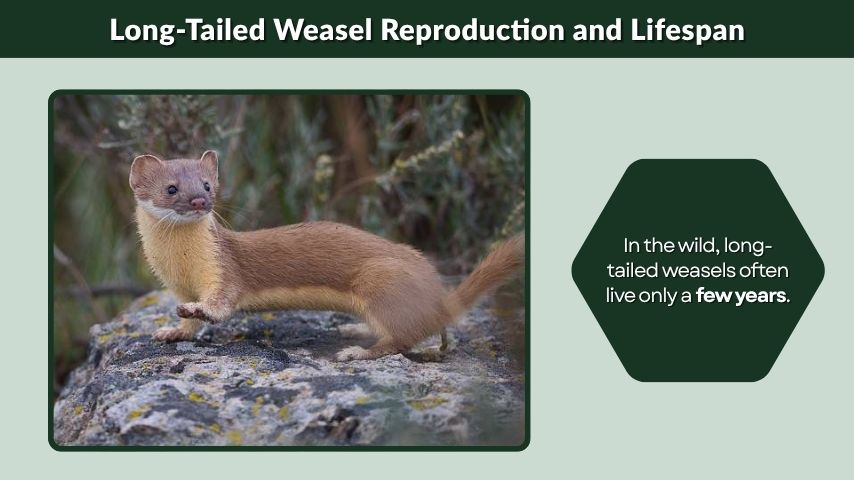
Long-tailed weasels usually breed in summer, but young are often born the following spring because of delayed implantation. This means the fertilized egg does not develop immediately.
A female may give birth in a den lined with grass, fur, feathers, or other soft material. The young are born helpless and depend on the mother for warmth and food.
Young Weasels
Baby long-tailed weasels grow quickly. As they develop, they begin eating meat brought by the mother. Later, they learn to hunt and explore near the den.
Young weasels eventually leave to establish their own territories. Because they are small predators, survival can be challenging.
Long-Tailed Weasel Lifespan
In the wild, long-tailed weasels often live only a few years. Predators, harsh weather, food shortages, disease, and accidents can limit survival. Some individuals may live longer in protected conditions, but wild life is risky for such a small animal.
Long-Tailed Weasel Adaptations
The long-tailed weasel has several adaptations that help it survive as a predator. Its long body allows it to enter burrows. Its sharp teeth help it kill prey efficiently. Its quick reflexes help it chase fast-moving animals.
Seasonal color change is another important adaptation in snowy regions.
Key Adaptations
Important long-tailed weasel adaptations include:
- Long, flexible body for entering burrows
- Sharp teeth and strong jaws
- Excellent sense of smell
- Fast movement and quick reflexes
- Black-tipped tail for identification and possible predator distraction
- Winter white coat in snowy regions
- Ability to hunt day or night
- Food caching behavior
These traits help the animal survive in many environments.
Long-Tailed Weasel Predators
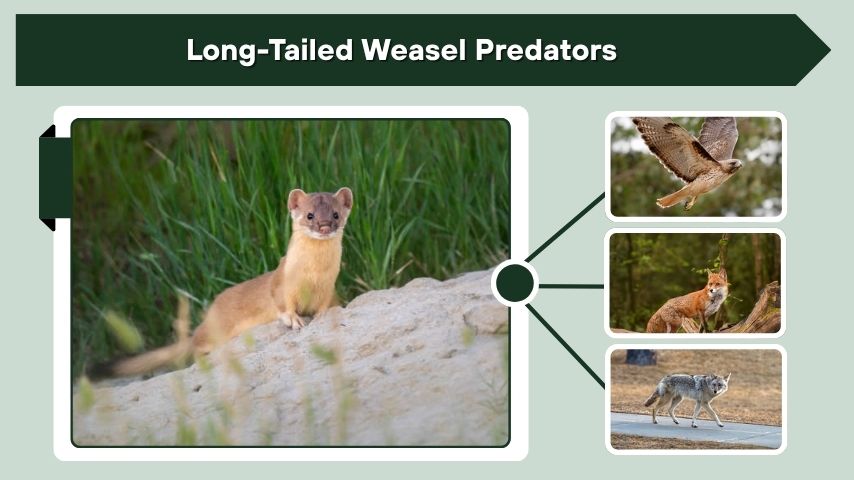
Although the long-tailed weasel is a skilled hunter, it is also prey for larger animals. Its small size makes it vulnerable, especially when crossing open ground.
Predators may include hawks, owls, foxes, coyotes, bobcats, snakes, and domestic cats or dogs. Young weasels are especially vulnerable.
To avoid danger, long-tailed weasels rely on cover, speed, burrows, and secretive movement.
Long-Tailed Weasel as a Pet
Some people search for long-tailed weasel pet or long-tailed weasel for sale, but this animal is not a good pet. It is a wild carnivore with strong hunting instincts, sharp teeth, and specialized needs.
In many places, keeping native wildlife as a pet is illegal without permits. Even where allowed, a wild weasel is not suitable for normal home life.
The best way to appreciate a long-tailed weasel is to observe it in the wild and protect natural habitat.
Fun Facts About Long-Tailed Weasels
The long-tailed weasel is one of the most interesting small predators in North America. Its speed, courage, and adaptability make it a fascinating animal.
Interesting Facts
- Its scientific name is Mustela frenata.
- It has a long tail with a black tip.
- It can turn white in winter in snowy regions.
- It mainly eats rodents and other small animals.
- It can follow prey into burrows.
- It may be active during day or night.
- It lives across much of North America.
- It is small but powerful for its size.
- It helps control rodent populations.
- It is rarely seen because it is fast and secretive.
FAQs
What does a long-tailed weasel look like?
A long-tailed weasel has a slim body, short legs, small head, rounded ears, and a long tail with a black tip. In summer, it is usually brown above and pale below. In snowy northern areas, it may turn white in winter while keeping the black tail tip.
What do long-tailed weasels eat?
Long-tailed weasels mainly eat small mammals such as mice, voles, rats, shrews, chipmunks, and young rabbits. They may also eat birds, eggs, reptiles, amphibians, insects, and carrion. Their rodent-heavy diet makes them important natural predators.
Are long-tailed weasels dangerous?
Long-tailed weasels are not usually dangerous to people because they are small and avoid humans. However, they can bite if handled or cornered. They may pose a risk to chickens, chicks, rabbits, or other small captive animals if enclosures are not secure.
Do long-tailed weasels turn white in winter?
Some long-tailed weasels turn white in winter, especially in northern regions with snow. The white coat helps them blend into snowy surroundings. In warmer climates, such as Florida, Texas, and parts of California, they often stay brown year-round.
What is the difference between a long-tailed weasel and a stoat?
A stoat, also called a short-tailed weasel, is generally smaller and has a shorter tail. A long-tailed weasel has a longer body and a noticeably longer tail, usually with a black tip. Both species may turn white in winter in colder areas.